

Welcome to the weekly letter from TheIntersection team. Our aim is simple: to decode and deconstruct the world of real-world asset tokenisation, stablecoins and DeFi for mainstream professional investors.
In this issue:
- News: Amundi, CACEIS and Ant International Bring Tokenisation to Corporate Treasury
- Data: Treasuries and Beyond - market dynamics
- Analysis: SpaceX - Victory or Fiasco for Tokenisation?
- Our weekly events round-up
And it's all free! If you haven’t already, please subscribe using the link below
Before we dive in, one request: please forward this weekly letter to anyone you think might be interested. We also very much welcome feedback (and contributors). If you want to email us, just drop an email to us at teams@theintersection.news.

News in Brief
Securitize and Ethena back tokenised credit on Solana
Securitize has expanded its Tokenised AAA CLO Fund (STAC) to the Solana blockchain, while Ethena Labs plans to allocate $250m to the fund. The move represents one of the largest commitments to tokenised structured credit on a public blockchain.
Why it matters: Crypto-native capital is increasingly flowing into traditional fixed-income products, accelerating the convergence of digital assets and institutional finance.
SEC explores new framework for tokenised securities
The SEC’s crypto task force is working with the Securities Industry and Financial Markets Association (SIFMA) on a framework for tokenised securities that could include innovation exemptions, regulatory sandboxes and programmable compliance requirements.
Why it matters: Regulatory reform is shifting from theory to implementation, providing a clearer path for tokenised securities to scale within U.S. markets.
Deep Dive — Amundi, CACEIS and Ant International Bring Tokenisation to Corporate Treasury
The Top Line
Tokenisation is increasingly moving beyond investment products and into the day-to-day mechanics of corporate finance. This week, asset manager Amundi, fund services provider CACEIS and Ant International announced a collaboration to explore how blockchain can modernise treasury management and fund distribution. Rather than targeting retail investors, the initiative focuses on a less visible but potentially much larger opportunity: how institutions move, invest and manage cash.
The Details
The partnership combines three different parts of the financial ecosystem.
- Amundi brings investment products and asset-management expertise.
- CACEIS provides fund administration, custody and servicing infrastructure.
- Ant International contributes blockchain-based treasury technology already used across its global payments network.
The goal is to connect corporate treasury operations with tokenised money-market and liquidity products. Today, large corporations often hold significant cash balances that move slowly between bank accounts, money-market funds and payment systems. These processes can involve multiple intermediaries, manual reconciliation and settlement delays. By using blockchain infrastructure, the partners aim to create a more automated framework in which cash can move, be invested, and be redeemed more efficiently.
In practice, that could allow treasury teams to deploy excess cash into tokenised liquidity funds and access those assets more quickly when needed, while maintaining the controls and compliance requirements institutions expect. The partners described the project as an effort to combine blockchain-powered treasury management with tokenised investment products, creating a more efficient framework for institutional liquidity management.

Treasuries and Beyond: market dynamics
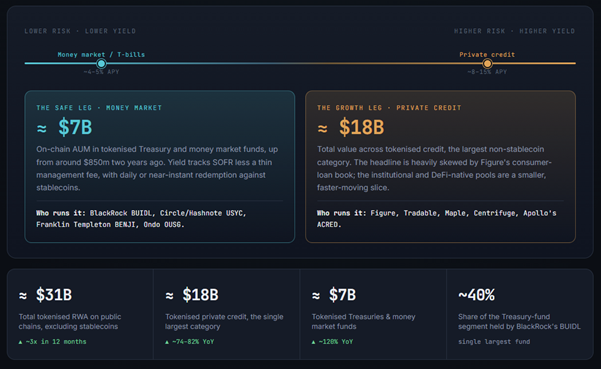
Data from platforms like rwa.xyz suggests that distributed on-chain RWA value stands at USD 31.4 bn , with tokenised US Treasuries at USD 13.4 bn (up from USD 9.6 bn at end-2025) and tokenised money market funds (TMMFs) at roughly USD 9 bn globally, more than tenfold their end-2023 level
In effect, capital has settled into a barbell. At one end sit tokenised Treasuries and money market funds, the cash-management rail that pays whatever short-dated government paper pays and almost nothing more. At the other end sits private credit, where investors knowingly take corporate and consumer default risk for high single and double-digit yields. The middle, the messy world of tokenised equities, real estate and commodities, remains comparatively thin.
Tokenised Treasury Giants Scale
Tokenised money market funds are scaling fast, in part because of their simplicity. Take short-dated US Treasury bills and repo, wrap them in a regulated fund, issue the shares as transfer-restricted tokens on a whitelist, and let holders move them around the clock and redeem against stablecoins. The yield is whatever the front end of the curve pays, currently somewhere in the 4 to 5 per cent range, less 15 to 50 basis points in fees. Investors are getting a programmable, twenty-four-hour cash leg that settles in minutes rather than days, and for treasury desks, DAOs and DeFi protocols sitting on idle stablecoins.
|
Metric |
Latest
reading |
Direction /
period |
|
Total tokenised RWA
value (on-chain, distributed) |
USD 31.4 bn |
+0.85% 30-day (RWA.xyz, 8
May 2026) |
|
Tokenised US Treasuries
(early Q2 2026) |
USD 13.4 bn |
Up from USD 9.6 bn at
end-2025 |
|
Tokenised money market
funds (TMMFs), global TVL |
~USD 9 bn |
10x+ growth since end-2023
(BIS) |
|
Ethereum share of RWA
value |
52.8% |
Dominant network; 50% of
TMMF TVL |
|
BlackRock BUIDL |
USD 2.45 bn |
Largest single tokenised
T-fund |
|
Circle USYC |
USD 2.98 bn |
+11.6% 30-day |
|
Franklin BENJI / FOBXX
7-day yield |
3.47% |
WAM 42 days, AUM ~USD 825 m |
|
Private credit, largest
single token (Figure HELOC) |
USD 17.8 bn |
+6.2% 30-day (Provenance) |
|
Total RWA holders
(wallets) |
788,388 |
+7.1% 30-day |
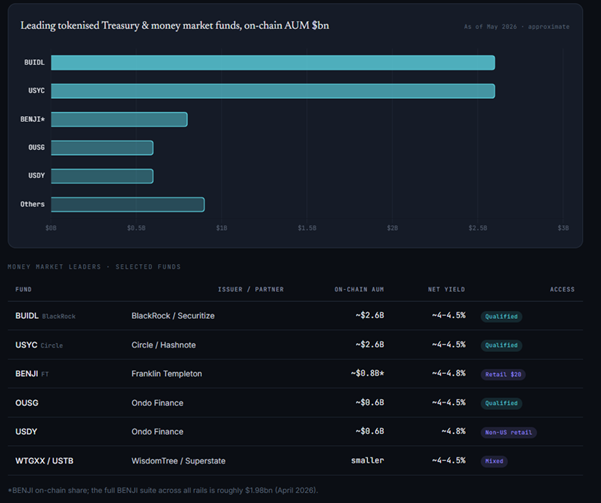
In terms of market dynamics, BlackRock's BUIDL remains the bellwether, holding close to 40 per cent of the tokenised Treasury-fund segment from a standing start of $100m in early 2024 - the firm has filed for two further tokenised funds to extend the franchise. The genuine surprise of the past year has been the rise of Circle and Hashnote's USYC, which now rivals BUIDL at the top of the table after Circle positioned it as the yield-bearing pair to USDC. Franklin Templeton's BENJI, the original from 2021, has quietly built a nearly $2bn suite across its retail and institutional rails and remains the most accessible to ordinary investors at a $20 minimum. Ondo's OUSG rounds out the front rank, with WisdomTree, Superstate and Mountain fighting for the long tail.
The leading vehicles by AUM are:
● Circle USYC – USD 2.98 bn, 3.13% 7-day APY, +11.6% 30-day
● BlackRock BUIDL (issued via Securitize) – USD 2.45 bn, 3.42% 7-day APY. Standard Chartered and OKX announced a collateral framework on 28 April 2026 allowing BUIDL to serve as trading margin while remaining with the custodian.
● Ondo USDY – USD 2.15 bn, 3.55% 7-day APY.
● Franklin BENJI / FOBXX – USD 1.48 bn iBENJI plus USD 815 m BENJI. The Franklin OnChain U.S. Government Money Fund (FOBXX, CUSIP 35473R104) reported a 3.47% 7-day yield, WAM of 42 days and total net assets of USD 824.6 m at 30 April 2026, with primary record-keeping on a public blockchain.
● WisdomTree Treasury Money Market Digital Fund (WTGXX) – USD 953 m on the dashboard; SEC/FINRA approved intraday trading on 23 February 2026, with T-instant settlement and USDC redemptions on Ethereum. WisdomTree Prime delivers the retail wrapper, including a Visa debit card linked to fund holdings.
BIS analysis highlights composition discipline: BENJI averages 54.6% Treasury repo, 16.1% Treasury debt, 15.5% agency debt and 13.8% cash, while Ondo's OUSG is structured as a fund-of-funds across BUIDL, WTGXX, BENJI and FYHXX. The same study four wallet addresses, a material concentration risk for any allocator relying on continuous secondary liquidity.
Beyond Treasuries: Private credit
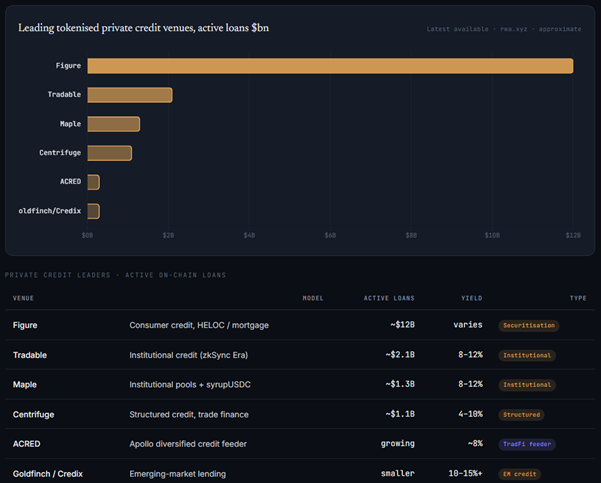
Tokenised private credit is now the largest real-world asset category after stablecoins: unlike Treasuries, which are already liquid and simply gain an on-chain wrapper, private credit suffers from exactly the problems blockchains are good at fixing, namely thin liquidity, weak price discovery and opaque reporting. Put a loan book on-chain, and an allocator can watch performance in real time rather than waiting for a quarterly statement.
The category aggregates asset-backed credit, corporate credit, and diversified credit and remains heavily concentrated in a single instrument:
- Figure's HELOC token on Provenance, at USD 17.8 bn, which grew 6.2% over the past 30 days. Figure also reported full-year 2025 revenue of USD 507 m and net income of USD 134 m, with cumulative on-chain loan origination above USD 21 bn.
- Beyond Figure, the segment is led by Maple's syrupUSDC (USD 1.57 bn) and syrupUSDT (USD 492 m), Bitbond's VuMe Bond 2030 (USD 500 m), and Janus Henderson's JAAA via Centrifuge (USD 421 m, 4.46% 7-day yield). Tradable's ZKsync Era programme has placed a series of senior secured term notes against collateral from fintech, government contracting, BNPL, and LatAm middle-market lenders.
- The most strategically significant development for advisory audiences is the Apollo–Securitize Tokenized Access to Credit Fund, launched across Aptos, Avalanche, Ethereum, Ink, Polygon and Solana. The structure brings a flagship private credit franchise into a multi-chain, transfer-agent-mediated wrapper, marking a shift from manager-controlled pilots to institutional distribution at scale.
None of this, of course, makes the credit risk go away - Tokenisation improves transparency; it does not improve underwriting. Baseline default rates across the institutional pools fall within the same 1 to 3 per cent annualised band as TradFi middle-market lending, and the higher-yielding emerging-market venues have already incurred real losses.
What’s the yield?
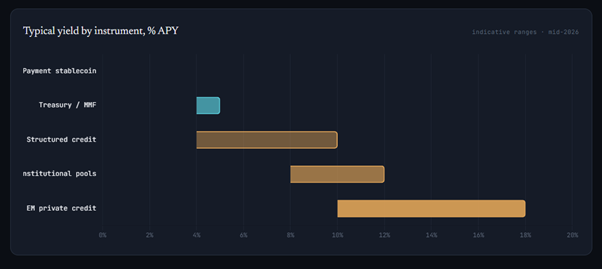
Stablecoins pay holders nothing by law under the GENIUS Act, which is precisely why the tokenised money market funds exist as a compliant way to earn the front-end rate. Step out along the curve, and the extra yield is simply compensation for credit risk, duration risk and illiquidity. There is no free lunch hiding in the tokenisation layer - an 8 per cent loan pool is paying 8 per cent because somebody might not get repaid.

SpaceX: Victory or Fiasco for Tokenisation?
By Anna Fedorova
The SpaceX IPO kicked off a frenzy of tokenized stock trading – at least, when taken as a proportion of the modestly-sized tokenization market. Over the last 30 days, tokenized stocks saw $4.3 billion of trading volume on-chain, according to data from RWA.xyz cited by the Kobeissi Letter – the highest monthly volume since inception and 140% jump year-to-date (YTD). Many market watchers saw this IPO as the first real-life test of tokenisation. For the first time ever, investors would have the opportunity to access a soon-to-be-launched stock on the blockchain, with the possibility of trading it 24/7, regardless of the Nasdaq’s opening hours. Now that the launch is done and dusted, the question is: was it a pass or a fail? The answer depends on who you ask.
Promises, promises
As the week of the IPO arrived, the hype around it reached fever pitch – and that extended to the tokenised market. Crypto exchanges Kraken, Bybit and Binance had rolled out major pre-IPO tokenisation campaigns, pre-IPO perpetuals were trading, and investors rushed to pre-order tokenised SpaceX (SPCX) shares and derivatives.
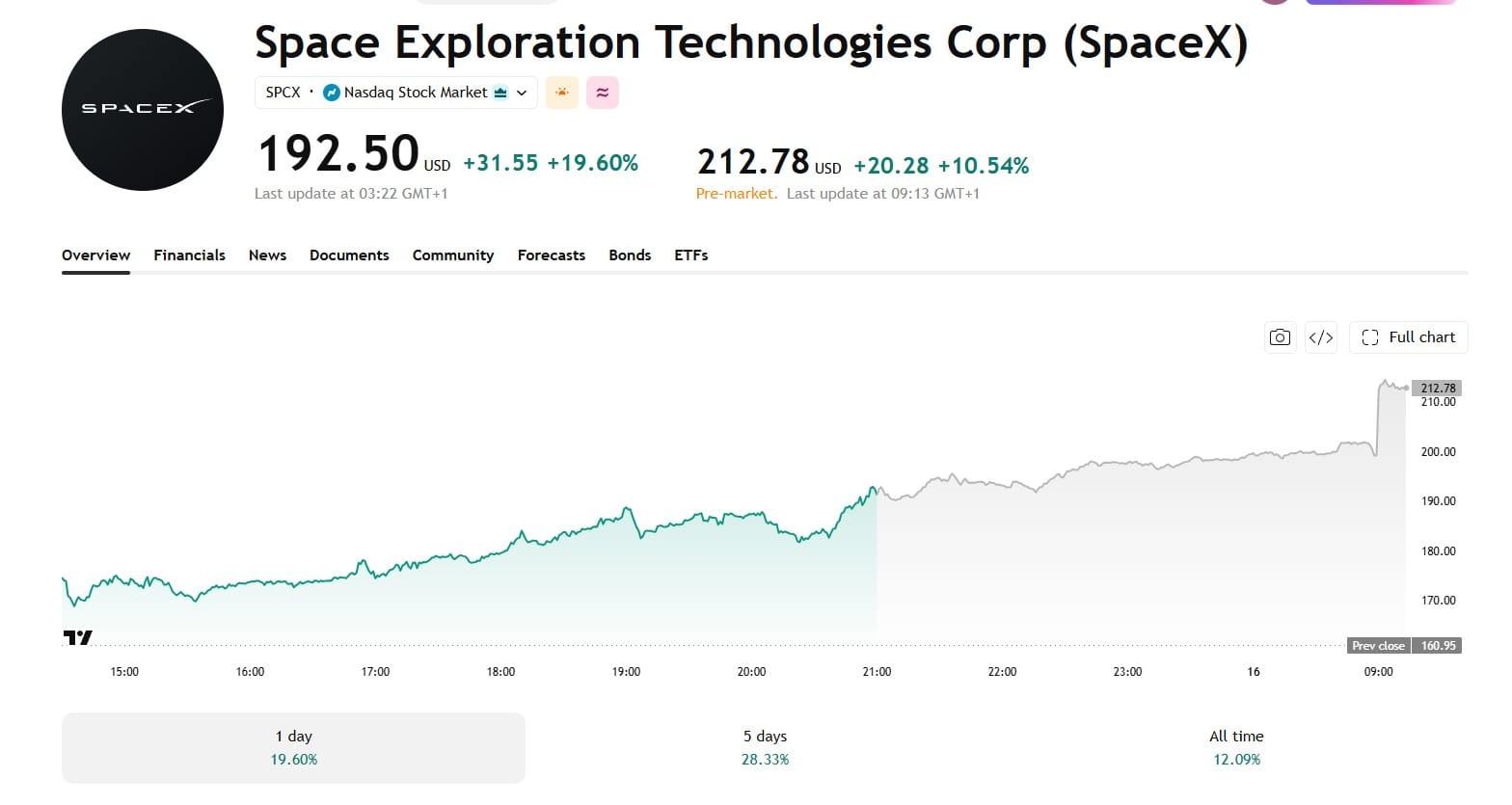
In a newsletter a few days ahead of the historic launch, Bloomberg reporter Suvashree Ghosh, who has been closely watching the digital asset market, noted that the listing has become “an unexpected referendum on tokenisation itself” – but the verdict would come only after the stock was live on the Nasdaq. The deciding factor would be whether investors would still trade tokenized versions of SpaceX once it’s live, or abandon them for the real shares on traditional exchanges.
The promise of tokenisation in this case was simple: retail investors had been largely locked out of SpaceX while VCs, sovereign funds and institutions gained early access. Tokenised equities could level the playing field, living up to crypto’s promise of “democratising” investment – providing access to anyone, anywhere, anytime.
But the big question, according to Nathanael Cohen, CIO at crypto hedge fund Indigo Fund, quoted in the Bloomberg piece, was whether there would be adequate liquidity available on tokenised platforms – an age-old problem for crypto tokens, which he called “a chicken-and-egg situation”. Given the size of the SpaceX IPO and the hype around it, liquidity constraints could become a really big problem.
The product selection
Liquidity wasn’t the only problem, though. Before the IPO even launched, the selection of tokenised products supposedly tracking SpaceX was confusing. Simply buying an “SPCX” token on-chain could give you a whole raft of different exposures depending on the issuer. ARK Invest’s director of research, Lorenzo Valente, tweeted: “I've seen 40 exchanges and wallets advertising SpaceX stock. What exactly am I buying?”
There were share-backed tokens, redeemable one-to-one for real SpaceX shares – from xStocks ahead of the launch, and from Backpack and Ondo once SpaceX was live. But there were also perpetuals offering synthetic derivative exposure to SpaceX.
Then there was the Paimon SPV SPCX token, launched by Paimon Finance on BNB Chain. This one doesn’t provide exposure to SpaceX shares in any way at all, but rather represents fractional ownership in a British Virgin Islands (BVI) Special Purpose Vehicle (SPV) that invests in venture capital funds with SpaceX exposure – a claim on a fund, not on the shares.
Then there were so-called structured claims from PreStocks and Republic. Both are synthetic trackers that also don't offer any actual equity exposure to SpaceX – only exposure to the economic performance of the company, and both traded ahead of the IPO.
Republic's rSPAX is a "Mirror Token" – a tokenized contingent payout note, essentially an IOU from Republic's subsidiary rather than a share. It confers no ownership, voting or dividend rights, and pays out only on a liquidity event such as the IPO, based on SpaceX's per-share value at that time.
Meanwhile, PreStocks has Special Purpose Vehicles (SPVs) that hold actual SpaceX shares or equivalent equity exposure. However, now that SpaceX is trading publicly, holders of the PreStocks SPACEX token must manually swap it for $SPCXx or another tokenised SpaceX product before 12 March 2027, or their tokens become worthless. And they can’t do so cleanly yet: the underlying shares unlock in tranches over roughly six months, so the token trades at a steep discount in the meantime.
In short, it was a somewhat confusing alphabet soup even before SpaceX started trading on the Nasdaq. But when it did, a bigger problem emerged for the exchanges that had promised retail investors on-chain access to real SpaceX shares.
The xStocks failure
Once the IPO allocation was distributed, investors on crypto exchanges Binance, Bitget and Bybit discovered they hadn’t received their shares – supposed to be distributed by Kraken’s tokenised equity platform, xStocks. The underlying stocks simply weren’t there. The exchanges were forced to cancel all their promotional campaigns and refund more than $1 billion to disappointed customers.
In all fairness, it wasn’t a failure of the technology. The technology worked just fine. The problem was scarcity, created in a seemingly artificial manner – despite promising a 30% retail allocation, Musk ended up reserving just over 20% for retail investors. With the offering already oversubscribed, that meant many retail investors – not only those on crypto platforms but also those buying through traditional brokerages – weren’t able to get their hands on SpaceX tokens.
And to be fair to the exchanges, many users did receive some allocation – reportedly 4.3 SpaceX shares from a fixed pool – and various other rewards to sweeten the deal. So, as Fortune’s finance and crypto editor Jeff John Roberts put it, it was a “bummer” for investors, but “hardly a fiasco”.
He sees it as simply part and parcel of constrained supply coming up against insatiable demand – and crypto platforms, being newer to the market, naturally ended up at the back of the queue. And, crucially, the possibility that this would happen was disclosed in the small print, so investors should have known what they were getting themselves into.
But some were not quite so sanguine. Tom Farley, CEO of Bullish, tweeted: “Maybe tokens should actually be approved by the issuer and therefore be the actual underlying share. Just a thought.”
After the storm
Once the dust settled, though, it turned out the tokenised shares that were available were doing what they said on the tin. They were trading 24/7 and tracked the price pretty closely once the stock was trading on Nasdaq (apart from PreStocks, which isn’t quite like-for-like exposure). The products that held real shares worked as they were supposed to. Binance's whole-share SPCX orders were executed through an introducing broker and cleared through Alpaca – real shares, cleared and settled under Nasdaq rules. Even the refunds were sorted out on IPO day.
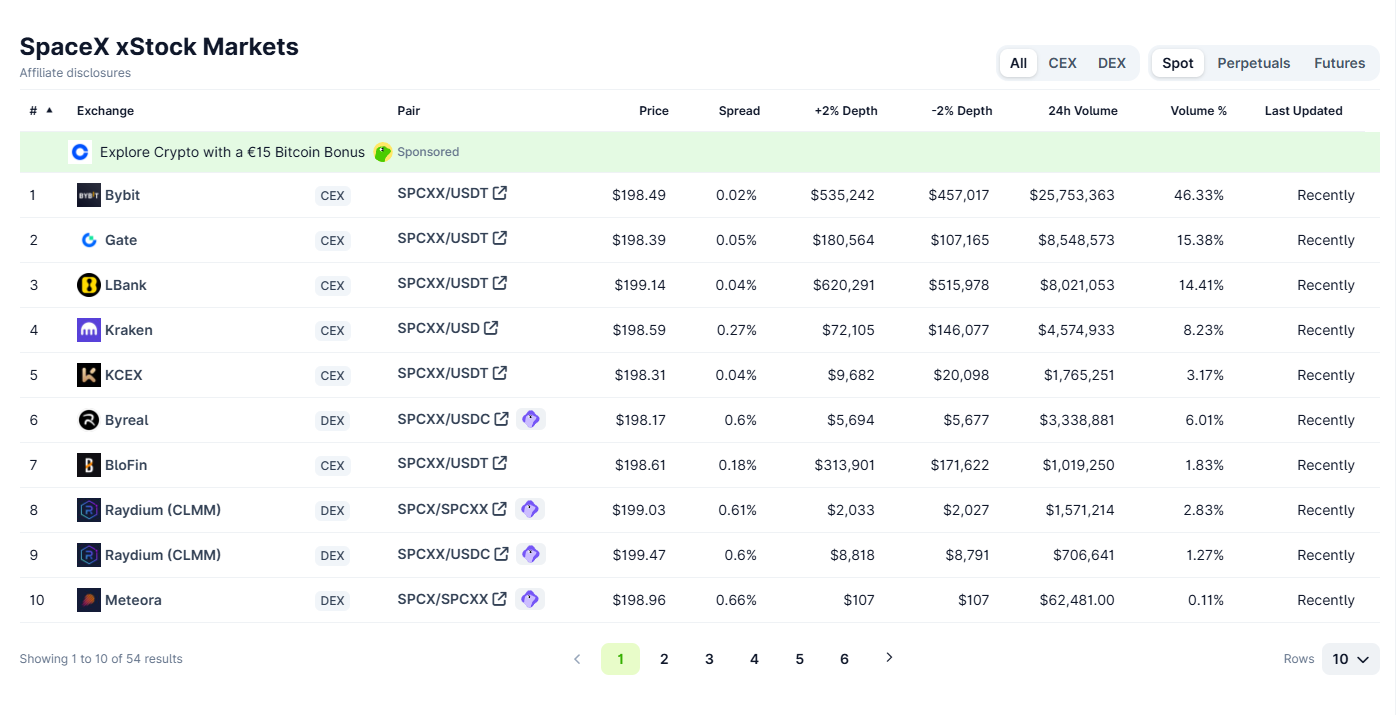
And there was some trading volume, much of it on Solana – a blockchain designed for fast transactions. Solana saw $100 million in 24-hour trading volume on Monday, 15 June, some 40% of that in Backpack Securities' SPCX token and the rest in competing products. And for the nascent blockchain sector, that number is impressive.By 17 June, the leading xStocks SpaceX token (SPCXX) was turning over roughly $40-48 million a day across 36 venues, with Bybit alone accounting for nearly half. That’s real, tradeable liquidity, even if it is concentrated in just a handful of centralised exchanges, and even if it remains a tiny fraction of the Nasdaq stock's turnover.
Tokenised stocks are slowly growing into a legitimate alternative to traditional market trading. As Gabor Gurbacs, CEO of OpenAssets, notes: “The SpaceX IPO demonstrated the potential of tokenised stocks. Despite initial hurdles, features like 24/7/365 markets enable broader participation from a wide range of investors.”
The verdict
By all accounts, then, it would be unfair to call the SpaceX tokenised stock rollout a fiasco. But it’s still a long way from a resounding victory. The reality is that the tokenised equity market is still tiny and niche compared to traditional markets. And the question is, what happens when traditional stock exchanges – like NYSE and Nasdaq – begin trading around the clock? Will tokenised equities continue to gain momentum due to their cross-border availability, instant settlement, and simpler user experience? Or will they lose their main appeal when the rest of the market is trading 24/7?
On top of this, one of the main concerns remains: tokens may offer access, but they don’t offer equivalence. Shareholder rights, market depth, and redemption certainty are still firmly reserved for traditional stock investors. And with SpaceX, the added irony is that the products promising to democratise access were the ones that couldn't deliver it, while others barred US investors outright.
The SpaceX IPO proved that tokenisation can work in practice. But if it is to become a real success, it needs more participation, deeper liquidity and reassurance that investors will be able to get their hands on tokenised shares when the time comes.
Gurbacs is convinced: “Future mega IPOs will likely feature more tokenised options, facilitating broader access to investors.” With a number of mega-IPOs slated for launch later this year, including OpenAI and Anthropic, we will soon find out.
Events on our radar
DigiAssets Connect Zurich, 16-17 June - Custody, banking, and institutional infrastructure – tickets HERE
European Blockchain Convention 12, Europe’s Deal Floor for Digital Assets. BARCELONA · 16-17 SEPTEMBER 2026 - tickets HERE


