

By Anna Fedorova
The London Stock Exchange (LSE) – one of the oldest and most traditional financial institutions on the planet – has announced plans for round-the-clock trading. It’s London’s answer to the US push for longer trading hours that has been underway for some time, with the New York Stock Exchange (NYSE), Nasdaq and Cboe Global Markets all set to launch overnight trading later this year.
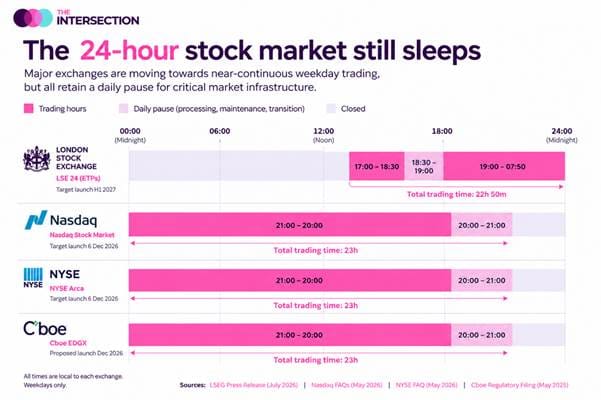
But London’s new service, dubbed LSE 24, is expected to start trading at 17:00, half an hour after the Main Market closes, and finish at 7:50, ten minutes before the Main Market opens. It will also have to hit the pause button for 30 minutes each day between 18:30 and 19:00. So total continuous trading time will actually be 22 hours 50 mins – broadly in line with its US counterparts – and it won’t be available on weekends.
So, London is officially becoming the city that never sleeps, but only Monday to Friday, with some power naps in the middle.
That 30-minute pause is an important breather that allows the underlying financial infrastructure to function. LSE itself explains that “the daily pause will support end-of-day processing, reference data updates, corporate actions and transition to the next trading day – a control increasingly recognised as important for orderly extended hours markets.”
But a nightly power-off doesn’t exactly fit the definition of an always-on market. And that’s by design. The exchange is laying the groundwork for a future when all markets are trading round the clock – a future that might, by its own admission, involve tokenisation and on-chain transactions. As such, LSE 24 should be seen as the bridge to that future, not a rigid final product.
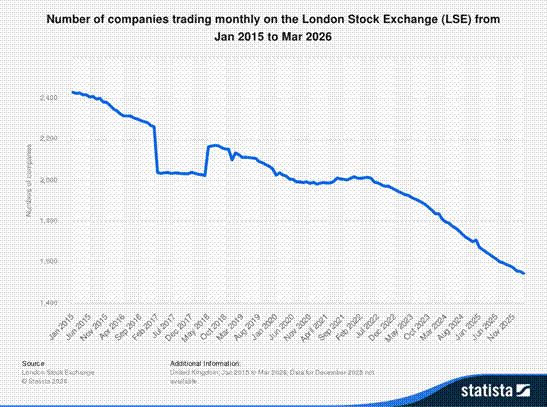
Number of companies trading monthly on the London Stock Exchange (LSE) from Jan 2015 to Mar 2026 (Source: Statista)
What is LSE 24 exactly?
Let's take a step back though, and look at how the new service will work in practice. LSE has an ambitious timeline for the launch. Provided regulatory approval comes in, and testing goes well, the new service is expected to launch in the first half of 2027 – not quite as soon as its American counterparts, but hot on their heels.
LSE 24 is launching as an entirely new market service with its own trading schedule, functionality and venue identifiers. In its supporting literature, it says LSE 24 is “designed to complement rather than extend traditional market hours”.
But while it’s a huge leap forward – the biggest since the "Big Bang" shift of 1986, when UK trading hours were expanded significantly to accommodate global interest – there are several caveats and constraints. Firstly, LSE 24 will only be available for exchange-traded products to start with – equities are expected to come later, depending on client demand, operational readiness and regulatory approval. So, in a way, this is both a pilot and a building block.
Secondly, while existing LSE member firms will be able to access LSE 24 through the LSE Millennium Exchange platform, because it's a separate permissioned service, LSE says firms may have to complete extra onboarding. It's a new, separate trading service, not simply an extension of hours on LSE’s existing platform.
Here’s how it will work: a hybrid model combining on-demand Request for Quote (RFQ) liquidity with traditional, visible public order books, designed to support activity during nighttime trading hours, when liquidity tends to be thin.
The bottom line is that LSE isn’t building entirely new infrastructure for this venture. The exchange says this new service “combines trusted exchange infrastructure with next-generation trading and connectivity capabilities, while preserving the integrity and operation of LSEG's existing markets”. It's a workaround rather than a makeover.
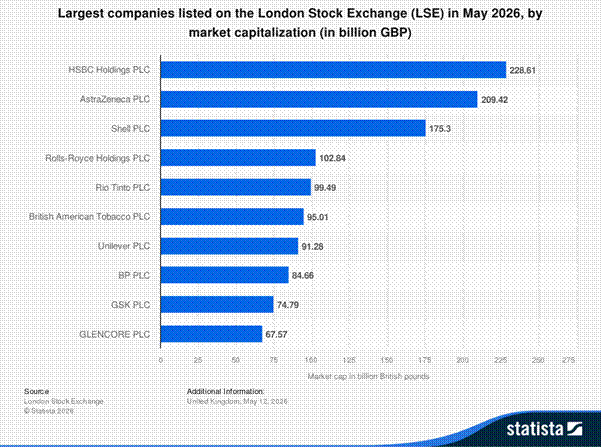
Largest companies listed on the London Stock Exchange (LSE) in May 2026, by market capitalisation (Source: Statista)
What about tokenisation?
All of this begs the question: what about tokenisation? It’s clear that LSE isn’t turning to blockchain technology on day one. What’s more interesting, though, is that it’s leaving the door relatively wide open to this technology in the future.
In its FAQ document, LSE explicitly says that although it’s relying on existing market infrastructure at launch, the new service “is being designed with the ability to connect to LSEG’s Digital Securities Depository (DSD) with the future in mind, creating optionality for tokenised issuance and settlement and other digital asset workflows as those services develop”.
DSD is the stock exchange’s on-chain settlement and market infrastructure solution designed to connect traditional and digital asset markets. “This means LSE 24 can operate as a conventional extended hours venue from day one, while preserving a path towards future digital market infrastructure,” the exchange said. So while LSE 24 and DSD are separate entities – the former a trading venue responsible for trading execution, the latter post-trade infrastructure handling issuance, settlement and asset servicing using blockchain technology – they are designed to connect at some point.
The constraint here appears to be, at least to some extent, technical. LSE specifically says that the clearing and settlement model is “designed to support future settlement optionality as LSEG’s digital market infrastructure develops”, which suggests it may not be ready to do so just yet. But it’s also yet another sign that the incumbent financial institutions are not looking to replace existing infrastructure with tokenisation and blockchain. Rather, the two will eventually complement each other.
Michael Winnike, Managing Director and Head of Strategy and Market Solutions at DTCC, says “tokenization is not about replacing the financial system. It is about evolving it, responsibly, at scale, and in a way that preserves the strengths of today’s markets while unlocking new capabilities.”
In an article entitled Tokenization, at Scale: Why Market Infrastructure Still Matters, Winnike argues that tokenisation is “a potential solution rather than a complication” – a way for markets to adapt to changing trading patterns without sacrificing stability. That seems to be exactly what LSE is going for here: extended access now, digital settlement potential at a later date. The million-dollar question is, of course, when will that later date come?
The challenge of 24/7 markets
That brings us to the question marks, of which there are many. LSE is very careful to hedge every forward-looking statement with “subject to regulatory approval, client demand and delivery readiness”.
The daily 30-minute trading pause is the elephant in the room, proving that legacy post-trade processes, like corporate actions, reference data, and symbol updates, can't yet run continuously. And then there’s the 30-minute gap between the Main Market close and LSE 24 open, and the ten minutes at the other end. A truly 24/7 marketplace can’t have that. T+0 settlement can’t have that.
Another constraint worth noting is that new instruments or those affected by corporate actions like splits or consolidations must first trade on the Main Market before becoming eligible for LSE 24. That’s a gating mechanism that ensures the new trading venue is always dependent on the old system, even if true 24/7 trading is achieved.
Corporate actions aren’t unusual – consolidations, M&A, stock splits happen all the time. With 1,545 companies trading on the LSE as of March 2026, according to Statista, this restriction could affect quite a few firms in any given year, which could be another source of friction for round-the-clock trading. In a joint paper entitled THE SHIFT TO 24X5 TRADING: What It Means for U.S. Equity Markets, DTCC and EY highlight the challenges of building a truly 24/7 marketplace. “Transitioning to a true 24x7 market would require significant changes to infrastructure, settlement, and regulation,” they say.
The same goes for the agentic AI push – another part of this puzzle. LSE says its new service is “being built to support both familiar client connectivity and new, permissioned agentic AI workflows, allowing AI-enabled tools to interact directly with defined venue capabilities within the governance, resilience and controls of trusted exchange infrastructure”. However, while it expects to be testing permissioned agentic connectivity by the end of 2026, this move is still bounded by “client responsibility, permissions, risk checks, surveillance and regulatory oversight”. Like tokenisation, AI automation is also happening strictly within the existing control parameters.
What to watch for
So questions remain. For one thing, it’s not even clear when LSE 24 will be available for equities rather than ETPs. This will likely depend on trading volume and liquidity more than regulatory constraints, so the first few weeks after the service goes live will be crucial. Equally, as pre-launch testing begins, it’s worth watching whether the launch timeline shifts. LSE says the service is expected to go live in H1 2027. Along the way, I’d expect to see successful pilots and further details announced.
For tokenisation specifically, the timeline will likely be longer than for agentic AI, as LSE has explicitly highlighted AI as a focus for this launch. So far, there are no details on integration with the Digital Securities Depository (DSD). Progress here is likely to be determined by two developments: what competitors are doing in the space, and how quickly regulation is adapting. With the FCA recently confirming that public blockchains are acceptable venues for tokenised authorised funds, the path is clearer than it’s ever been for the LSE to integrate tokenisation into its trading infrastructure.
So competitive pressures will be the deciding factor. Especially considering that the LSE isn't just competing with NYSE and Nasdaq on hours, but also trying to make the exchange itself more attractive at a moment when the number of London-listed companies has been shrinking.
The verdict
With the launch of LSE 24, one of the oldest stock exchanges in the world is boldly marching into the future. But it’s not transforming into a truly 24/7 trading venue. It’s more of a rehearsal for one, the first phase in a multi-phased rollout plan.
And that’s what makes this launch particularly interesting. The London Stock Exchange has told us how it envisages the future of trading: agentic AI, and eventually tokenised trading using blockchain technology. The only question is how long it will take to get there – and that will depend as much on other market participants as on LSE itself.


