

Welcome to the summer double issue (#25) from TheIntersection team - our next issue will be out in two weeks' time! Enjoy the holidays !!
In this issue:
- News: Visa launches its Stablecoin platform for customers
- Data: Hyperliquid volumes pick up momentum
- Analysis: How has Kelp changed the conversation around DeFi risk?
- Analysis (2): LSE goes 24/5, but preps for 24/7
- Our weekly events round-up
And it's all free! Before we dive in, one request: please forward this weekly letter to anyone you think might be interested. We also very much welcome feedback (and contributors). If you want to email us, just drop an email to us at teams@theintersection.news.

News in Brief
SEC clears the way for tokenised securities
The SEC has approved Nasdaq's rule change to support certain tokenised securities, while also considering an "innovation exemption" that could allow crypto platforms to list tokenised equities under a more flexible regulatory framework.
DTCC begins live tokenisation pilot
DTCC has started live production trades using tokenised versions of Russell 1000 stocks, ETFs and U.S. Treasuries, with firms including BlackRock, Goldman Sachs, JPMorgan and Circle taking part. A full commercial launch is expected later this year.
Samsung brings stablecoins to its wallet
Samsung has announced plans to add native stablecoin support to Samsung Wallet, alongside its new Galaxy Card. While the company hasn't confirmed which stablecoins will be supported or when the feature will launch, the move could put digital dollars in front of millions of Galaxy users.
Deep Dive — Visa launches new platform
The Top Line
Visa's latest announcement focuses on the firm's plan to launch a Visa Stablecoin Platform, a service that lets banks and fintechs issue, hold, transfer and redeem stablecoins through a single platform.
The Details
The new platform gives financial institutions a ready-made way to manage stablecoins while connecting them to Visa's existing payments network. It launches with support for Open USD (OUSD), with additional tokens expected over time. Stablecoins are increasingly being used for treasury operations, cross-border payments and settlement, rather than just crypto trading. Rather than building a new financial system, Visa is adapting the one it already runs for a world where digital dollars become part of everyday payments.

Hyperliquid volumes pick up momentum, but regulators circle
Decentralised perpetual exchange Hyperliquid saw weekly RWA trading volume surge to $25.1 billion (52% of its total platform volume), marking the first time tokenised RWAs surpassed all other asset trading categories combined on the DEX. “Hyperliquid’s RWA market alone was larger than the combined crypto perpetual volume of every other DEX,” wrote ARK Invest’s research director for digital assets, Lorenzo Valente, in a Thursday X post.
Over the past month, RWA holders grew by 32% to 1.25 million users, while the total value of tokenised RWAs rose by 3.5% to $36.7 billion, according to data aggregator RWA.xyz. Hyperliquid generated $7.6 million in revenue over the past week, according to DefiLlama.
The perp DEX ranked third among crypto applications by weekly revenue, behind stablecoin issuers Tether and Circle, which generated $112 million and $45 million, respectively. Hyperliquid also surpassed $1 billion in cumulative protocol revenue on 30 June, according to DefiLlama. The positive momentum reversed sharply after the half-year mark, though. Perpetual volume fell from $84 billion in early July to $43 billion within three weeks, revenue dropped from a weekly average of $23 million to $7.5 million, and HYPE fell to around $58 from a July high of $73.
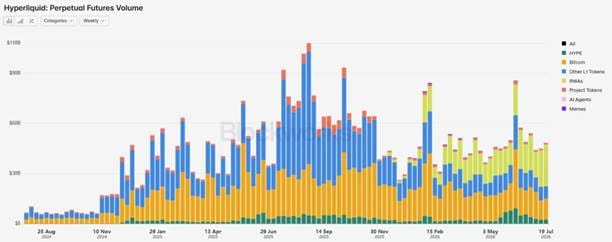
Hyperliquid: Perpetual Futures Volume, 2-year chart. Source: Blockworks
One of the tailwinds has been the platform's 24/7 functionality. During the West Asia crisis, traders moved to Hyperliquid to trade oil, gold and silver around the clock. TD Securities noted oil perpetual volume jumping from $25 million to over $550 million across three weekends of the US-Israel-Iran conflict, with the platform pricing in nearly 80% of WTI's next move before CME reopened, prompting CME and ICE to seek regulatory scrutiny while developing rival products.
One driver for growth was the HIP 3 upgrade, which also made a big difference – this was a network upgrade that allows builders to launch permissionless perpetual futures markets, working with third-party developers. HIP-3 markets drove up to 40% of total platform volume. It is worth noting, though, that market insiders report that TradeXYZ alone accounts for more than 90% of total open interest across all HIP-3 markets, so the entire tokenised-asset story rests on one deployer's oracle quality and solvency.
Regulatory pressure is also growing. The MAS in Singapore, the local regulatory body, added Hyperliquid to its Investor Alert List in late June - both MAS and Hyperliquid confirmed the listing is not a ban, fine, or formal enforcement action. There have also been UK warnings, while CME and ICE executives in the US urged the CFTC to review the platform's commodity perpetuals. The FCA lists the platform as unauthorised, and synthetic stock perpetuals sit in a regulatory grey zone. That said, the CFTC issued a policy statement recognising perpetual futures as a valid contract structure and cleared the first such product on a registered US exchange

How has Kelp changed the conversation around DeFi risk?
by John Gray
A line has been drawn under the Kelp DAO exploit: the post-mortems have been published, the op-eds have dried up, and the DeFi news cycle has moved on. In this sense, it feels like the right moment to follow up on our recent breakdown of the exploit with an article exploring some of the broader lessons that DeFi could draw from April’s $300m heist.
New attack surfaces, new sources of risk
As Alec Zebrick, Senior Manager, Global Services at Chainalysis, highlighted to The InterSection, the major takehome is that the exploit wasn’t due to a smart contract bug, but rather to a sophisticated attack on off-chain bridge verification infrastructure. In other words, it was an illustration of the fact it is no longer enough to audit the contract and assume you’re safe. Bridges, verifiers, oracles, governance systems, administrators and even human operators may now be equally important attack surfaces. This is particularly true in the case of collateral used in lending markets, which typically requires a degree of management overhead.
But Kelp was far more than a cybersecurity issue. The exploit exposed the growing importance of risk management around the assets themselves. Lending protocols are not responsible for securing another project’s infrastructure, but they are responsible for deciding whether an asset should be listed at all, how much users can borrow against it, whether it should sit in an isolated market, and what supply caps, debt ceilings and liquidation parameters should apply.
“Detection needs to happen at the invariant level,” Zebrick argued, “continuously verifying that cross-chain accounting adds up, and single points of failure in verification infrastructure need to be treated as active and not theoretical risks.” Zebrick pointed to another key consideration. “The composability that makes DeFi powerful also means a major exploit creates immediate contagion risk across protocols.”
Of course, this is precisely what happened in the case of the Kelp exploit: once the supposedly legitimate rsETH entered the ecosystem, the damage rippled through the network. In this way, despite the fact its own systems were not violated, Aave came to be the principal victim of the exploit.
Composability and its discontents
For Michael Lewellen – cybersecurity expert and security advisor to the Compound Foundation – this is one of the most important lessons of Kelp. The exploit, as Lewellen told The InterSection earlier this week, was an example of a broader question, “one that I think a lot of people probably should have been looking closer at.”
Kelp, he said, is “a relatively exotic collateral” with a decent but not stellar reputation, far from being a blue-chip style asset such as stETH or similar. This type of liquid restaking token has become popular because they enable people to earn yield and generate additional revenue.
However, the more of these collaterals you add, Lewellen explained, “the more your risk expands. And a monolithic model like Aave is especially vulnerable to this because those assets are existing in the same pool as many of the others.” Increasingly, protocols need to underwrite the operational risks of the collateral they accept, not just its market volatility. In light of this, “what we’re realizing now is that DeFi is not going to necessarily insulate you from systemic risk”, unless you go for a very particular DeFi protocol, such as Morpho, which has certain limitations. Even then, however, “you’re usually just picking different risks. I mean, USDC is a systemic risk. If anything happens to USDC all of DeFi is effectively screwed. “Going forward, people will probably need to think more frankly about where their yield is coming from and what are the risks behind it. I think there’s still very strong cases to use DeFi protocols, but I think what Kelp DAO did was destroy the narrative that passive yield equivalent to a short-term treasury was the right risk factor.
“The yield has to justify the risk.”
DeFi united?
One notable characteristic of the Kelp exploit was the speed and effectiveness of the initial response to it. For Chainalysis’ Zebrick, “perhaps the most consequential action was the Arbitrum Security Council’s freeze of over 30,000 ETH in attacker funds within days, coordinated with law enforcement and supported by Chainalysis. This demonstrated what credible L2 governance can accomplish when it moves quickly.”
Further to this, the weeks after the initial incident saw an interesting and unprecedented development: the coming together of an informal coalition known as DeFi United, spearheaded by Aave, which worked to restore rsETH’s backing and, effectively, make everyone whole. For Zebrick, “DeFi United’s speed in organizing a coalition to restore rsETH’s backing was impressive, and it reflects a maturing ecosystem.”
However, to many it looked like DeFi United was redolent of the worst of TradFi: a bailout to save an institution that had become “too big to fail”. As David Phelps of Confetti said at the time, it was “a solution that just depends on trust. You’re just trusting that Daddy Warbucks is gonna come in with his billions of dollars and give it back to you to try to help you out. I don’t think this instills a lot of confidence.”
Did DeFi United really introduce an element of moral hazard into DeFi? If protocols, investors and users know that the ecosystem may intervene to absorb the consequences of catastrophic failures, does that weaken the incentive to build secure systems?
Michael Lewellen thinks this is not an issue. For him, DeFi United was really the “save Aave” fund. The Kelp DAO exploit was critical to Aave, as it would have had the largest hole out of anyone. “The test would be if we see another incident, and Aave is not not the one that’s actually the most at risk, will we see another DeFi United? I would be surprised.”
Apart from anything else, even DeFi United was touch-and-go, with a lot of legal limbo and voting processes. The money may have been committed fairly quickly, but it took some time to be accessed. While this was going on, Aave had to find ways to ensure that the protocol could remain solvent. “If a few things had fallen through,” Lewellen said, “it could have ended badly.”
Considering this, Lewellen underlined the importance of individual protocols being able to stand on their own two feet. “They need to be thinking more about their own insurance, their own reserves, their own way to cover risk. At Compound we have reserves that can help cover losses. We ended up being made whole through DeFi United, which was great, but we could have used a pretty large amount of our reserves to make our users whole, and the protocol could have kept functioning after the initial pause was over.”
This is particularly important because DeFi lacks FDIC insurance, or any comparable statutory resolution process. Users will likely be at the back of the line when it comes to a recovery. For individual protocols, the key learning from Kelp DAO should not be that the system will come to their rescue, but, again, that they must do everything they can to mitigate their risk of being caught up in a similar contagion. Lewellen suggested that such mitigation could look like boosting their ability to pause; to delist collateral more effectively; or to isolate “exotic” collateral from more “conservative” deposits.
Isolated markets or monolithic pools
Are there any risks Lewellen feels DeFi is still underestimating? What structural changes would he make, were he the demiurge of the system? “My cypherpunk brain would say, find a way to make ETH a stable asset or find ways to have natively on-chain assets backing protocols and creating stablecoins – kind of like the old MakerDAO model.
“The problem is that you always struggle with maintaining stability and liquidity in those events. So I understand the natural push towards centrally issued stablecoins and/or RWAs to have better, safer sources of yield.”
One response to the possibility of contagion exemplified by Kelp would be to build markets to be more isolated, somewhat along the lines of Morpho or Comet. “You can have different markets for different flavours of risk,” Lewellen noted. “I do like the isolation model over the monolith model. I think the monolith model has its advantages, especially in that it does not fragment liquidity, but it comes with pooling your risk, which means that it’s really on the person managing these large pools of many different assets to think through every asset that’s being added.
“It's a very difficult balance. You want to go after new sources of revenue and new collateral, but not all of them are maybe worthy, or at least are worth the potential risk increase that they introduce.” In terms of procedure, he would recommend building fast, capable emergency response controls. This would give emergency responders – the people that sit on multisigs or security councils – more options to deal with crises, although, he conceded, “it’s always a balancing act between giving more control and then maintaining the right level of permissionlessness and non-custodial nature.”
In conclusion, Lewellen said, “I think DeFi is here to stay. It still has a great use case. It’s just we’re now realising that we have to be careful about what our assets are sharing room with.”

LSE goes 24/5, but preps for 24/7
By Anna Fedorova
The London Stock Exchange (LSE) – one of the oldest and most traditional financial institutions on the planet – has announced plans for round-the-clock trading. It’s London’s answer to the US push for longer trading hours that has been underway for some time, with the New York Stock Exchange (NYSE), Nasdaq and Cboe Global Markets all set to launch overnight trading later this year.
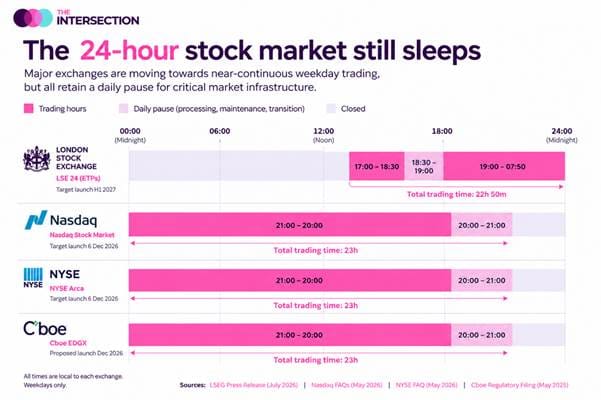
But London’s new service, dubbed LSE 24, is expected to start trading at 17:00, half an hour after the Main Market closes, and finish at 7:50, ten minutes before the Main Market opens. It will also have to hit the pause button for 30 minutes each day between 18:30 and 19:00. So total continuous trading time will actually be 22 hours 50 mins – broadly in line with its US counterparts – and it won’t be available on weekends.
So, London is officially becoming the city that never sleeps, but only Monday to Friday, with some power naps in the middle.
That 30-minute pause is an important breather that allows the underlying financial infrastructure to function. LSE itself explains that “the daily pause will support end-of-day processing, reference data updates, corporate actions and transition to the next trading day – a control increasingly recognised as important for orderly extended hours markets.”
But a nightly power-off doesn’t exactly fit the definition of an always-on market. And that’s by design. The exchange is laying the groundwork for a future when all markets are trading round the clock – a future that might, by its own admission, involve tokenisation and on-chain transactions. As such, LSE 24 should be seen as the bridge to that future, not a rigid final product.
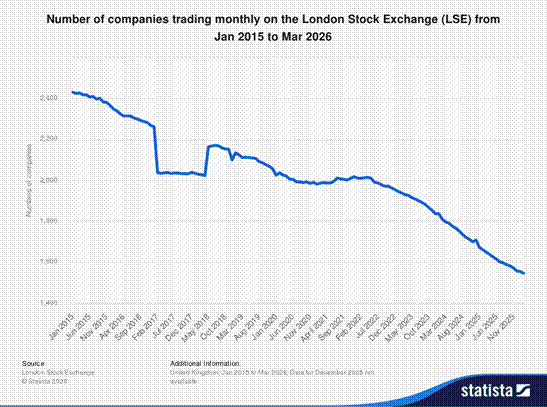
Number of companies trading monthly on the London Stock Exchange (LSE) from Jan 2015 to Mar 2026 (Source: Statista)
What is LSE 24 exactly?
Let's take a step back though, and look at how the new service will work in practice. LSE has an ambitious timeline for the launch. Provided regulatory approval comes in, and testing goes well, the new service is expected to launch in the first half of 2027 – not quite as soon as its American counterparts, but hot on their heels.
LSE 24 is launching as an entirely new market service with its own trading schedule, functionality and venue identifiers. In its supporting literature, it says LSE 24 is “designed to complement rather than extend traditional market hours”.
But while it’s a huge leap forward – the biggest since the "Big Bang" shift of 1986, when UK trading hours were expanded significantly to accommodate global interest – there are several caveats and constraints. Firstly, LSE 24 will only be available for exchange-traded products to start with – equities are expected to come later, depending on client demand, operational readiness and regulatory approval. So, in a way, this is both a pilot and a building block.
Secondly, while existing LSE member firms will be able to access LSE 24 through the LSE Millennium Exchange platform, because it's a separate permissioned service, LSE says firms may have to complete extra onboarding. It's a new, separate trading service, not simply an extension of hours on LSE’s existing platform.
Here’s how it will work: a hybrid model combining on-demand Request for Quote (RFQ) liquidity with traditional, visible public order books, designed to support activity during nighttime trading hours, when liquidity tends to be thin.
The bottom line is that LSE isn’t building entirely new infrastructure for this venture. The exchange says this new service “combines trusted exchange infrastructure with next-generation trading and connectivity capabilities, while preserving the integrity and operation of LSEG's existing markets”. It's a workaround rather than a makeover.
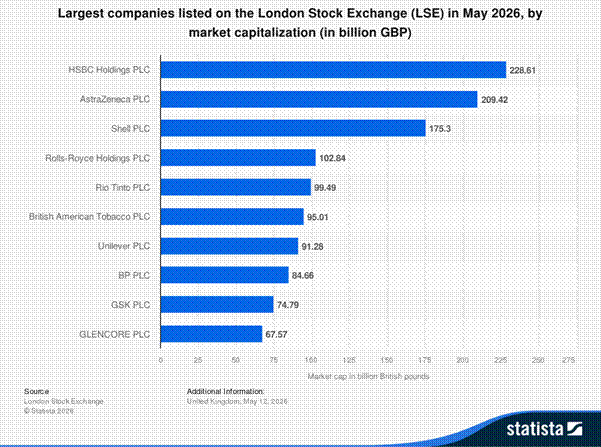
Largest companies listed on the London Stock Exchange (LSE) in May 2026, by market capitalisation (Source: Statista)
What about tokenisation?
All of this begs the question: what about tokenisation? It’s clear that LSE isn’t turning to blockchain technology on day one. What’s more interesting, though, is that it’s leaving the door relatively wide open to this technology in the future.
In its FAQ document, LSE explicitly says that although it’s relying on existing market infrastructure at launch, the new service “is being designed with the ability to connect to LSEG’s Digital Securities Depository (DSD) with the future in mind, creating optionality for tokenised issuance and settlement and other digital asset workflows as those services develop”.
DSD is the stock exchange’s on-chain settlement and market infrastructure solution designed to connect traditional and digital asset markets. “This means LSE 24 can operate as a conventional extended hours venue from day one, while preserving a path towards future digital market infrastructure,” the exchange said. So while LSE 24 and DSD are separate entities – the former a trading venue responsible for trading execution, the latter post-trade infrastructure handling issuance, settlement and asset servicing using blockchain technology – they are designed to connect at some point.
The constraint here appears to be, at least to some extent, technical. LSE specifically says that the clearing and settlement model is “designed to support future settlement optionality as LSEG’s digital market infrastructure develops”, which suggests it may not be ready to do so just yet. But it’s also yet another sign that the incumbent financial institutions are not looking to replace existing infrastructure with tokenisation and blockchain. Rather, the two will eventually complement each other.
Michael Winnike, Managing Director and Head of Strategy and Market Solutions at DTCC, says “tokenization is not about replacing the financial system. It is about evolving it, responsibly, at scale, and in a way that preserves the strengths of today’s markets while unlocking new capabilities.”
In an article entitled Tokenization, at Scale: Why Market Infrastructure Still Matters, Winnike argues that tokenisation is “a potential solution rather than a complication” – a way for markets to adapt to changing trading patterns without sacrificing stability. That seems to be exactly what LSE is going for here: extended access now, digital settlement potential at a later date. The million-dollar question is, of course, when will that later date come?
The challenge of 24/7 markets
That brings us to the question marks, of which there are many. LSE is very careful to hedge every forward-looking statement with “subject to regulatory approval, client demand and delivery readiness”.
The daily 30-minute trading pause is the elephant in the room, proving that legacy post-trade processes, like corporate actions, reference data, and symbol updates, can't yet run continuously. And then there’s the 30-minute gap between the Main Market close and LSE 24 open, and the ten minutes at the other end. A truly 24/7 marketplace can’t have that. T+0 settlement can’t have that.
Another constraint worth noting is that new instruments or those affected by corporate actions like splits or consolidations must first trade on the Main Market before becoming eligible for LSE 24. That’s a gating mechanism that ensures the new trading venue is always dependent on the old system, even if true 24/7 trading is achieved.
Corporate actions aren’t unusual – consolidations, M&A, stock splits happen all the time. With 1,545 companies trading on the LSE as of March 2026, according to Statista, this restriction could affect quite a few firms in any given year, which could be another source of friction for round-the-clock trading. In a joint paper entitled THE SHIFT TO 24X5 TRADING: What It Means for U.S. Equity Markets, DTCC and EY highlight the challenges of building a truly 24/7 marketplace. “Transitioning to a true 24x7 market would require significant changes to infrastructure, settlement, and regulation,” they say.
The same goes for the agentic AI push – another part of this puzzle. LSE says its new service is “being built to support both familiar client connectivity and new, permissioned agentic AI workflows, allowing AI-enabled tools to interact directly with defined venue capabilities within the governance, resilience and controls of trusted exchange infrastructure”. However, while it expects to be testing permissioned agentic connectivity by the end of 2026, this move is still bounded by “client responsibility, permissions, risk checks, surveillance and regulatory oversight”. Like tokenisation, AI automation is also happening strictly within the existing control parameters.
What to watch for
So questions remain. For one thing, it’s not even clear when LSE 24 will be available for equities rather than ETPs. This will likely depend on trading volume and liquidity more than regulatory constraints, so the first few weeks after the service goes live will be crucial. Equally, as pre-launch testing begins, it’s worth watching whether the launch timeline shifts. LSE says the service is expected to go live in H1 2027. Along the way, I’d expect to see successful pilots and further details announced.
For tokenisation specifically, the timeline will likely be longer than for agentic AI, as LSE has explicitly highlighted AI as a focus for this launch. So far, there are no details on integration with the Digital Securities Depository (DSD). Progress here is likely to be determined by two developments: what competitors are doing in the space, and how quickly regulation is adapting. With the FCA recently confirming that public blockchains are acceptable venues for tokenised authorised funds, the path is clearer than it’s ever been for the LSE to integrate tokenisation into its trading infrastructure.
So competitive pressures will be the deciding factor. Especially considering that the LSE isn't just competing with NYSE and Nasdaq on hours, but also trying to make the exchange itself more attractive at a moment when the number of London-listed companies has been shrinking.
The verdict
With the launch of LSE 24, one of the oldest stock exchanges in the world is boldly marching into the future. But it’s not transforming into a truly 24/7 trading venue. It’s more of a rehearsal for one, the first phase in a multi-phased rollout plan.
And that’s what makes this launch particularly interesting. The London Stock Exchange has told us how it envisages the future of trading: agentic AI, and eventually tokenised trading using blockchain technology. The only question is how long it will take to get there – and that will depend as much on other market participants as on LSE itself.
Events on our radar
- TOKEN2049 Singapore, 7–8 October 2026, Singapore - tickets HERE
- WebX Asia (Tokyo), 13–14 July 2026, Tokyo, Japan - tickets HERE
- Blockchain Futurist Conference (Toronto), 21–22 July 2026, Toronto, Canada - tickets HERE
- European Blockchain Convention 12, Europe’s Deal Floor for Digital Assets. BARCELONA · 16-17 SEPTEMBER 2026 - tickets HERE
- Digital Assets Forum New York, New York 13 November 2026 - tickets HERE


