

By Damien Black and David Stevenson
Continuing our explainer series, stablecoins: are they really the next big thing, or just the next big disaster waiting to happen?? Unsurprisingly, the regulators are showing interest!
Imagine, if you can, a disillusioned small-business owner in Argentina. They have a wonderful product which they sell internationally. They sell in dollars, but their central bank restricts access to hard currency. They’re desperate to work out a workaround which doesn’t involve hugely expensive wire transfers or dodgy currency brokers. Cue cryptocurrencies and especially stablecoins.
Stablecoin cross-border flows are accelerating. The IMF is concerned.
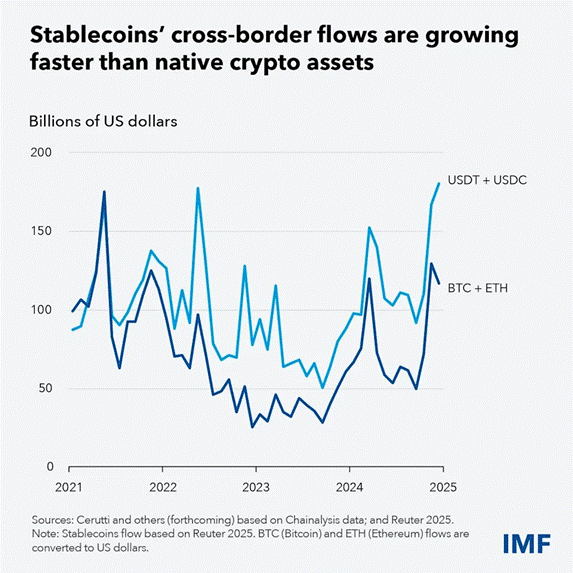
source: Cerutti, Chainalysis, Reuter 2025, IMF
Stablecoins are cryptocurrencies engineered to hold a fixed value — almost always $1 — rather than fluctuating like Bitcoin or Ethereum. The interesting question is how they maintain that peg, and there are actually three quite different mechanisms for doing it.
Fiat-backed (the simple version)
For every stablecoin in circulation, the issuer holds an equivalent amount of real dollars (or dollar-equivalent assets like Treasury bills) in a bank or custodian. It's essentially a digital IOU. You give Tether $1, they give you 1 UST and put your dollar in a reserve account. When you want your dollar back, you return the UST and they redeem it. The peg holds as long as people trust that the reserves are genuinely there — which is why the monthly attestations matter so much.
There are, of course, variations. DAI, for instance, is popular in Argentina and is a decentralised stablecoin pegged to the US dollar, issued by the MakerDAO protocol (now rebranded as Sky). Unlike USDC or USDT, there's no company holding dollars in a bank account behind it — it's generated entirely through smart contracts on the Ethereum blockchain.
Instead of dollars in a bank, it's backed by crypto assets locked in smart contracts on the blockchain. Because crypto is volatile, it's overcollateralised — you might need to lock up $150 worth of Ethereum to mint $100 of DAI. If the collateral falls too far in value, the system automatically liquidates it to protect the peg. There's no company holding reserves — it's all governed by code and the MakerDAO protocol.
More generally, with stablecoins such as Tether and USD Coin, you can effectively trade in dollars without actually owning dollars. Argentina leads Latin America in cryptocurrency value received, with an estimated $91.1 billion in 2024, and ranks 14th globally in the Chainalysis adoption index. Stablecoins such as USDT (Tether) and USDC dominate — on the exchange Bitso, USDT and USDC together accounted for 72% of all purchases. Suddenly, you can access an international currency clearing system by using coins backed up – collateralised – in hard currency. What’s not to like ?
Where Circle (USDC) puts its dollars at a glance. Could this add up to a liquidity problem in the event of a crisis?
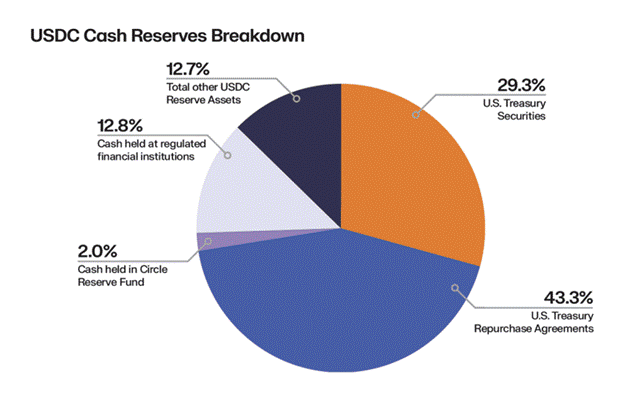
source: CryptoRank, CoinLaw
What's not to like ? Alot as it happens, especially if you are a central bank, or an organisation that represents central banks. The IMF was pretty unequivocal in its recent criticisms. Yes, tokenisation has the benefit of speeding up transactions – the coveted T+0 model of instantaneous transfers – but it could also have the unwanted side effect of accelerating a crisis when things get out of control.
Which, as anyone who remembers 2007 will recall, they most certainly can do. The Fund argues that this malaise could easily spread to stablecoins. Increasingly used as settlement assets in transactions, they “may be vulnerable to run dynamics if confidence breaks down” leading it to conclude that “efficiency comes at the cost of resilience”. Goldman Sachs has joined its voice to the IMF in raising concerns, warning that if investors shift en masse from domestic banks to stablecoins, “central banks may lose control over monetary policy and capital flows”.
The IMF isn’t the only major fiscal institution to raise eyebrows at the seemingly headlong dash towards stablecoins and tokenization. The Bank for International Settlements (BIS) warned in June 2025 that stablecoins fail three key “sound money” tests – namely singleness, elasticity and integrity.
Let’s take a look at each of these in turn.
A return to Wild West banking?
The BIS describes the singleness of money as being a property that allows it to be “issued by different banks and accepted by all without hesitation”. “It does this because it is settled at par against a common safe asset (central bank reserves) provided by the central bank, which has a mandate to act in the public interest,” says the BIS. This underpins universal trust in money, allowing transactors to use it with “no questions asked”. However, stablecoins fare poorly on the singleness issue because as digital bearer instruments they lack the settlement function provided by the central bank. “Stablecoin holdings are tagged with the name of the issuer, much like private banknotes circulating in the 19th century Free Banking era in the United States,” the BIS explains. “As such, stablecoins often trade at varying exchange rates, undermining singleness.” This in turn means they are “unable to fulfil the no-questions-asked principle of bank-issued money”.
The importance of trust
Another key property of sound money is elasticity. Essentially this allows banks to issue money that they might not, strictly speaking, have on them at the time. This can cover lending activities such as extending overdrafts and other lines of credit, but the BIS notes it also can refer to “money being provided flexibly to meet the need for large-value payments in the economy, so that obligations are discharged in a timely way without gridlock taking over”. This makes sense. If every transaction had to be pre-funded, then said gridlock would occur in pretty short order, and the economy would become hopelessly snarled up. This ties in again with the key issue of trust, with central banks acting as guarantors of such workarounds to keep the wheels of the economy oiled and moving.
Stablecoins require money up front
“When needed, the central bank can provide intraday settlement liquidity so that transactions can be settled in real time,” says the BIS. “Banks, in turn, can decide how much money (in the form of deposits) they want to provide to the real economy.” Unfortunately, stablecoins aren’t capable of fulfilling this function, “because the issuer’s balance sheet cannot be expanded at will”. For a fiat-backed digital currency token to be issued, real currency has to be first expended – a dollar-denominated stablecoin simply can’t exist without a dollar behind it.
The BIS notes: “Any additional supply of stablecoins thus requires full up-front payment by its holders – a strict cash-in-advance set-up with no room to create leverage when it is required for the functioning of the system. This differs fundamentally from banks, which can elastically expand and contract their balance sheets within regulatory limits.”
The crook’s ‘go-to’ currency
Finally, there is the test of integrity, and because it touches on safeguarding money from illicit use it is perhaps the hottest potato in the basket. “This imperative flows from the recognition that a monetary system that is open to widespread abuse from fraud, financial crime and other illicit activities will not command trust from society or stand the test of time,” says the BIS. Unsurprisingly, the BIS has little good to say about stablecoins in this regard.
"The pseudonymity of public blockchains, where individual users’ identities are hidden behind addresses, can preserve privacy but also facilitates illegal use,” it says. “The absence of know-your-customer (KYC) standards like those of the traditional financial system exacerbates this issue. The bearer nature of stablecoins allows them to circulate without issuer oversight, raising concerns about their use for financial crime, such as money laundering and terrorism financing.” It even goes so far as to describe stablecoins as 'the go-to choice for illicit use to bypass integrity safeguards”
Stablecoins ‘unsound’
The BIS concludes “stablecoins do not stack up well against the three desirable characteristics of sound monetary arrangements and thus cannot be the mainstay of the future monetary system”. If global banking decides to go all-in on stablecoins while forgoing the “tried and tested foundations of trust” that underpin sound money principles, it runs the risk of relearning “the historical lessons about the limitations of unsound money, with real societal costs”. Nevertheless the BIS acknowledges the high demand for stablecoins despite these shortcomings, and hopes that robust policies will ensure legitimate use cases are appropriately regulated.
However, it adds: “Adequate regulation can only go so far in addressing some important structural flaws that are likely to persist, such as the limitations placed by cash-in-advance constraints.”
So why the headlong dash?
Such warnings, stark as they are, only serve to illustrate how much of a presence stablecoins have become in the financial landscape. “The most influential organisations are preparing for a major digital transformation,” says Michael Hunter, writing in the Intersection. “There are a variety of strategies in place and under development. Each involves stablecoin-style payments for the transactions at the wholesale level of finance – across borders and between central banks – taking the blockchain beyond retail-level transactions between individual users.”
The prospective benefits are not to be sneezed at. Faster and cheaper cross-border payments, an end to cumbersome paperwork and atomised regulatory oversight in each transacting country slowing down transactions. “A web of bilateral relations […] loaded with fees, making the system cumbersome and exposing it to geopolitical turbulence,” as Hunter puts it. Being blunt about it, the benefits that stablecoin-driven transactions offer are just too tempting for the warnings from the IMF and BIS to carry much weight. Human beings have a tendency to innovate first and ask questions later.
ECB’s cost-benefit analysis
The European Central Bank (ECB) says that stablecoins present potential risk and reward in equal measure. While expressing concerns that the phenomenon could erode European monetary sovereignty – noting in 2025 that 99% of stablecoin market capitalisation consisted of US dollar-backed currency tokens – the ECB also sees opportunity.
“Euro-based stablecoins, if designed to high standards and effective risk mitigation, could serve legitimate market needs,” says the ECB. “They could also reinforce the international role of the euro.” The ECB believes that the EU’s stable framework and rules-based approach could provide a solid foundation for the kind of trust that the BIS suggests is currently lacking elsewhere (read: the US). “If the Eurosystem and the European Union can build on this advantage – through robust regulation, infrastructure investment and digital currency innovation – the euro could emerge from this period of change as a stronger currency,” it concludes.
Staying safe has its perils too
On the other hand, if the eurozone remains cautious and stays out of the game, allowing the US to shore up its dollarized stablecoin hegemony, the ECB worries it could end up losing control of monetary policy. “Should US dollar stablecoins become widely used in the euro area – whether for payments, savings or settlement – the ECB’s control over monetary conditions could be weakened,” says the ECB. “This encroachment, though gradual, could echo patterns observed in dollarised economies, especially if users seek perceived safety or yield advantages that are not available in euro-denominated instruments.”
So far the ECB seems to be making good on its pledge to keep abreast of the stablecoin boom. Earlier this year the Intersection reported that it had launched “twin initiatives” – Pontes and Appia – on the tokenization of international payments. “The ECB says it will head toward an innovative and integrated payments and securities ecosystem in Europe that also facilitates safe and efficient operations at the global level,” writes Hunter.
But there’s one last issue to contend with – because they can’t issue credit, stablecoins are not subject to Basel III. Bear in mind that this regulation was created after the 2008 crisis to ensure banks had sufficient capital buffers to survive a debtor's default on a loan. If you remember that turbulent period of financial history with a shudder, this is a crucial detail you cannot afford to ignore.
Sure, stablecoins might not carry credit risk, but they do present a liquidity risk – 100% dollar-backing does not necessarily mean the issuer has all of the ‘real’ dollars sitting in its account at any given time. This is because stablecoin issuers like Circle and Tether tend to invest the dollars you’ve given them in things like short-term US Treasury bonds to turn a profit. Stablecoins failed the elasticity test. So what happens if there’s a run and everyone asks for their fiat dollars back at once?


