

By Anna Fedorova
Until very recently, the rest of the world had been ahead of the US in the tokenisation race. Then, on 17 September, the US Securities and Exchange Commission (SEC) changed the game in one fell swoop. For several years, it has felt like every region o financial systems. Europe has had the DLT Pilot Regime since 2023, while the UK opened the Digital Securities Sandbox in 2024. Dubai's financial regulator introduced a framework for tokenised securities as far back as 2021, and Singapore and Hong Kong have also run sandboxes and pilots.
But on 17 September, the US securities watchdog announced the long-awaited innovation exemption that could help it leapfrog all of its global competitors: a five-year relief from many of the rules that apply to exchanges like NYSE and Nasdaq for platforms that facilitate the trading of tokenised stocks.
This exemption creates a five-year regulatory sandbox for tokenised stocks, allowing US-based platforms to run on-chain trading venues without having to register as a national securities exchange. These must be tokenised versions of existing US-listed stocks or exchange-traded products, carrying the same shareholder rights as the underlying asset. The rights part is really important. Last summer, Robinhood took some serious heat when it launched several tokenised stocks on its platform, including OpenAI, a company that is yet to go public. OpenAI pushed back, saying the tokens had been launched without its consent and don’t carry the same rights as real shares.
Ryan Haczynski, head of protocol partnerships at staking platform GlobalStake, calls it “one of the most consequential things the SEC has done for on-chain markets”. The move cthe $75 trillion US stock market, the biggest and most liquid, to the rest of the world.
“So far, the problem was that there was no compliant venue in the US where those tokens could change hands on-chain, so most tokenised stock activity grew up offshore, out of reach of US investors and US oversight,” Haczynski explains. “By letting tokenised securities venues run permissioned liquidity pools on public blockchains, with tokens that carry the same rights as the underlying shares, the SEC is giving that activity a legitimate home onshore.”
Since the exemption was announced, crypto firms have rushed to launch tokenised equity offerings. This includes Perpetuals, which applied for the exemption, and Securitize, which has just launched a tokenised equity trading venue on Solana. Crypto exchange OKX and NYSE owner Intercontinental Exchange (ICE) filed with the SEC to launch a tokenised equity trading platform, OKXICE, with initial plans to tokenise some 63 US stocks, including Nvidia, Apple and Coca-Cola.
But the push has already been met with resistance. Several of these companies, including Broadcom, UnitedHealth and Verizon, have objected to their stocks being tokenised on the new platform. They cite a variety of reasons, including concerns over investor confusion, corporate governance and the impact on the underlying stock price.
American stocks for everyone
Despite these early concerns, many in the tokenised asset space believe this exemption puts America ahead of all other jurisdictions for one simple reason: its vast stock market. Haczynski says that “much of the global demand for tokenised stocks is already for US names, so allowing US venues and US investors to participate directly shifts the center of gravity toward the US”. He says: “As more of this activity happens in the US, it's going to act as a gravity sink and pull more capital into the space. Once tokenised stocks are trading [in the US] at scale, interest will follow and more money will flow toward US venues. Other markets will then have to follow suit.”
But American investors may not reap the benefits. After all, they already have access to US stocks and ETPs via local brokerages, and the 24/7 trading advantage will soon become marginal as the NYSE and other US exchanges start trading around the clock. Mitchell DiRaimondo, founder of real-estate tokenisation firm SteelWave Digital, told The Intersection: “If I'm sitting in California and I have a Charles Schwab account that I can go play on, there's not much advantage. But if I'm sitting in Kenya and I have access to get onto this exchange, I think it's a big thing.” The percentage of US equity holdings in foreign portfolios has “sharply increased” between 2022 and 2026, according to data from the IMF’s 2026 Global Financial Stability Report, which the agency attributes to the AI boom. Mexico, Korea and the UK have seen particularly marked increases.
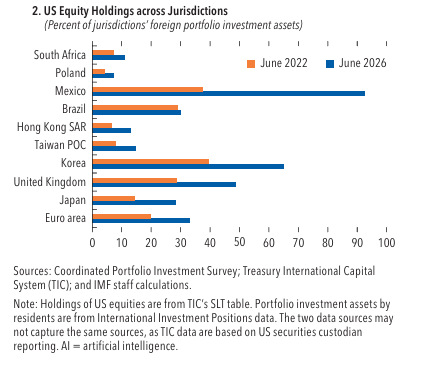
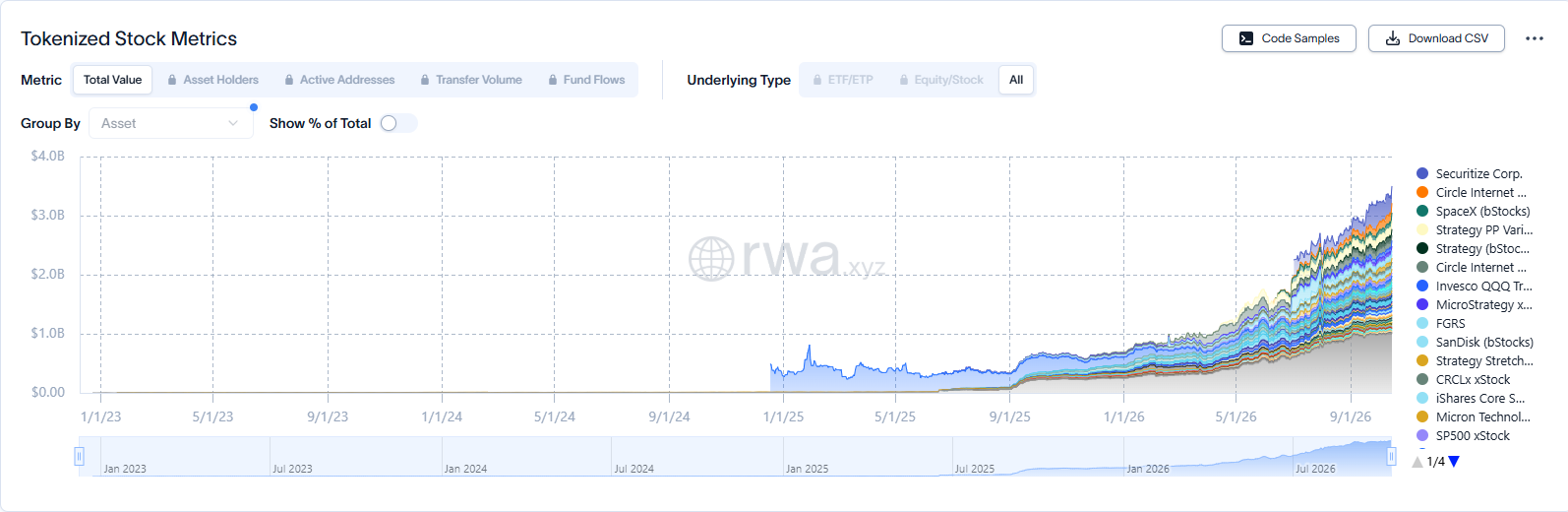
Meanwhile, the US Treasury reports that at the end of June 2025, foreign investors held nearly $20 trillion in US equities. Demand has been strong this year too, with net inflows of around $942 billion into US equities from foreign buyers in the year to end of June. Some of this ownership is already happening via tokenised stocks. The IMF report reveals that 70% of tokenised equity value could be attributed to just two platforms, Ondo Finance and Backed Finance, whose products are aimed at investors outside the US, while more than 50% of the trading activity happens outside US trading hours. Of course, at just around $3.5 billion, the tokenised stock market is still tiny in comparison to the traditional equity market itself, but it is growing rapidly, with assets up nearly five-fold this year, according to RWA.xyz.
The winners and losers
If the five-year exemption does kick off a ‘Hunger Games’-esque fight for tokenisation leadership, there will be both winners and losers. Haczynski says investors and issuers are the clearest winners. The former get access to tokenized shares with real ownership, while the latter can control who launches tokenized versions of their stocks. We’re already seeing this control being exercised in practice with the nine companies blocking their shares from being tokenised on OKXICE. The infrastructure providers that spent the last few years building tokenisation platforms in line with institutional standards, such as Ondo Finance, are also among the winners, according to Haczynski. But early pushback from companies concerns these players. If more dissent emerges, it could become the biggest bottleneck. Haczynski also points to business models built on regulatory arbitrage among the losers. “Offshore platforms selling wrapped or synthetic versions of US stocks now face a regulated onshore alternative,” he says.
If tokenised share trading does take off, we could also see crypto venues like Coinbase or Robinhood take trading activity away from traditional brokerages like Schwab. But simply being permitted to and able to tokenise a share isn’t the same as attracting and retaining investors. Igor Samotesov, founder of tokenised asset verification firm SPEC Intelligence, says the winners “will be venues and liquidity providers that already have customers, capital and the ability to meet the SEC's conditions”. On the flip side, the likely losers are “tokenisation platforms with technology but no order flow”. He says the key for firms building trading venues is to give investors “a reason to use them repeatedly: access to the assets they want, competitive prices, clear rights and reliable service”. As such, he expects to see partnerships between larger firms with significant customer bases and smaller players supplying the technology.
The five-year ticking clock
With the SEC’s innovation exemption, the US has upped the stakes on the race for tokenisation leadership. But for now, even this is just a regulatory pilot. The main challenge now is to move towards “frameworks that make it economically attractive to build businesses around it”, says Edwin Mata, CEO and co-founder of RWA tokenisation platform Brickken. He says: “Regulators need to give firms a clearer path from experimentation into permanent operation, reduce uncertainty around how tokenised securities interact with existing market infrastructure, and make cross-border activity easier, because institutions will ultimately build where they can see a credible route from their first issuance to a market operating at scale.”
Mata’s firm is based in Spain, so he has a front-row seat to regional developments. He says one challenge for Europe is that interoperability across the bloc remains difficult. “Tokenised securities remain financial instruments under the existing securities framework rather than MiCA, while the DLT Pilot creates exemptions for specific market infrastructures, so a company still has to think about issuance, licensing, custody, distribution, settlement and the rules of the individual markets in which it operates,” he says.
In the UK, meanwhile, the Digital Securities Sandbox is designed around live activity rather than a purely theoretical test environment. But while the UK has the key ingredients – a deep capital market, a sophisticated financial sector and a regulator clued up on the potential of distributed ledger technology (DLT) – Mata says “the question now is how quickly firms can move through the sandbox, prove the model and graduate into a permanent framework without losing momentum”.
That momentum matters more now that the US is in the picture. But the real test will come as these markets scale, Samotsev says, pointing to trading volume and investor access as key metrics to watch. The US is well positioned to deliver on both fronts, given the depth of its equity market and global investor demand. But investor demand and trading volumes won’t be enough if companies don’t want their shares on-chain. The early pushback against OKXICE’s plans could be an early warning sign. If others follow suit, that would undermine the benefits of America’s deep equity market. US firms have just five years to prove that tokenised equity trading can work at scale. The deciding factor may not be the technology or the regulatory support, but whether corporate America is willing to play along.


