

Welcome to another weekly letter (#34 for the week beginning Monday, October 19th, 2026) from TheIntersection team.
In this issue:
- News: DTCC Outlines $30 Trillion Tokenisation Architecture Ahead of Month-End Debut
- Data: RWA Market Crosses $39 Billion but stablecoin growth stalls
- Analysis: Let The Tokenisation Games Begin
- Opinion: Tokenization Could Open the Door to Generational Wealth
- Our weekly events round-up
Before we dive in, one request: please forward this weekly letter to anyone you think might be interested. We also very much welcome feedback (and contributors). If you want to email us, just drop an email to us at teams@theintersection.news

News in Brief
EBA Designates USDC as the EU’s First "Significant" E-Money Token: On October 14, the European Banking Authority officially classified USDC as a significant e-money token under the Markets in Crypto-Assets (MiCA) framework. Beginning November 12, the EBA will take over prudential oversight of Circle’s reserves, liquidity stress testing, and capital requirements from France's ACPR. USDC is the first of 45 notified MiCA e-money tokens to receive the designation, subjecting it to systemic EU-wide supervisory standards. TradingView and KuCoin Research Portal.
Mastercard Debuts "Stablecoin Security" at Money20/20 USA: Mastercard announced the launch of its Stablecoin Security platform in Las Vegas. Rather than issuing a competing token, Mastercard’s tool gives banks and payment processors pre-settlement threat intelligence. Cryptopolitan.
Franklin Templeton's high-yield bond ETF went on-chain as a yield-trading instrument (Oct 13). Ondo's tokenized version of the Franklin High Yield Corporate ETF (FLHYon) got a Pendle market with a December 10, 2026 maturity, letting users trade principal and coupons separately; the token had $497K on-chain and was already accepted as collateral on Morpho. CryptoBriefing
OKX moved into yield-bearing stablecoin products for emerging markets, launching "OKX Money" letting retail users in Latin America, Africa, South Asia and the Middle East hold and spend dollar stablecoins, with qualifying USDG balances earning up to 10%. TheBlockChainMonitor
Morgan Stanley is quietly building a Digital Asset Lab which might be testing tokenized deposits, MMFs and DeFi vaults CryptoNews
Issuer pushback: nine companies object to tokenised trading of their shares on OKXICE. Nine companies, including CoreWeave, Broadcom and Verizon, have objected to tokenised trading of their shares on OKX-ICE, the planned ICE–OKX tokenised securities venue. Securitize President Brett Redfearn argued that issuers can object to one venue without rejecting tokenisation. AMC has separately criticized Robinhood's offshore stock tokens. TheBlock
Federated Hermes partners with Prometheum for first in-house tokenised fund, targeting Q1 2027. Federated Hermes ($911.6bn AUM at end-June 2026) said it will issue tokenised share classes directly, starting with money market funds, and distribute them through Prometheum's broker-dealer channels. The first product is slated for Q1 2027. Previously, the firm tokenized through third parties such as Archax and Goldman Sachs. CryptoNinjas
StoneX lifts Securitize share price target 50%: StoneX raised its price target on Securitize (SECZ) for its impending IPO, citing new revenue from the tokenised stock platform launched on 8 October. Investing.com.
What to Watch Out For Next Week
- The DTCC Tokenization Service go-live, expected by end-October. Watch for the list of 25 securities and the first participants.
- The GENIUS Act after the comment period: the OCC final rule, said to be due "in the very near term", and Treasury's review of comments on foreign-issuer comparability, which is the key issue for USDT. The effective date is 18 January 2027.
- More issuer objections to OKX-ICE, any response from the SEC, and how far tokenised trading under the Innovation Exemption gets in practice.
Deep Dive:
DTCC Outlines $30 Trillion Tokenisation Architecture Ahead of Month-End Debut. The Depository Trust & Clearing Corporation detailed the launch architecture for its commercial tokenisation service rolling out in late October. Operating under a three-year SEC no-action letter, the infrastructure connects DTCC’s central ledger to the Canton Network and a private Hyperledger Besu environment.
It starts with 25 liquid instruments across US Treasuries, major index ETFs, and Russell 1000 equities, opening a pathway to tokenize an eventual $30 trillion in eligible custodial assets. The framework allows 24/7 wallet-to-wallet inter-firm transfers and processes corporate actions and distributions directly on-chain while retaining traditional book-entry protections. DTCC puts the eligible pool at about $30trn, roughly a quarter of the $114trn+ held at DTC. Treasury distributions are still paid in fiat at launch. The 25-instrument start and lack of cross-chain transfers at launch mean little immediate volume, though.
Source: BigGo Finance DTCC Tokenization Report.

RWA Market Crosses $39 Billion: Industry data show that the total value of tokenised real-world assets (excluding stablecoins) reached $39.2 billion, an 8on year-to-d expansionate. However, reports analysing the sector alongside the IMF's October 2026 Global Financial Stability Report highlighted a widening liquidity divide: while tokenised equity holders rose to 4.3 million across blockchains, over 50% of institutional RWA products with market caps over $10 million demonstrate negligible secondary market trading. Highly regulated, permissioned products like BlackRock's BUIDL turn over just 0.12 times monthly compared to 21 times for liquid fiat stablecoins. Read the full market metrics on BigGo Finance and the liquidity breakdown in Finance Magnates.
Morgan Stanley called for a $3T - $10T tokenised RWA market by 2030 while delaying its own tokenised equities ATS to Q1 2027. Amy Oldenburg, head of digital asset strategy, made the forecast at TOKEN2049. The claim is above the bank's published $2.3T base case; she attributed the delay in Morgan Stanley's own venue to limited product supply and thin institutional demand. CryptoNews
Stablecoins are growing in use, not in supply. Supply was flat at about $302bn (USDT $183.5bn, USDC $72.6bn), while researchers at Allium counted $482bn of stablecoin payments in the first nine months of 2026, up 45%. Payment counts rose 71% to more than 1bn. Stablecoin-linked card spending hit $3.9bn, about 10x a year earlier, but Q2 card spend was only about 0.03% of Visa's $4trn volume. Supply grew just 0.4% year-to-date. CoinPaprika
Total stablecoin supply is about $20.1bn below the all-time peak of $322.4bn set on 17 May 2026, according to DefiLlama data. Standard Chartered says supply growth has stalled even as velocity and payment use rise. On-chain RWA value is growing at roughly 2% a month: the "represented" figure, about nine times larger, mostly sits on permissioned ledgers and is not freely transferable. Standard Chartered also pushed its $2trn stablecoin forecast back to 2030 as supply growth stalls. Geoff Kendrick, from the bank, says average monthly velocity has doubled to about 30x from 15x in 2025, and names OUSD, M^0 and the planned bank-shared "A+" network as challengers in developed-market payments. TheBlock.
Key Market Data
|
Metric |
Value |
Source / note |
|
Total stablecoin market cap |
$302.33bn (−0.50% 7d; +0.36% 30d) |
DefiLlama, 19 Oct — https://defillama.com/stablecoins |
|
USDT / USDC |
$183.46bn / $72.59bn; USDT dominance 60.68% |
DefiLlama, 19 Oct |
|
Stablecoins on Ethereum |
$144.3bn (DefiLlama, 18 Oct); $147.3bn (rwa.xyz) |
https://defillama.com/stablecoins/ethereum |
|
Distributed RWA value (excl. stablecoins) |
$39.29bn (+1.96% vs 30d ago) |
rwa.xyz networks dashboard — https://app.rwa.xyz/networks |
|
"Represented" RWA value (mostly permissioned
ledgers) |
$367.88bn (−1.97% vs 30d ago) |
rwa.xyz |
|
Tokenised stocks |
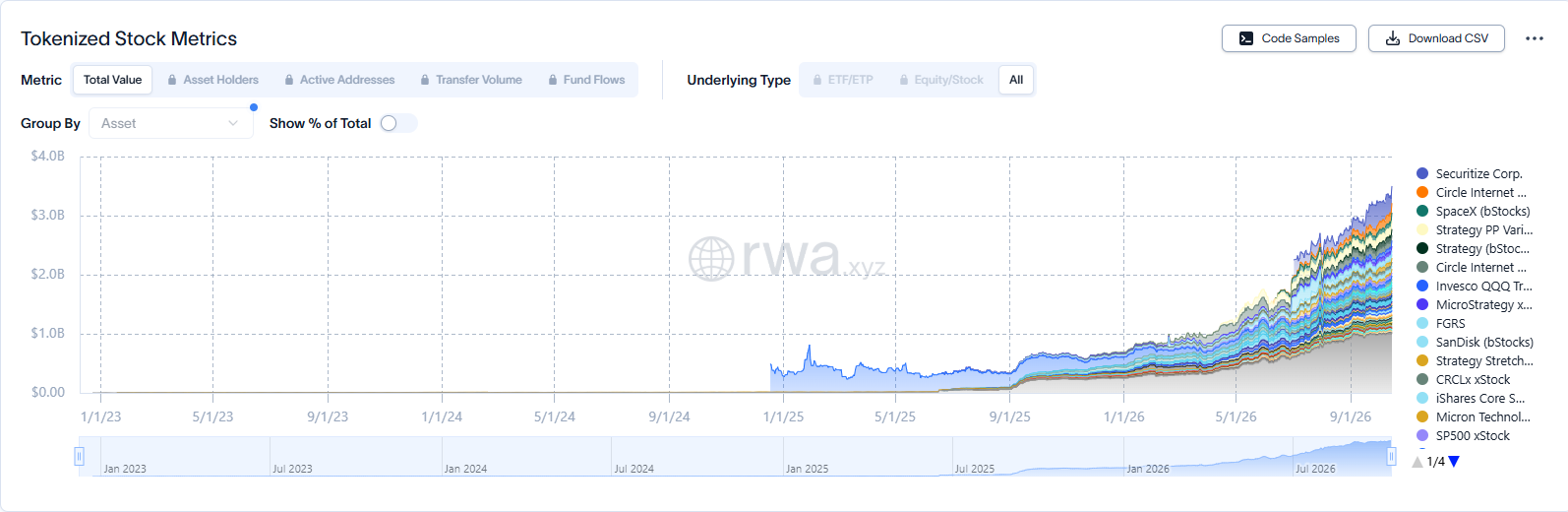
$3.42bn |
rwa.xyz, 19 Oct — https://app.rwa.xyz/stocks |
|
Total DeFi TVL |
$89.64bn |
DefiLlama, 19 Oct — https://defillama.com/ |

Let The Tokenisation Games Begin
By Anna Fedorova
Until very recently, the rest of the world had been ahead of the US in the tokenisation race. Then, on 17 September, the US Securities and Exchange Commission (SEC) changed the game in one fell swoop. For several years, it has felt like every region o financial systems. Europe has had the DLT Pilot Regime since 2023, while the UK opened the Digital Securities Sandbox in 2024. Dubai's financial regulator introduced a framework for tokenised securities as far back as 2021, and Singapore and Hong Kong have also run sandboxes and pilots.
But on 17 September, the US securities watchdog announced the long-awaited innovation exemption that could help it leapfrog all of its global competitors: a five-year relief from many of the rules that apply to exchanges like NYSE and Nasdaq for platforms that facilitate the trading of tokenised stocks.
This exemption creates a five-year regulatory sandbox for tokenised stocks, allowing US-based platforms to run on-chain trading venues without having to register as a national securities exchange. These must be tokenised versions of existing US-listed stocks or exchange-traded products, carrying the same shareholder rights as the underlying asset. The rights part is really important. Last summer, Robinhood took some serious heat when it launched several tokenised stocks on its platform, including OpenAI, a company that is yet to go public. OpenAI pushed back, saying the tokens had been launched without its consent and don’t carry the same rights as real shares.
Ryan Haczynski, head of protocol partnerships at staking platform GlobalStake, calls it “one of the most consequential things the SEC has done for on-chain markets”. The move cthe $75 trillion US stock market, the biggest and most liquid, to the rest of the world.
“So far, the problem was that there was no compliant venue in the US where those tokens could change hands on-chain, so most tokenised stock activity grew up offshore, out of reach of US investors and US oversight,” Haczynski explains. “By letting tokenised securities venues run permissioned liquidity pools on public blockchains, with tokens that carry the same rights as the underlying shares, the SEC is giving that activity a legitimate home onshore.”
Since the exemption was announced, crypto firms have rushed to launch tokenised equity offerings. This includes Perpetuals, which applied for the exemption, and Securitize, which has just launched a tokenised equity trading venue on Solana. Crypto exchange OKX and NYSE owner Intercontinental Exchange (ICE) filed with the SEC to launch a tokenised equity trading platform, OKXICE, with initial plans to tokenise some 63 US stocks, including Nvidia, Apple and Coca-Cola.
But the push has already been met with resistance. Several of these companies, including Broadcom, UnitedHealth and Verizon, have objected to their stocks being tokenised on the new platform. They cite a variety of reasons, including concerns over investor confusion, corporate governance and the impact on the underlying stock price.
American stocks for everyone
Despite these early concerns, many in the tokenised asset space believe this exemption puts America ahead of all other jurisdictions for one simple reason: its vast stock market. Haczynski says that “much of the global demand for tokenised stocks is already for US names, so allowing US venues and US investors to participate directly shifts the center of gravity toward the US”. He says: “As more of this activity happens in the US, it's going to act as a gravity sink and pull more capital into the space. Once tokenised stocks are trading [in the US] at scale, interest will follow and more money will flow toward US venues. Other markets will then have to follow suit.”
But American investors may not reap the benefits. After all, they already have access to US stocks and ETPs via local brokerages, and the 24/7 trading advantage will soon become marginal as the NYSE and other US exchanges start trading around the clock. Mitchell DiRaimondo, founder of real-estate tokenisation firm SteelWave Digital, told The Intersection: “If I'm sitting in California and I have a Charles Schwab account that I can go play on, there's not much advantage. But if I'm sitting in Kenya and I have access to get onto this exchange, I think it's a big thing.” The percentage of US equity holdings in foreign portfolios has “sharply increased” between 2022 and 2026, according to data from the IMF’s 2026 Global Financial Stability Report, which the agency attributes to the AI boom. Mexico, Korea and the UK have seen particularly marked increases.
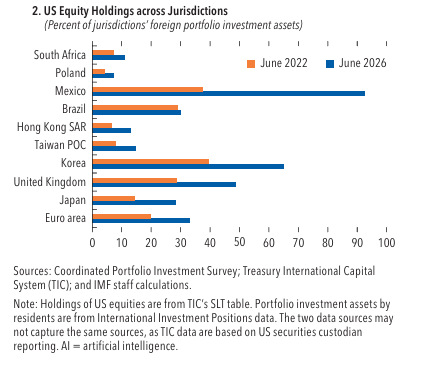
Meanwhile, the US Treasury reports that at the end of June 2025, foreign investors held nearly $20 trillion in US equities. Demand has been strong this year too, with net inflows of around $942 billion into US equities from foreign buyers in the year to end of June. Some of this ownership is already happening via tokenised stocks. The IMF report reveals that 70% of tokenised equity value could be attributed to just two platforms, Ondo Finance and Backed Finance, whose products are aimed at investors outside the US, while more than 50% of the trading activity happens outside US trading hours. Of course, at just around $3.5 billion, the tokenised stock market is still tiny in comparison to the traditional equity market itself, but it is growing rapidly, with assets up nearly five-fold this year, according to RWA.xyz.
The winners and losers
If the five-year exemption does kick off a ‘Hunger Games’-esque fight for tokenisation leadership, there will be both winners and losers. Haczynski says investors and issuers are the clearest winners. The former get access to tokenized shares with real ownership, while the latter can control who launches tokenized versions of their stocks. We’re already seeing this control being exercised in practice with the nine companies blocking their shares from being tokenised on OKXICE. The infrastructure providers that spent the last few years building tokenisation platforms in line with institutional standards, such as Ondo Finance, are also among the winners, according to Haczynski. But early pushback from companies concerns these players. If more dissent emerges, it could become the biggest bottleneck. Haczynski also points to business models built on regulatory arbitrage among the losers. “Offshore platforms selling wrapped or synthetic versions of US stocks now face a regulated onshore alternative,” he says.
If tokenised share trading does take off, we could also see crypto venues like Coinbase or Robinhood take trading activity away from traditional brokerages like Schwab. But simply being permitted to and able to tokenise a share isn’t the same as attracting and retaining investors. Igor Samotesov, founder of tokenised asset verification firm SPEC Intelligence, says the winners “will be venues and liquidity providers that already have customers, capital and the ability to meet the SEC's conditions”. On the flip side, the likely losers are “tokenisation platforms with technology but no order flow”. He says the key for firms building trading venues is to give investors “a reason to use them repeatedly: access to the assets they want, competitive prices, clear rights and reliable service”. As such, he expects to see partnerships between larger firms with significant customer bases and smaller players supplying the technology.
The five-year ticking clock
With the SEC’s innovation exemption, the US has upped the stakes on the race for tokenisation leadership. But for now, even this is just a regulatory pilot. The main challenge now is to move towards “frameworks that make it economically attractive to build businesses around it”, says Edwin Mata, CEO and co-founder of RWA tokenisation platform Brickken. He says: “Regulators need to give firms a clearer path from experimentation into permanent operation, reduce uncertainty around how tokenised securities interact with existing market infrastructure, and make cross-border activity easier, because institutions will ultimately build where they can see a credible route from their first issuance to a market operating at scale.”
Mata’s firm is based in Spain, so he has a front-row seat to regional developments. He says one challenge for Europe is that interoperability across the bloc remains difficult. “Tokenised securities remain financial instruments under the existing securities framework rather than MiCA, while the DLT Pilot creates exemptions for specific market infrastructures, so a company still has to think about issuance, licensing, custody, distribution, settlement and the rules of the individual markets in which it operates,” he says.
In the UK, meanwhile, the Digital Securities Sandbox is designed around live activity rather than a purely theoretical test environment. But while the UK has the key ingredients – a deep capital market, a sophisticated financial sector and a regulator clued up on the potential of distributed ledger technology (DLT) – Mata says “the question now is how quickly firms can move through the sandbox, prove the model and graduate into a permanent framework without losing momentum”.
That momentum matters more now that the US is in the picture. But the real test will come as these markets scale, Samotsev says, pointing to trading volume and investor access as key metrics to watch. The US is well positioned to deliver on both fronts, given the depth of its equity market and global investor demand. But investor demand and trading volumes won’t be enough if companies don’t want their shares on-chain. The early pushback against OKXICE’s plans could be an early warning sign. If others follow suit, that would undermine the benefits of America’s deep equity market. US firms have just five years to prove that tokenised equity trading can work at scale. The deciding factor may not be the technology or the regulatory support, but whether corporate America is willing to play along.

Tokenization Could Open the Door to Generational Wealth. Most families can't find the Door.
By Toby Nicole
For most of American history, the best investments have been behind a velvet rope: private credit, commercial real estate, and early-stage companies. If you wanted in, you needed to be what the SEC calls an accredited investor. For most people, that means a net worth over $1 million not counting your home, or income over $200,000 a year ($300,000 with a spouse) for two years running. Most of the families I talk to will never clear that bar. I spent 15 years in trucking and transportation, and I am a licensed insurance adjuster. Nobody in those rooms was getting invited into a private credit deal. Tokenization is starting to change who gets through the door and that is the good news. The bad news is that the people who need it most are the least prepared to use it.
The rope is getting lower
Look at two tokenized money market funds that both hold short term U.S. government debt. BlackRock's BUIDL fund requires a $5 million minimum and is limited to qualified purchasers. Franklin Templeton's OnChain U.S. Government Money Fund, the one behind the BENJI token, lets most accounts start with $20 through its app. Same asset class, same basic technology, but two very different doors.
That gap is the whole argument for tokenization as a wealth building tool. When ownership is recorded on a blockchain, an asset can be split into small pieces and settled without the layers of paperwork that used to make small investors not worth the trouble. The market is also growing fast. RWA.xyz tracks nearly $39 billion in tokenized real world assets on public blockchains, up from around $6 billion at the start of 2025. Now put that next to the biggest money event of our lifetime. Cerulli Associates projects $124 trillion will change hands in the U.S. through 2048. More than half of that, about $62 trillion, is expected to come from high net worth households that make up only 2% of all households. That meanslargebig share of the largest wealth transfer in histostays withinide families that already have money. Many other families have no inheritance coming at all, so they will have to start from zero with whatever they can save. Low minimums and fractional ownership let them begin investing with $20 or $50 instead of waiting until they have thousands.
Access without understanding is a trap
Here is where I get worried.
The 2026 TIAA Institute and GFLEC Personal Finance Index found that U.S. adults answered only 47% of basic personal finance questions correctly. That is the lowest score in the ten years they have run the survey. On questions about understanding risk, the number dropped to 36%. Gen Z, the generation that will live with tokenized markets the longest, averaged 38%. Meanwhile, the scammers are already running amok. The FBI's 2025 Internet Crime Report logged more than $11.3 billion in cryptocurrency-related losses. That was over half of all internet crime losses reported to the Bureau last year and crypto investment fraud alone accounted for about $7.2 billion.
Now, put those numbers side by side. People who struggle with basic risk questions are being handed 24/7 markets with a buy button on their phone and some of the voices explaining those markets to them are the same people trying to rob them. I see it all the time in social media comments.
Scams are only part of the problem, because even well-built products can confuse people. In his July piece for The Intersection, “Tokenized Stocks Are Up 422%. Most of Them Aren't Stocks,” Gabor Gurbacs explained that much of the recent growth in tokenized stocks comes from synthetic tokens. These follow a company's price without giving the holder ownership in the company itself. An experienced investor might catch that difference, but a 24-year-old starting a portfolio with $50 probably will not.
Education has to ship with the product
I do not think the answer is to slow tokenization down. Keeping the rope high protects nobody because it just keeps the same families on the outside. The answer is to treat education as part of the infrastructure. The industry spends a lot of time on custody, settlement and regulation. It spends very little on whether a first time investor knows what they actually own.
Every tokenized product marketed to everyday people should explain in plain language whether the holder owns the asset or only tracks its price. Platforms that open low-minimum doors should also teach what a money market fund is, what redemption means, and how to spot a fake support account in your DMs and comments. Community educators, churches, credit unions and creators who already have the trust of these families need to be part of the conversation instead of an afterthought. The message to families has to be simple. Ownership is the goal and understanding comes before buying. If someone is rushing you, walk away.
What generational wealth actually requires
Generational wealth is not a lottery ticket. It is an asset someone understood well enough to hold through the hard years and pass down with instructions. Tokenization can put real assets within reach of families who were never invited to own them. I believe that and I have built my work around it. Still, opening a door to people who cannot see the risk on the other side does them no favors.
In his 2026 letter to investors, BlackRock CEO Larry Fink wrote that most wealth has flowed to people who already own assets and that tokenization could open the door to more investors. A lot of people read that as an invitation, but in my opinion it was not one. It was a business case from a firm with nearly $150 billion tied to digital assets and BlackRock's own tokenized Treasury fund still requires $5 million to get in. The real invitation for everyday families has to come through education. The doors are opening. Our job is to make sure people walk through them with their eyes open.
Toby Nicole is a financial educator, author, and founder of I Am My Own Asset®. She teaches everyday families about crypto, tokenization and generational wealth. Her free ebooks, The Million Dollar Mistake and Step Out On Faith, are available at tobynicole.com. Learn more at iammyownasset.com.
This article is for educational purposes only and is not financial advice.
Events on our radar
|
Start |
End |
Event |
City |
Country |
RWA
/ stablecoin angle |
Tickets
/ registration |
|
18 Oct 2026 |
21 Oct 2026 |
Money20/20 USA |
Las Vegas |
US |
Tokenisation and stablecoins are one of the content
pillars |
|
|
2 Nov 2026 |
6 Nov 2026 |
Hong Kong FinTech Week
(main conference 2-3 Nov) |
Hong Kong |
Hong Kong |
Digital Assets & Web3 Forum: regulated stablecoins,
RWA tokenisation |
|
|
13 Nov 2026 |
13 Nov 2026 |
Digital Assets Forum New
York |
New York |
US |
Institutional-only: tokenisation, stablecoins, regulation |
|
|
18 Nov 2026 |
20 Nov 2026 |
Singapore FinTech
Festival |
Singapore |
Singapore |
MAS-run; tokenisation and digital currencies on agenda |
|
|
7 Dec 2026 |
10 Dec 2026 |
Abu Dhabi Finance Week |
Abu Dhabi |
UAE |
Tokenisation and digital financial assets; 70+ sub-events |
|
|
19 Jan 2027 |
22 Jan 2027 |
Stablecoins for Banks
(virtual) |
Online |
US |
Banking Exchange stablecoin series for banks |
https://m.bankingexchange.com/joomla-pages-iii/categories-list/223-channel-page |
|
1 Feb 2027 |
2 Feb 2027 |
Digital Assets Forum
London |
London |
UK |
Institutional digital assets, 1,500+ expected |
https://www.tickettailor.com/events/europeanblockchainconvention/2031272 |
|
1 Feb 2027 |
3 Feb 2027 |
Consensus Hong Kong |
Hong Kong |
Hong Kong |
CoinDesk flagship for Asia; tokenised assets, stablecoins |
|
|
3 Feb 2027 |
3 Feb 2027 |
RWA Summit Hong Kong
(Hong Kong RWA Week 1-3 Feb) |
Hong Kong |
Hong Kong |
Pure RWA tokenisation summit (UVECON.VC) |
|
|
19 Apr 2027 |
21 Apr 2027 |
Hong Kong Web3 Festival |
Hong Kong |
Hong Kong |
RWA, tokenisation and stablecoin payments named as themes |
|
|
21 Apr 2027 |
22 Apr 2027 |
TOKEN2049 Dubai |
Dubai |
UAE |
Large crypto event; stablecoins and RWA on agenda.
Postponed from Apr 2026. |
|
|
7 May 2027 |
8 May 2027 |
Stablecoin Super
Conference |
Miami |
US |
Banking Exchange stablecoin conference |
https://m.bankingexchange.com/joomla-pages-iii/categories-list/223-channel-page |


