

Welcome to another weekly letter (#33 for the week beginning Monday, October 12th, 2026) from TheIntersection team.
In this issue:
- News: Regional Banks are issuing on public chains
- Data: Coinshares says affluent investors are still committed to crypto but want more advice
- Analysis: Tokens - a nightmare for fiduciaries?
- Opinion: The Vault Opportunity: Why the Next Big Asset Class Won't Arrive With a Ticker
- Our weekly events round-up
Before we dive in, one request: please forward this weekly letter to anyone you think might be interested. We also very much welcome feedback (and contributors). If you want to email us, just drop an email to us at teams@theintersection.news

News in Brief
Securitize launches tokenised US stocks. Securitize Stocks has put 12 US equities on Solana as security entitlements backed one-for-one by the underlying shares. Trading runs through its registered broker-dealer and settles in USDC. Holders are not registered shareholders until they convert, and conversion is only possible once a company adopts issuer-sponsored tokenisation.
- Decrypt: Securitize launches tokenised stocks on Solana
- Crypto Briefing: broker-dealer and USDC settlement detail
- Solana Compass: UCC Article 8 and “not registered shareholders unless they convert”
Tokenized Stocks Surge: A joint report by RedStone and Alea Research revealed that the market for tokenized equities expanded significantly, climbing 395% year-over-year to hit $3.2 billion across 4.2 million unique holders. Structured note and entitlement platforms (such as Ondo Finance, xStocks, and Robinhood) now account for approximately 70% of that total value.
- Alea Research: “Prices fell, tokens multiplied”
- CoinMarketCap summary of The Defiant’s coverage (395%, $3.2bn, 4.2m holders)
Euro stablecoins. Schuman Financial, eToro, SwissBorg, DFNS and seven others launched the Eurøpe Consortium on 5 October to scale EURØP, a MiCA euro stablecoin.
Tether pushes deeper into RWAs. Tether is extending its Hadron tokenization platform into Saudi Arabia, starting with institutional real estate (with plans for energy and infrastructure), timed with the Kingdom's Vision 2030 and its REGA tokenization sandbox.
Deep Dive: Banks are issuing on public chains.
U.S. Bank (5th-largest U.S. commercial bank) completed a live cross-border pilot using its proprietary USBDC stablecoin on public Stellar, and the 37-bank Qivalis consortium (ING, BNP Paribas, BBVA, etc.) confirmed its MiCA-compliant euro stablecoin will issue on public Ethereum — a marked shift from permissioned-ledger pilots.
Also, ninety North Dakota banks went live on Solana. Fiserv's digital asset platform went live on 1 October with Roughrider Coin as its first production use case, and more than 90 North Dakota banks and credit unions are taking part. Roughrider is a permissioned token on public Solana, issued by VersaBank USA, with each token backed one-to-one by US dollars. Tokens are minted only after confirmed transfers from institutional operating accounts. The Bank of North Dakota provides governance oversight.

Affluent investors are still committed despite the sell-off, want more regulation & demand more from their wealth managers, says Coinshares
CoinShares released its Affluent Investor Crypto Report last week, surveying 2,230 high-net-worth individuals with at least $500,000 in investable assets across seven markets, including 305 in the UK. Fieldwork ran from 11 May to 5 June 2026, with the sample split evenly between a $1 million-plus band and a $500,000-$999,999 band. The report's central claim is that wealthy crypto investors are long-term, macro-minded and eager for professional guidance, rather than speculative. The report suggests that "Digital asset investment is now a majority behaviour2 while the foreword warns that "most of their clients' digital asset holdings sit completely out of view" of advisers, whose firms tend to be conservative. On platform choice, the report says "HNWIs are shopping for the most trustworthy crypto platform", with brand recognition ranked first in every market and low fees fifth on average. On policy, it describes the US as "a sort of lighthouse for finance”. Key UK findings from the Coinshares report include:
Crypto is mainstream among the UK's wealthy. 70% of UK HNWIs hold digital assets, and 35% rank crypto as their best long-term bet, ahead of real estate (25%) and equities (21%). 85% see Bitcoin as a reliable long-term store of value. Despite February's sell-off, 91% of holders plan to buy more this year.
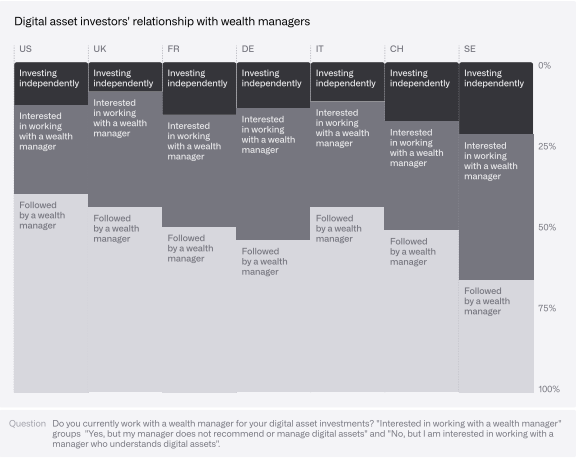
Clients want crypto advice, but aren't getting it. 80% would work with a crypto-savvy wealth manager, the highest of any market. Yet the UK is the only market where market trends (33%) outrank wealth managers (27%) as the main influence on decisions, and a third say their adviser is too cautious.
Not speculators. Just 11% see themselves as short-term traders. Most are believers (31%) or diversifiers (25%). By contrast, 52% of European wealth managers cite speculation as a barrier to client investment.
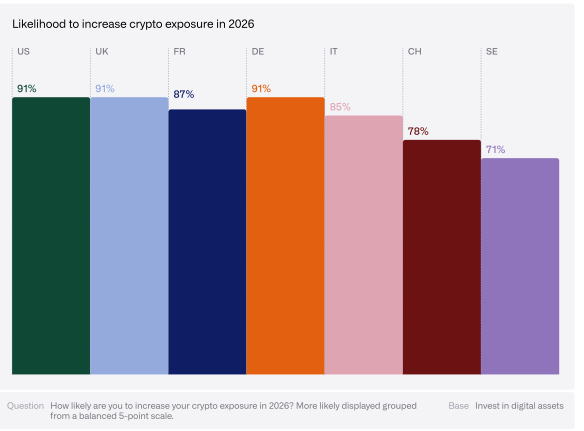
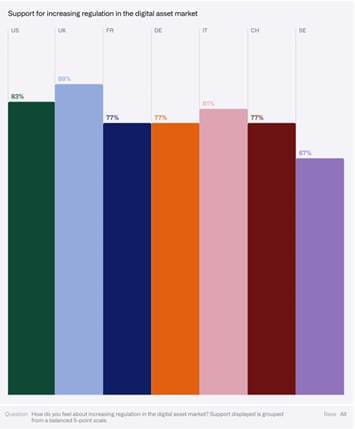
They want more regulation, not less. 88% back tighter crypto regulation, the highest of any market. 71% are more likely to invest since the FCA opened Bitcoin and Ethereum ETPs to retail investors, a timely finding with the FCA's authorisation window opening on 30 September. Policy cuts both ways, though: 28% are less likely to invest after HMRC barred crypto from stocks-and-shares ISAs.
Trump is a draw, even in the UK. 65% of UK HNWIs say Trump's personal endorsement of crypto makes them more likely to invest. The US Administration's stance carries more weight still, at 75%.
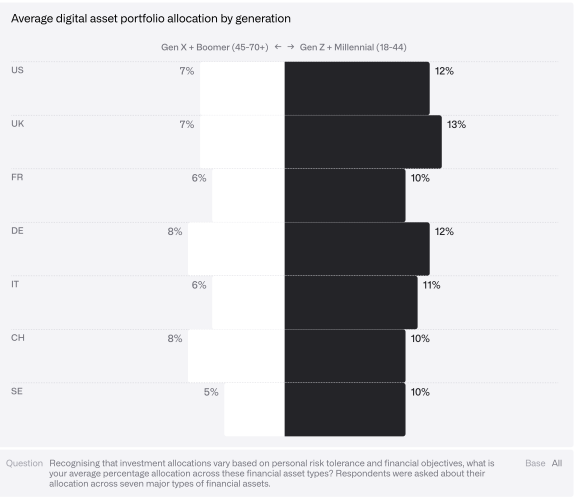
The next generation is doubling down. Under-45s hold nearly twice the crypto allocation of over-45s (13% vs 7%) and are twice as willing to pay premium fees for crypto expertise (39% vs 20%).

Tokens: a nightmare for fiduciaries?
by Damien Black
Fiduciaries have their work cut out for them now that stablecoins and tokens are moving into the mainstream of finance. Heightened due diligence, added compliance, and new regulations are core challenges for those tasked with looking after other people’s money in the tokenization age.
Because fiduciaries – corporate bank boards, investment advisers, trustees and the like – must transparently disclose all conflicts of interest to their clients, they have greater responsibility than regular brokers or dealers. This arguably makes the brave new world of tokenization look rather nightmarish for them – risks, if taken at all, must be thoroughly analyzed first, and stablecoins and tokens present, well, a brave new world of risk.
At least some guidance exists in the form of the GENIUS Act, which “marks a watershed moment for the US financial sector, particularly in the regulation and adoption of stablecoins,” according to Certuity. The wealth management firm added: “For Registered Investment Advisers (RIAs) and fiduciaries, the legislation establishes new compliance requirements, opens innovative portfolio possibilities, and brings both opportunity and greater scrutiny to digital asset adoption within fiduciary frameworks.”
This includes ensuring stablecoins are backed one-for-one by dollars or US Treasuries and that regulated entities, such as federal banks or non-bank issuers approved by the GENIUS Act, issue digital currencies. Like anyone else, fiduciaries can benefit from 24/7 settlements and reduced costs through things like the automated smart contracts that stablecoins enable, as well as purchasing fractionalized shares in tokenized commodities on behalf of their clients – presumably the opportunity Certuity is talking about.
Stablecoins vs tokens
The problem is that this opportunity comes with heavy caveats for fiduciaries, who must strictly abide by regulation. Marcel Thiess, CEO of Thiess Invest, works in global markets and regulation, and he thinks stablecoins and tokens differ in the challenges they pose for fiduciaries.
Thiess says the GENIUS Act should make their job easier a propos of stablecoins because it put reserve and licensing obligations on non-bank issuers from July 2025, with MiCA doing something similar in Europe by authorizing issuers like Circle and “pushing the rest off regulated venues”.
“Stablecoins are mostly a counterparty question,” according to Thiess. “Say you are a trustee and part of the portfolio sits in USDC. Your job there has very little to do with blockchain. It is who issued this, are the reserves actually where they say they are, and can I redeem at par on a bad Tuesday? That is credit analysis, and fiduciaries have been doing that work for a hundred years.”
But when it comes to tokenization, the game is a bit trickier: “If you hold a token representing a fractional interest in a building or a corporate bond, you have to establish whether that token actually gives you a claim on the asset when the issuer goes bankrupt. That means reading the off-chain contract and checking whether the ledger entry maps onto it properly. Most trustees have never had to do that, and there is not much case law to lean on yet.”
For bank boards, the real issue is funding rather than compliance, Thiess adds, because the Bank for International Settlements has shown that when corporate clients move deposits into stablecoins, the money exits a commercial bank’s reserve base much faster than a normal deposit outflow. This means boards are now having to model intraday flows they never had to before.
For registered investment advisers (RIAs), the watershed occurred in March this year, when the US Department of Labor proposed letting fiduciaries incorporate digital assets into 401(k) tax-deferred retirement plans. “That opens the door and increases the diligence burden at the same time,” said Thiess. “RIAs also cannot self-custody, so they lean on sub-custodians like Fidelity Digital Assets or BitGo, and auditing those becomes part of the annual routine.”
Despite that, Thiess thinks the problem is manageable for fiduciaries. He also has one nugget of advice: tokenized deposits probably represent the best of a bad bunch in terms of the operational difficulties stablecoins and tokenization create, so they should lean into them.
“Tokenized deposits are the easy case, which is why banks keep pushing them,” he said. “A tokenized deposit is still a bank liability, just moving over different rails, so it sits inside the legal and insurance frameworks that already exist. If a fiduciary wants exposure without rebuilding their whole risk framework, that is the path of least resistance.”
GENIUS isn’t fail-safe
It’s worth noting that the GENIUS Act is by no means a get-out-of-jail-free card. Certuity notes that “new insurance, reserve, and audit provisions reduce, but do not eliminate, custodial and default risk”. It added: “Advisers must now formally consider whether, and how, stablecoins fit within a prudent investment strategy for clients, including documentation of risks and compliance factors.”
If you’re thinking this adds up to a headache for fiduciaries, you’re probably not wrong. Times are a’ changing, and nobody likes change for a reason. But like it or not, tokenization has entered the mainstream and it needs to be regulated. That means it’s going to be part of the professional landscape for fiduciaries – on both sides of the pond. Writing in the Intersection in June, Allan Lane said: “Fund tokenization has been five years away for about a decade. Then, on 30 April 2026, it quietly stopped being a future technology and became a regulated one.” The date refers to a Financial Conduct Authority (FCA) tokens policy statement, which “took effect with immediate force, formally bringing tokenized funds inside the UK’s existing regulatory perimeter”.
FTI Consulting agrees that stablecoins bring a new layer of complexity to the duty of care owed by those ultimately responsible for other people’s money. “Unlike conventional bank products, stablecoins sit at the intersection of banking regulation, payments infrastructure, digital assets and distributed ledger technology,” said the financial consultant-cum-troubleshooter. “Their hybrid nature raises important questions regarding capital treatment, liquidity management, consumer protection, financial crime risk and operational resilience.”
Bank boards must scrutinise stablecoins closely, and directors need to stay on top of the legal, financial and operational challenges they present. FTI stresses that stablecoins cannot be regarded as a newfangled tech fad: getting involved is “a strategic decision that may affect the institution’s balance sheet, regulatory posture, product offering and risk profile”.
Uneven regulation
Advisers4Advisers runs educational masterclasses and podcasts aimed at finance professionals. In February, it spoke to former SEC employee Tyler Gellasch, who worked on the Dodd-Frank Act in the aftermath of the 2007-2008 financial crisis, aimed at redressing the damage caused by regulations that failed to keep up with systemic risk. Paraphrasing Gellasch afterwards, Advisers4Advisers said: “Some crypto market developments are not about technology and more about operating outside existing securities frameworks.” This distinction matters for fiduciaries: “If a product resembles a traditional security but claims a different regulatory status, advisers must consider whether equivalent investor protections are applicable.”
“Tokenized securities, stablecoins, and parallel derivatives markets often pose questions about jurisdiction and whether their regulation is on par with securities regulations,” added Advisers4Advisers. “You [sic] clients may want regulatory parity and have no idea crypto investing is not on par. When advisers recommend exposure to products operating outside traditional oversight, they assume heightened responsibility for due diligence and disclosure.”
This lies at the heart of Gellasch’s thesis on tokenization and what it portends for fiduciaries: when regulation weakens, fiduciary obligation is not permitted to recede along with it. In other words, the goal posts might have just moved, but bank boards and their ilk still have to go on playing the same game they always have. A cautious one. “If anything, the burden on the adviser increases,” added Advisers4Advisers. “Which could eventually translate into higher liability insurance premiums for professionals and IARs [investment adviser representatives].”
Communication is key
A core part of the challenge for fiduciaries will be explaining, in plain English, the nuances that tokenization and stablecoins bring to the financial landscape. “Clients rarely understand regulatory nuances. Advisers must bridge that gap […] and disclosure should not rely on technical jargon. They must evaluate whether recommending exposure aligns with a client’s sophistication and risk tolerance,” added Advisers4Advisers. “Crypto risk for fiduciaries includes assessing whether clients understand that a product may trade under materially different rules than traditional securities.”
DeFi firms want a regulatory structure that differs from the traditional securities market clients know and trust and fiduciaries cannot afford to ignore these structural differences. To do so risks “failing in disclosure and suitability analysis”. On the other hand, advisers and trustees who get on top of them will in effect “strengthen their fiduciary judgement”. Advisers4Advisers concluded: “As digital assets evolve, fiduciaries must evolve as well. The professionals who learn the lessons [...] will be better prepared to serve clients ethically, defensibly, and transparently in 2026 and beyond.”

The Vault Opportunity: Why the Next Big Asset Class Won't Arrive With a Ticker
By Vanessa Grellet, Managing Partner at Arche Capital
The most important development in asset management this year will not show up in any fund filing, and most of the industry has not heard of it. It is called a vault, it lives on blockchains, and it is doing what finance has promised for a decade: turning crypto from an asset you speculate on into a market you allocate to. Money is already moving, institutions are already arriving, and the next two years will decide who writes the rules.
What a vault actually is
A vault is an automated money market on a blockchain. Investors deposit assets, usually dollar-pegged stablecoins; a computer program pools the deposits; and the program lends or deploys the pool according to a written strategy that decides where the money goes, what counts as acceptable collateral, how much can be borrowed against it, and how returns are distributed. The program runs continuously, 24 hours a day, and it enforces its own rules.
The concept is not new. Yield aggregators have been automating the same deposit-pool-deploy-compound-redemption loop for years. What is new is the scale, the institutional plumbing being built around it, and the migration from a retail yield-chasing tool into something that looks like a managed fund. The closest traditional analogue is a managed fixed-income fund: the pool, the strategy, the manager, the distributions all exist on both sides. The differences are what matter. There is no custodian holding the assets and no fund administrator computing the NAV; the program does both jobs. There is no quarterly statement and no cutoff date; anyone can check the pool's holdings and price at any moment. And the "manager" is a team called a curator, whose authority comes from a set of cryptographic keys rather than a prospectus.
The curator is the single largest variable in a vault's outcome. A good curator rebalances before a market turns and cuts exposure when collateral quality deteriorates. A bad curator, or no curator, is where the money goes. Deposits sit in the program itself, not with the curator, and the curator's changes are logged publicly and auditable. That separation is real, and it is one reason the category has grown. But it also means the diligence question that matters most is the oldest one in money management: who runs this, and what do they have to lose?
The money is already moving
The growth numbers are not a prediction; they are a measurement. S&P Global counted roughly $10 billion in vault deposits as of September 2026, against $1.5 billion two years earlier. The most complete independent survey of the curated vault market, published in August by vaults.fyi, counted $11.29 billion spread across 856 vaults, 131 curators and 18 protocols. Note what happened underneath the growth: overall crypto lending activity contracted significantly over the same window while curated vaults expanded. That is not speculative froth chasing a headline rate. That is allocator behavior, capital rotating from structureless lending into vehicles with named managers, written parameters and a redemption mechanism.
The protocols themselves are now distinct enough to compare. Morpho, the largest, carries roughly $5.2 billion of the surveyed total and runs a minimal-trust model: every lending market is a single isolated loan-collateral pair with fixed parameters, and the risk management layer sits in the curated MetaMorpho vaults on top. Aave, the oldest and most established lending protocol, activated its V4 architecture in 2026 with an institutional layer called Horizon that allows regulated tokenized assets to serve as collateral. Spark, built by Sky on an Aave V3 fork, offers a simpler, more conservative single-protocol approach. The point is not which one wins. The point is that the category has matured enough to have distinct products with different risk profiles, which is what an investable market looks like.
The institutions are arriving
For anyone who has watched crypto's institutional overtures come and go, the difference this time is that the participants are not buying exposure. They are building infrastructure around the structure itself. Morgan Stanley is the clearest signal. In September, Bloomberg reported that the bank stood up a Digital Asset Lab, a ring-fenced environment testing stablecoins, tokenized deposits, tokenized money-market funds, central bank digital currencies and DeFi vaults without exposing its core banking systems. Scale is what separates this from the dozens of bank pilots before it: Morgan Stanley oversees roughly $9.3 trillion in client assets and more than 15,000 financial advisers, so anything that clears the lab has large internal distribution channels waiting for it. Its wealth division has already moved, arranging with Galaxy Digital to let eligible clients lend bitcoin, ether or Solana and potentially receive spot crypto ETP shares in return, with Galaxy cutting its $25 million minimum to $5 million for referred clients.
The institutional plumbing layer is deeper than most people realize. Fireblocks, which serves thousands of institutional clients, launched an Earn product in 2025 that lets enterprise customers generate yield on stablecoin balances through Morpho and Aave vaults directly from its platform. Coinbase and Binance both use Morpho's infrastructure for their lending services. IPOR, a specialist institutional access provider, builds regulated vaults that give traditional financial entities compliant entry points to Aave and Morpho liquidity. In a report on DeFi lending's modularization, Tiger Research noted that the institutional access layer has moved from "whether" to "how," with regulated partners building compliance wrappers around the raw protocol rails.
S&P Global Ratings launched its Vault Risk Assessment on October 4: a letter-based scale for lending vaults, graded across six risk factors — portfolio credit quality, liquidity mismatch, curator risk, blockchain risk, protocol risk, and vault security and governance. Note which factor sits third on the list. The largest rating agency in the world is formally saying that the biggest variable in a vault is the quality of the judgment of the people who picked the strategy. That is a fund-manager question, not a crypto question, and it is the moment the industry stopped pretending otherwise. The Depository Trust Company is the clearinghouse leg. In July, more than 30 firms used tokens created from assets held at DTCC in live production trades, and DTCC plans to open its tokenization service more broadly this month. Tokenizing a single security is settled technology; the question is whether tokenized cash, securities and collateral can work at institutional volume, and the vault is where that work gets tested.
Even the asset managers are showing up in the data. The vaults.fyi survey found institutions such as Bitwise, Apollo and JPMorgan Chase now engaging with the vault market. Banks do not stand up labs, rating agencies do not build risk frameworks, clearinghouses do not open tokenization services, and custody platforms do not launch yield products for hobbies.
The objection, and why it cuts the other way
The obvious pushback is the hacks, and it deserves to be stated plainly. In July, an attacker extracted about $6 million from two USDC vaults in a single transaction by manipulating the vaults' net asset value, donating over-valued tokens from a paused market into the share-price calculation. On October 4, the very day S&P announced its rating scale, a vault on the Base network lost about $6 million in wstETH after a freshly deployed contract was whitelisted and allowed to take the vault's Aave position.
The broader loss data, from Immunefi's six-year Ecosystem Vulnerability Audit, tells a more nuanced story than the headlines. DeFi protocol exploit losses peaked at $2.62 billion in 2022, fell to $534 million in 2024, and were $680.3 million in 2025. The median loss per incident dropped from $6 million in 2022 to $1.5 million in 2025. The first half of 2026 saw $972 million in losses, less than half of H1 2025, even as the incident count hit a record 207. More attacks, less damage: the security surface is widening, but the blast radius per failure is shrinking.
Read the 2026 vault incidents closely. Neither attack broke cryptography. Both were failures of administration: who controls the pricing inputs, who controls the whitelist, who watches the rules change. Those are precisely the failure modes that institutional capital is engineered to fix: continuous audit, named accountability, disclosure standards a risk committee can sit next to its other fund documentation. The hacks are not the argument against the institutions arriving. They are the argument for it.
Why this moment, and why you
Here is the part that should make sophisticated allocators uncomfortable. The concentration data: five curators control 69 percent of the curated vault market. Named curators in the Morpho ecosystem include Gauntlet, Steakhouse and Block Analitica, risk and analytics firms that have built their own institutional reputations around the quality of their parameter-setting. One protocol, Morpho, carries nearly half of the total market, roughly $5.2 billion of the $11.29 billion surveyed. A handful of teams run most of an entire asset class. That is a risk statistic, but it is also a window. The next $10 billion will be allocated against norms that are being written right now: what disclosure looks like, what audit standards look like, what a curator's skin in the game looks like. Whoever sets those norms gets the durable advantage, and the early allocators who demand them will be the ones who set them.
The opportunity is not in the money already in vaults. It is in the structure's demonstrated ability to move from speculation to asset management, and in the small set of operators building the track record that move requires. The technology is new. Every serious allocator already knows the questions: who runs the money, what are the rules, what happens in a downturn, and what have they got to lose. The vaults that answer best will earn the privilege of the next hundred billion dollars. At this point, "we don't do crypto" is no longer a neutral position. It is a decision to let others write the norms without you.
Sources and further reading
- S&P Global Ratings, "S&P Global Ratings launches Vault Risk Assessment for digital asset markets," press release, October 4, 2026: https://press.spglobal.com/2026-10-04-S-P-Global-Ratings-launches-Vault-Risk-Assessment-for-digital-asset-markets
- S&P Global Ratings, Vault Risk Assessment product page (analytical approach and letter-based scale): https://spglobal.com/ratings/en/products/vault-risk-assessments
- Wallfacer Labs / vaults.fyi, "The State of DeFi Curation 2026," August 2026 — market survey of 856 vaults, 131 curators, 18 protocols: https://wallfacerlabs.github.io/research/defi-curation/
- Cryptopolitan, "Morpho leads $11.3B curated DeFi market as five curators hold 69%," August 2026: https://www.cryptopolitan.com/morpho-leads-curated-defi-market/
- Bloomberg (via ETHNews), "Morgan Stanley Digital Asset Lab Tests DeFi Vaults and Stablecoins," September 29, 2026: https://ethnews.com/morgan-stanley-digital-asset-lab-tests-defi-vaults-and-stablecoins/
- Morpho network data (total value locked, deposits, vault assets under curation), as of October 5, 2026: https://data.morpho.org/
- Fireblocks, "Fireblocks Launches Native Yield on Stablecoin Balances," 2025: https://www.fireblocks.com/blog/earn-on-stablecoin-balances
- The Defiant, "Fireblocks Launches Stablecoin Yield Product via Aave, Morpho": https://thedefiant.io/news/defi/fireblocks-launches-stablecoin-yield-via-aave-morpho
- Tiger Research, "The Risk Management War Among Morpho, Euler, and Aave" — DeFi lending modularization and institutional access: https://reports.tiger-research.com/p/defi-lending-is-modularizing-the-eng
- IPOR, "Institutional Vaults: Regulated Access to Aave and Morpho": https://ipor.io/institutional-vaults/
- DeFi Intel, "Morpho vs Spark: 2026 Comparison" — protocol architecture and TVL data: https://defi-intel.com/compare/morpho-vs-spark/
- Immunefi, "The Ecosystem Vulnerability Scoreboard: 6 Years of DeFi Loss Data" — $2.62B (2022), $534M (2024), $680.3M (2025), median loss $6M to $1.5M: https://immunefi.com/blog/research/the-ecosystem-vulnerability-scoreboard-6-years-of-defi-loss-data/
- Immunefi, "June 2026 Immunefi Ecosystem Update" — H1 2026 losses of $972M, record 207 incidents: https://docs.immunefi.foundation/june-2026-immunefi-ecosystem-update/
- Lazy Summer Protocol, "Lazy Summer USDC Vault Exploit Post-Mortem," July 2026 — $6.04M NAV-manipulation attack: https://blog.summer.fi/lazy-summer-usdc-vault-exploit-post-mortem-what-happened-and-what-comes-next/
- PublicAML, "Base vault hack: $6M wstETH, Tornado gas, 1,000 wstETH in a 7-day bridge window," October 2026: https://publicaml.org/base-vault-hack/
- The Defiant, "What Is Yearn Finance?" — Andre Cronje, iEarn/yEarn origins, yVault architecture: https://thedefiant.io/education/blockchains/what-is-yearn-finance-2
- Alea Research, "Yearn Finance" deep dive — vault evolution, strategist/guardian roles, V1 through V3 architecture: https://alearesearch.io/reports/deep-dives/yearn-finance
Events on our radar
|
Start |
End |
Event |
City |
Country |
RWA
/ stablecoin angle |
Tickets
/ registration |
|
18 Oct 2026 |
21 Oct 2026 |
Money20/20 USA |
Las Vegas |
US |
Tokenisation and stablecoins are one of the content
pillars |
|
|
2 Nov 2026 |
6 Nov 2026 |
Hong Kong FinTech Week
(main conference 2-3 Nov) |
Hong Kong |
Hong Kong |
Digital Assets & Web3 Forum: regulated stablecoins,
RWA tokenisation |
|
|
13 Nov 2026 |
13 Nov 2026 |
Digital Assets Forum New
York |
New York |
US |
Institutional-only: tokenisation, stablecoins, regulation |
|
|
18 Nov 2026 |
20 Nov 2026 |
Singapore FinTech
Festival |
Singapore |
Singapore |
MAS-run; tokenisation and digital currencies on agenda |
|
|
7 Dec 2026 |
10 Dec 2026 |
Abu Dhabi Finance Week |
Abu Dhabi |
UAE |
Tokenisation and digital financial assets; 70+ sub-events |
|
|
19 Jan 2027 |
22 Jan 2027 |
Stablecoins for Banks
(virtual) |
Online |
US |
Banking Exchange stablecoin series for banks |
https://m.bankingexchange.com/joomla-pages-iii/categories-list/223-channel-page |
|
1 Feb 2027 |
2 Feb 2027 |
Digital Assets Forum
London |
London |
UK |
Institutional digital assets, 1,500+ expected |
https://www.tickettailor.com/events/europeanblockchainconvention/2031272 |
|
1 Feb 2027 |
3 Feb 2027 |
Consensus Hong Kong |
Hong Kong |
Hong Kong |
CoinDesk flagship for Asia; tokenised assets, stablecoins |
|
|
3 Feb 2027 |
3 Feb 2027 |
RWA Summit Hong Kong
(Hong Kong RWA Week 1-3 Feb) |
Hong Kong |
Hong Kong |
Pure RWA tokenisation summit (UVECON.VC) |
|
|
19 Apr 2027 |
21 Apr 2027 |
Hong Kong Web3 Festival |
Hong Kong |
Hong Kong |
RWA, tokenisation and stablecoin payments named as themes |
|
|
21 Apr 2027 |
22 Apr 2027 |
TOKEN2049 Dubai |
Dubai |
UAE |
Large crypto event; stablecoins and RWA on agenda.
Postponed from Apr 2026. |
|
|
7 May 2027 |
8 May 2027 |
Stablecoin Super
Conference |
Miami |
US |
Banking Exchange stablecoin conference |
https://m.bankingexchange.com/joomla-pages-iii/categories-list/223-channel-page |


