

Welcome to the weekly letter (#23) from TheIntersection team. Our aim is simple: to decode and deconstruct the world of real-world asset tokenisation, stablecoins and DeFi for mainstream professional investors.
In this issue:
- News: Open USD puts stablecoin economics under the spotlight
- Data: Citi reckons tokenised assets could hit $5.5 trillion by 2030
- Opinion: Hyperliquid: the exchange TradFi cannot afford to ignore
- Our weekly events round-up
And it's all free! Before we dive in, one request: please forward this weekly letter to anyone you think might be interested. We also very much welcome feedback (and contributors). If you want to email us, just drop an email to us at teams@theintersection.news.

News in Brief
Swift brings blockchain into its global payments network
Swift has launched a blockchain-based shared ledger with an initial group of 17 banks, including UBS, BNP Paribas, Citi, HSBC and Wells Fargo. The platform will support the settlement of tokenised deposits around the clock while operating alongside Swift's existing payments network. Why it matters: Rather than building a new payments system, Swift is adapting the one banks already use, bringing blockchain into mainstream financial infrastructure.
Ondo brings tokenised U.S. securities onshore
Ondo Finance has launched tokenised versions of BlackRock's iShares Core S&P 500 ETF (IVV) and Micron shares using a structure that complies with the SEC's new custody framework. The tokens are backed one-for-one by shares held in regulated U.S. custody and carry the same voting and dividend rights as the underlying securities.
GENIUS Act rules enter the final stretch
U.S. regulators face an 18 July deadline to finalise the first set of rules under the GENIUS Act, which establishes a federal framework for payment stablecoins. The regulations are expected to cover capital requirements, reserve assets and issuer oversight.
Another DeFi exploit
Bonzo Lend, the largest lending protocol on Hedera, lost around $9 million after attackers exploited a flaw in its system. The incident led to a sharp fall in the network's total value locked and has renewed scrutiny of third-party infrastructure used across DeFi.
Deep Dive: Open USD puts stablecoin economics under the spotlight
The Top Line
Open USD, a new stablecoin backed by companies including Stripe, Visa, Mastercard and BlackRock, is built around a simple idea: instead of keeping all of the interest earned on reserve assets, share some of it with the businesses that help distribute and use the token.
Until now, the stablecoin market has been dominated by issuers such as Tether and Circle. Their model is well established: issue a dollar-backed token, invest the reserves in short-term government securities and earn the yield. Open USD takes a different approach. Rather than concentrating those economics with the issuer, the project is designed to reward the companies that build products around the stablecoin. Payments firms, fintechs and other partners receive a share of the reserve income, giving them a direct incentive to support the network.
More than 140 companies have joined the initiative, including Stripe, Visa, Mastercard and several large financial institutions. The announcement presents challenges for Circle. Investors questioned whether a consortium-backed model could put pressure on USDC's position in payments, sending the company's shares lower following the news.

Citi reckons tokenised assets could hit $5.5 trillion by 2030.
Quick summary: Citi's new report, Tokenisation 2030: Wall Street On-Chain, outlines a bullish path for real-world assets. The tokenised securities market is roughly $17 billion today, but Citi's base case forecasts it reaching $5.5 trillion by the end of the decade, with a bull case of $8.2 trillion. The bank also expects up to 10% of the US Treasury bill market to be tokenised by 2030, with stablecoin issuers seeking yield doing much of the heavy lifting.
A few years back, tokens and DeFi seemed to be all about meme coins and digital JPEG NFTs. Now Wall Street has muscled in on the act, and the latest indicator of this profound change comes from the Citi Institute, whose new report, Tokenisation 2030: Wall Street On-Chain, sets out a roadmap for where real-world assets might go next.
Before we get to the big numbers being bandied about in the report, the Citi analysis comes with some standout interviews. BlackRock's Larry Fink and Rob Goldstein liken today's tokenisation market to the internet circa 1996, which is either thrilling or terrifying depending on your memories of that era. Peter Bain of Blockstream puts tokenised assets at just one or two out of ten on the adoption curve, well behind the technology itself.
Blue Macellari of T. Rowe Price compares the transition to America's E-ZPass tollbooths: automated and manual lanes ran side by side for years, the road got wider and costlier before it got simpler, and the real question is how quickly we reach the automated end state. At the punchier end, Rob de Rozario of Alphaparty Capital thinks half of all public equities could be tokenised in some markets by 2030, arguing that "Convenience, not just speed, will drive adoption."
And Deborah Querub at Citi Wealth points to the great generational wealth transfer, with digitally native inheritors expecting value to move as fast as data does. Finally, Chris Rayner-Cook of Brevan Howard Digital adds a sobering practical note: the biggest bottleneck isn't settlement tech at all, it's the lack of a universal digital identity standard that lets regulated firms know who's on the other side of a trade without splashing sensitive information across a public chain.
What about the opportunity – how big is it, according to Citi? Their analysts think the global tokenised asset market can reach $5.5 trillion by 2030 in their base case. Set that against a market currently worth around $17 billion, and the 'upside' is very substantial.
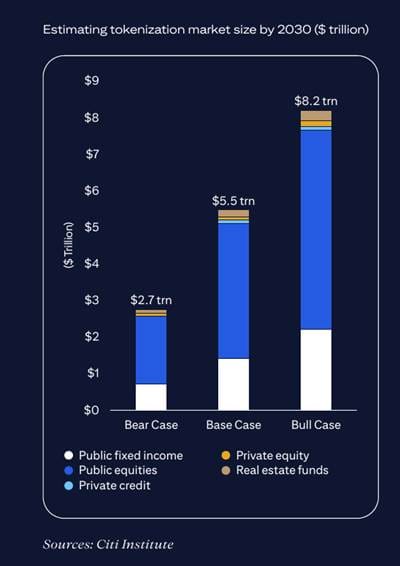
Chart 1: Citi's three scenarios for tokenised assets by 2030, split by asset class
Three scenarios
Citi sensibly hedges its bets with three scenarios, hinging on how quickly regulators move and how fast the underlying infrastructure matures. That said, even the pessimistic scenario is fairly upbeat! If regulatory approvals inch along and platforms remain a fragmented mess, Citi still sees a $2.7 trillion market by 2030. By contrast, if institutions sprint on-chain and retail investors pile in, the bull case runs to $8.2 trillion. The table below sets out the three paths.
|
Scenario |
2030 market size |
What has to happen |
|
Bear
case |
$2.7
trillion |
Regulators
drag their feet, platforms stay fragmented, institutions stick to cautious
pilots |
|
Base
case |
$5.5
trillion |
Major
clearing houses embed tokenisation at system level and liquid public assets
lead the way |
|
Bull
case |
$8.2
trillion |
Rapid
retail onboarding, joined up cross border regulation and a huge stablecoin
float |
And Citi's estimates for future growth don't sit in isolation. The table below shows other firms' estimates (third-party estimates) for the potential size of the market. McKinsey's $1 trillion looks positively cynical, while BCG's $18 trillion estimate looks a tad ambitious. Something in the region of $10 trillion looks eminently possible if this range of projections is right.
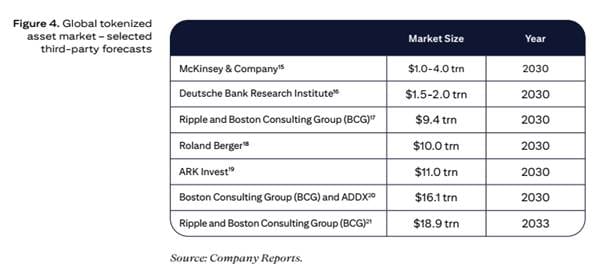
Chart 2: Third-party forecasts for the size of the tokenised asset market
Citi now expects US Treasuries and listed equities to be the workhorses of this multi-trillion-dollar innovation: 10% of the US short-term Treasury market and 3% of all public equities living on-chain by 2030. The next chart breaks down where the projected demand actually comes from, segment by segment.
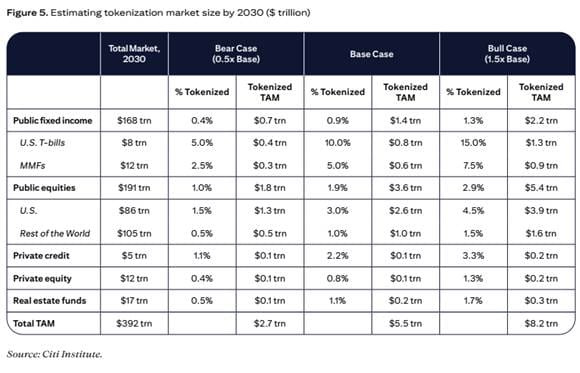
Chart 3: Citi's segment-by-segment breakdown of the tokenised market by 2030
Regardless of the asset class, what's driving the potential shift towards tokenised markets?
This debate is crucial: what are the practical reasons behind the possible shift? What are the USPs? The next table from the Citi report tries to address the functionality of digital chains, with the different coloured bars showing how opinion amongst market participants has changed over the last few years: key is post-trade processing costs (back office costs), which is now regarded by 51% of survey respondents as a key plus. Then comes liquidity (asset mobility). Interestingly, bid-offer spreads have declined as a plus, as has market turnover.
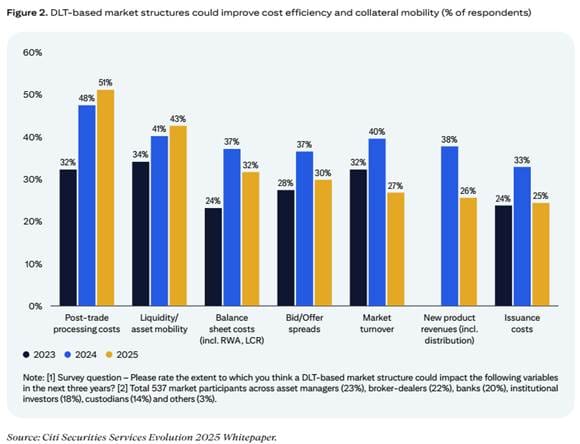
Chart 4: How 537 surveyed market participants rate the benefits of DLT based market structures
It's also worth spelling out what tokenisation actually promises each link in the chain, because Citi devotes a whole framework to it. Issuers get self-executing securities, with the report imagining corporate bonds that trigger their own buybacks or adjust coupons in response to real-time data. Trading venues achieve atomic settlement, eliminating the counterparty risk inherent in T+1 and T+2 cycles. Asset managers get single-ledger recordkeeping and real-time NAVs, and end investors get cryptographic proof of ownership plus the ability to lend their securities in on-chain money markets for extra yield. The table below sets out the full picture.
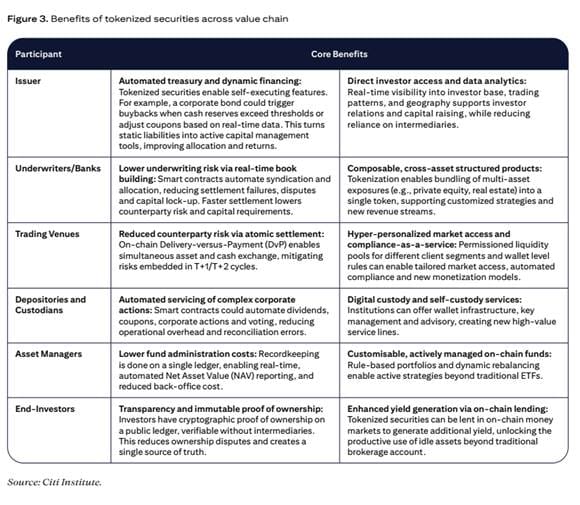
Chart 5: What tokenised securities offer each participant across the value chain
The rail builders
Crucially, this wave of adoption isn't being driven by scrappy startups trying to disrupt the incumbents. It's the incumbents doing it to themselves. The DTCC, the New York Stock Exchange and Nasdaq are embedding tokenisation directly into their core issuance and settlement workflows. The prize is a world of round-the-clock trading in traditional stocks, near-instant settlement, and much better capital efficiency, which, for the plumbing nerds among us, is where the real value lies.
Take the DTTC as an example of this trend. The DTCC received regulatory clearance in late 2025 to offer a tokenisation service for the assets it already custodies, with a three-year pilot planned for late 2026 covering stocks, ETFs and US Treasuries. The NYSE has announced plans for a tokenised securities platform, subject to regulatory approval, to launch by late 2026, enabling 24/7 trading of US-listed equities and ETFs with stablecoin-based funding. And Nasdaq has already secured SEC approval for certain stocks and ETFs to be issued, traded and settled in tokenised form within the existing market structure. David Cunningham of Consensys describes this in the report as the full weight of American financial power and the global reserve currency moving on-chain, and calls the DTCC and NYSE moves a tipping point.
Two numbers in the report jump out. First, Citi estimates that if just 10% of casual retail investors in the US migrate to digital trading platforms, it would generate $2.6 trillion in demand for digital equities. Second, the projected growth of regulated stablecoins, expected to reach a float of around $1.9 trillion by 2030, needs secure backing, and that requirement drives roughly $1 trillion of demand straight into tokenised US Treasuries.
The regulators are mostly playing ball
Much of Citi's confidence about the future depends on regulation rather than technology. In the US, the SEC issued a statement in January 2026 confirming that a digital wrapper on an asset doesn't change its regulatory treatment, thereby allowing institutions to treat tokenisation as a market infrastructure question rather than a legal experiment, while the CLARITY Act continues its journey towards a full Senate vote. Closer to home, the Bank of England and the FCA have their Digital Securities Sandbox running live DLT issuance and settlement, and on 30 April this year, the FCA published Policy Statement 26/7 on fund tokenisation. Europe has MiCA and the DLT Pilot Regime, although Citi notes that trade bodies regard the pilot's limited scope as a genuine constraint on scaling.
The caveats
Citi is suitably cautious about some much-hyped trends. Take Private markets, for instance, long touted as tokenisation's natural home. Hamilton Lane, KKR and Apollo all offer tokenised feeder funds to wealthy investors, yet these remain a tiny fraction of their overall assets, and Citi's own base case pencils in just $100 billion each for tokenised private credit and private equity by 2030.
Tokenised real estate is currently a mere $165 million globally. The Securitize executives interviewed make the essential point bluntly: tokenisation can broaden access, but it cannot manufacture liquidity. Wrapping an illiquid asset in a token doesn't make it liquid; it just makes it an illiquid token.
The Citi report also flags that settling securities in stablecoins introduces credit and redemption risks in stress scenarios, and that a proliferation of competing digital monies challenges the 'singleness of money' that underpins trust in the financial system.
There are also unresolved questions about whether holding a token always confers enforceable legal ownership of the underlying asset, and a new breed of systemic risk if issuance and settlement concentrate in a handful of dominant platforms. For context, today's $17 billion tokenised market, up roughly threefold in a year according to DefiLlama, is still over half short-dated US government paper and money market funds, with another third in tokenised gold and commodities.
Last but by no means least, for all the eye-watering numbers, Citi is careful to say this won't be a sudden flip from the old world to some fully decentralised utopia, and that's undoubtedly right. Expect a long, slightly awkward hybrid phase in which legacy systems and on-chain networks run side by side for years. The winners, in Citi's telling, will be the giant institutions that can manage both asset issuance and digital cash settlement under a single compliant roof.

Hyperliquid: the exchange TradFi cannot afford to ignore
By James Butterfill, Head of Research at CoinShares

For much of the past decade, decentralised exchanges have been dismissed by traditional finance as a sideshow, useful for speculative token trading but irrelevant to serious capital markets. Hyperliquid, a blockchain built specifically to house an on-chain derivatives exchange, is forcing a reassessment of that view. Since its mainnet launch in 2023, the platform has processed over US$4.33 trillion in lifetime trading volume, generated more than US$1.1 billion in cumulative revenue, and attracted 1.2 million users. On several trading days, its volumes have rivalled those of established venues such as the London Stock Exchange. That is a striking outcome for a platform that did not exist three years ago.
What makes Hyperliquid interesting to a traditional finance audience is not simply its scale, but the mechanism through which the business translates usage into value for token holders. Roughly 99% of the fees generated on the platform are routed into an Assistance Fund, which uses the proceeds to buy back HYPE, the network's native token, on the open market every day. Approximately 44.4 million HYPE has been repurchased to date, worth around US$2.2 billion at current prices. The effect is economically similar to a corporate share buyback, executed transparently, on chain, and scaling automatically with platform activity rather than at management's discretion. Few assets in digital markets offer this direct a link between revenue growth and demand for the underlying instrument.
The competitive picture reinforces the point. A year ago, Hyperliquid represented roughly 5% of the combined trading volume of the major centralised exchanges. That share has since risen to 6 to 7%, a modest figure in aggregate, but a more telling one when measured against individual competitors. Against Bybit, Hyperliquid's share of trading volume has grown from around 30% to over 50% in twelve months. Against OKX, volume share has moved from approximately 25% to 31%, and open interest share from 45% to 57%. This is a platform taking a meaningful share from incumbents with a decade or more of operating history and considerably greater resources.
Hyperliquid is also expanding beyond crypto-native trading into markets that directly matter to institutional investors. HIP-3, launched in October 2025, allows builders to deploy permissionless perpetual contract markets referencing commodities, equity indices, foreign exchange and pre-IPO equity. Since launch, this segment has cleared over US$60 billion in cumulative volume. Notably, trade.xyz, the largest HIP-3 deployer, secured an official licence from S&P Dow Jones Indices in March 2026 for a perpetual contract referencing the S&P 500, the first time a major traditional finance index has been formally licensed for a decentralised derivative product. That is a meaningful validation signal, and one reason CME and ICE have separately raised concerns to US regulators about the competitive threat Hyperliquid poses, a dynamic worth watching as much for what it implies about incumbent perception as for its regulatory substance.
Looking in more detail at what is actually traded, the platform tends to track prevailing market sentiment closely. During the debasement trade of late 2025 and early 2026, daily volumes in gold, silver and other precious metals reached as high as US$4.5 billion. The onset of the Iran bombing in late February this year drove daily trading in commodity energy instruments to as much as US$6 billion. We have also seen strong demand for more esoteric instruments, such as pre-IPO trading in SpaceX, which has attracted over US$6 billion in cumulative volume on the platform, with prices closely tracking those achieved at the company's actual listing. This illustrates the practical benefit of blockchain-based trading platforms, which are highly accessible and operate 24 hours a day, seven days a week. Had an investor wanted to express a view at the outset of the Iran bombing, the traditional finance world would have required a two-day wait before investing, whereas oil contracts on Hyperliquid were available immediately. We believe accessibility, availability and low cost are the key reasons behind its popularity, something the Tradfi world cannot accommodate.
None of this is without risk. Hyperliquid's validator set remains relatively concentrated, competition in the perpetuals category is dynamic rather than settled, and a meaningful portion of team token allocations remains unvested through 2027 and 2028. Regulatory scrutiny, while currently focused on established venues defending market share, could intensify as on-chain derivatives markets grow. These are genuine considerations for any institutional allocator assessing the space.
For traditional finance, the relevant takeaway is less about HYPE as a speculative token and more about what Hyperliquid represents structurally. It is a venue where usage, revenue and token value are mechanically linked, and one that is beginning to capture volume in markets, equity indices, commodities and foreign exchange, that sit squarely within the traditional institutional remit. Whether or not on chain derivatives ultimately displace a meaningful share of these markets, Hyperliquid's growth trajectory to date suggests the question is no longer whether decentralised venues can compete with traditional infrastructure, but how quickly they will.
James Butterfill is Head of Research at Coinshares. A finance veteran with roots in equity, fund management, and securities, James previously served as Head of Research at ETF Securities. He now leads CoinShares' renowned Research department, bringing decades of expertise to digital asset analysis and market intelligence.
Events on our radar
- TOKEN2049 Singapore, 7–8 October 2026, Singapore - tickets HERE
- WebX Asia (Tokyo), 13–14 July 2026, Tokyo, Japan - tickets HERE
- Blockchain Futurist Conference (Toronto), 21–22 July 2026, Toronto, Canada - tickets HERE
- European Blockchain Convention 12, Europe’s Deal Floor for Digital Assets. BARCELONA · 16-17 SEPTEMBER 2026 - tickets HERE
- Digital Assets Forum New York, New York 13 November 2026 - tickets HERE


