

Welcome to another summer double issue (#26) from TheIntersection team - our next issue will be out in two weeks' time! Enjoy the holidays!!
In this issue:
- News: UK regulators investigate digital gold
- Data: CoinShares says Assets Growing Fastest On-Chain Are the Most Traditional Ones
- Analysis: SS&C to push deeper into tokens… at some point
- Our weekly events round-up
And it's all free! Before we dive in, one request: please forward this weekly letter to anyone you think might be interested. We also very much welcome feedback (and contributors). If you want to email us, just drop an email to us at teams@theintersection.news.

News in Brief
BlackRock targets the stablecoin reserve market
BlackRock has launched two tokenised money market products, BSTBL and BRSRV, with the latter built specifically for stablecoin reserves and deployed on Solana. CFO Martin Small said the firm wants to become a leading reserve manager as demand grows under the GENIUS Act.
Why it matters: BlackRock is treating stablecoin reserves as a new institutional product market, rather than simply another use case for tokenisation.
CLARITY Act stalls in the Senate
The CLARITY Act failed to reach a Senate floor vote before the August recess, despite earlier hopes of a vote. Senate leadership has since filed cloture on the motion to proceed, with the bill now set to return when lawmakers reconvene on September 14.
Why it matters: The delay pushes one of Washington's biggest crypto-market reforms into the autumn, leaving firms with more uncertainty over the rules for digital assets.
Robinhood brings crypto trading to UK customers
Robinhood has begun rolling out crypto trading in the UK, giving eligible customers access to more than 50 digital assets through its app. The service is being provided through Bitstamp UK, which is registered with the Financial Conduct Authority.
Why it matters: Robinhood is bringing crypto further into its mainstream investment platform, putting digital assets alongside the stocks and other products already available to UK users.
Deep Dive — Why the UK is looking at tokenised gold
The Top Line
The UK is working on rules for tokenised gold, as regulators look at how physical gold could be bought, sold and moved using blockchain technology. The city handles around 70% of global gold trading, so the UK has a clear interest in keeping the market competitive.
The Details
The idea behind tokenised gold is fairly straightforward. The physical gold stays in a vault, while a digital token represents ownership of it. That token can then be transferred and settled on a blockchain. For the FCA, one of the main attractions is the potential use of tokenised gold as collateral. A digital representation could make it easier to transfer ownership and settle transactions without having to move the underlying gold. This is part of a wider push by UK regulators to bring more traditional financial assets onto digital infrastructure. There is also a competitive reason for doing it.
London is still the world's leading gold trading centre, but markets in places such as Shanghai and Hong Kong are growing. HSBC has already launched a tokenised gold product in Hong Kong, showing that the idea is moving beyond small-scale experiments. According to the Financial Times, HSBC's product has already recorded more than $2.2bn in trades across more than 276,000 transactions.

Coinshares on why the assets growing fastest On-Chain are the most traditional ones
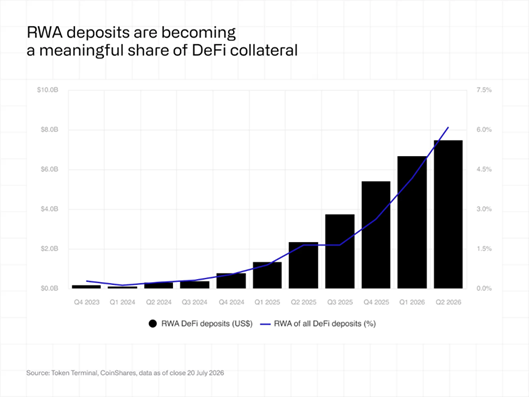
A new CoinShares and Token Terminal research report finds deposits of tokenized real-world assets more than tripled to $7.4 billion over the past year, while total deposits across decentralized finance fell by around 15%, evidence, CoinShares says, that finance is converging with blockchain infrastructure rather than being displaced by it.
Earlier this year, CoinShares set out Hybrid Finance as its investment thesis: the argument that finance is not being disrupted by blockchain technology but rewired by it, at the intersection of performant blockchains, decentralized lending and trading venues, and tokenized representations of traditional asset classes. The industry spent a decade arguing that one system would replace the other. The latest report, covering the period from the second quarter of 2025 to the second quarter of 2026, sets out the evidence that neither happened. The two are merging, and the movement is coming from the traditional side.
The report observes that Total DeFi deposits fell roughly 15% over the year, reflecting withdrawals and lower crypto prices, yet RWA deposits across lending platforms and decentralised exchanges more than tripled, from $2.3bn to $7.4bn. The pattern repeats in trading: aggregate spot DEX volumes, still overwhelmingly crypto-native, collapsed by around 70%, while RWA spot volumes rose roughly 220%, albeit from a small base.
On perpetual futures, volumes on tradeXYZ, the RWA-focused venue built on Hyperliquid, are up approximately 20x since launch, even as the wider on-chain perps market has declined since 10 October 2025, and RWA open interest has kept climbing, which the authors read as committed capital rather than incentive-driven turnover.
What is actually being used on-chain is not crypto
The clearest evidence is the composition of demand. The tokenised assets being deposited into on-chain lending venues are Treasury and multi-strategy funds first, followed by private credit and delta-neutral strategies. The largest share of spot trading volume in tokenised assets is in gold. On perpetual futures venues, activity is concentrated in oil and precious metals, equity indexes such as the S&P 500 and the Nasdaq-100, and technology and semiconductor stocks.
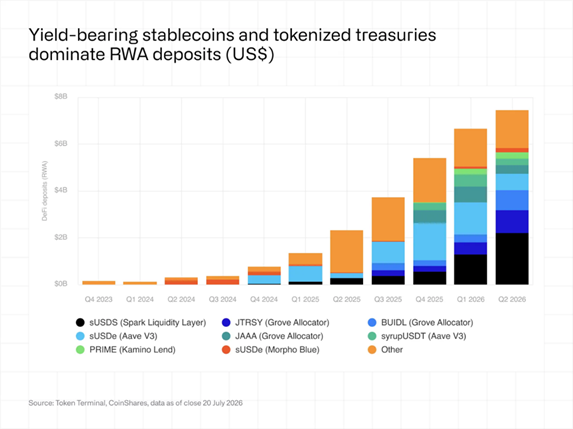
None of these are crypto assets. They are the most conventional exposures in global markets and are growing fastest on-chain. Investors are not leaving traditional finance for a parallel system. They are taking traditional assets onto infrastructure that settles in seconds and does not close overnight or on weekends, which is why the assets attracting the most on-chain derivatives activity are those with continuous global interest and discontinuous trading hours.
Collateral is dominated by yield-bearing instruments: tokenised Treasury and multi-strategy funds (JTRSY, BlackRock's BUIDL, sUSDS), then private credit (JAAA, Maple's syrup products, PRIME), then delta-neutral strategies such as Ethena's sUSDe. Investors want collateral that keeps earning while it supports borrowing, and they park it where liquidity already sits, on Aave, Morpho and Kamino. Spot volume concentrates in tokenised gold (XAUT and PAXG, actively traded through the gold price's swings) and yield-bearing dollar funds, with tokenised equities a growing share. In perps, oil, precious metals, the S&P 500 and Nasdaq-100 indices, and semiconductor names lead, with SK Hynix singled out as having rapidly become one of tradeXYZ's largest markets after listing.
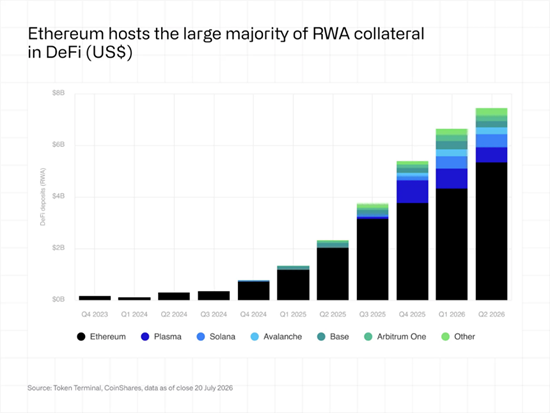
Geographically, at least on-chain, this remains an Ethereum story. Almost 70% of RWA collateral sits on Ethereum-based lending venues, with Plasma second (via Aave's expansion) and Solana third (via Kamino). Spot trading concentrates on Ethereum and Solana, and the report points out laggards: Arbitrum, BNB Chain, and Base have yet to establish meaningful RWA spot activity despite years of operation. The explanation offered is DeFi's strongest network effect, tHat borrowers go where lending liquidity is deep and lenders go where borrowing demand exists, so new ecosystems must build liquidity and trust simultaneously while incumbents compound both.
The report concedes that RWA adoption has not yet materially changed the revenue trajectories of the largest on-chain financial applications. Hyperliquid is the standout, generating substantially more application revenue than any other venue and, unusually, capturing economics at both the application and settlement layers, having overtaken Solana and Ethereum as the top revenue chain. Trading venues (Hyperliquid, Uniswap, Aerodrome) command the highest fully diluted revenue multiples, which the authors attribute to capital velocity and scalable operating models, and they predict on-chain applications will increasingly be valued using traditional financial services frameworks.
About the report
The Growth of Hybrid Finance covers the second quarter of 2025 to the second quarter of 2026, with longer time series where available. All data is provided by Token Terminal. TokTokenizedal-world assets here meamean tokenizednds, stocks an,d commodities. The analysis covers distributed assets only, meaning tokenised assets that can be moved to wallets outside the issuing platform. Networks hosting assets that are not broadly transferable across the venues examined fall outside its scope. Visit the Hybrid Finance report page: https://coinshares.com/insights/research-data/token-terminal-hybrid-finance-q2-report

SS&C to push deeper into tokens… at some point
by Damian Black
Financial and healthcare technology firm SS&C Technologies has declared ambitious plans to allow digital cash settlements for investment transactions. These are expected to cover stablecoins and tokenized commercial bank deposits. However, so far it hasn’t said when this will happen.
In July SS&C said it planned to build on its existing framework, which already enables asset managers to use tokenized versions of TradFi investment funds. The company boasts 23,000 clients and a market capitalization north of $20 billion.
“Tokenized funds are becoming another mainstream investment structure alongside mutual funds and ETFs,” said Nick Wright, general manager of SS&C Global Investor & Distribution Solutions. “As asset managers begin supporting these products in production, they need infrastructure that evolves with them.” The announcement comes in the wake of SS&C’s acquisition of Calastone – a global leader in wealth management technology – in 2025, for £766 million. SS&C wants to build on its tokenized fund issuance and distribution service as it eyes the next level up in a burgeoning tokenization market. “We have continued to invest in expanding these capabilities, helping clients adopt digital investments with confidence while leveraging the scale, resilience and connectivity they already rely on,” said Wright.
SS&C says it will enable digital investment transactions to settle using “regulated forms of digital cash, including stablecoins and tokenized commercial bank deposits”. The tech firm says this is designed to support “future atomic settlement” – an industry term for simultaneous bilateral transactions.
The firm says this will help reduce settlement risk, improve operational efficiency and simplify cross-border investment transactions as digital markets continue to evolve. “The capability further extends the practical application of tokenized investment products,” said SS&C. “These planned enhancements [will] create a pathway for eligible funds across the combined SS&C and Calastone ecosystem to be transacted and settled using digital forms of cash.”
Stock analysts applaud the move
The NASDAQ listed [ticker: SSNC] firm was recently tipped by Insider Monkey as undervalued thanks to the growing potential its move into digital investments signals. “Given its 39.60% upside potential and 9.80 Forward P/E, SSNC remains one of the undervalued software stocks to buy now,” said the stocks analyst, which also praised the tech company’s tokenized fund launch earlier this year. Simply Wall St agrees that SS&C could be undervalued. “News around SS&C Technologies Holdings moving deeper into tokenized funds and digital settlement comes as the stock trades at US$68.06, with recent share price momentum picking up over the past week but still soft on a year to date basis, while multi-year total shareholder returns remain positive,” said the analyst after the SS&C announcement. It claims that future earnings growth might see SSNC shares climb to what it regards as a “fair value” of $93.
Can SS&C fulfil such optimistic forecasts? Its solid track record suggests it just might. Founded in 1986, it survived the financial crisis that swept Wall St the following year and has since acquired more than 70 other businesses. Its digital platforms service offices across major industries and in recent years it has also incorporated AI into its software – the tech firm certainly appears to have its finger on the pulse.
As well as boasting of past achievements, SS&C insists it has its eyes firmly on the future. “As interest in tokenized investment products continues to grow, the market is increasingly looking beyond tokenization towards the infrastructure needed to support digital transactions,” it said. “Having already enabled the issuance and distribution of tokenized funds, SS&C is now extending its innovation roadmap to support the next stage of the digital investment lifecycle.”
OK, but when is this actually happening?
SS&C’s declaration that “further details regarding product availability and implementation timelines will be announced as development milestones are achieved” is, to say the least, maddeningly unspecific. If increased tokenization is such a beneficial move, why the absence of any rollout timetable or at least a rough date when such might be announced? The Intersection reached out to SS&C for comment but received no definitive response. Reading between the lines of its big talk, the company is taking a cautious stance. And it may well have good reasons for doing so.
Andrew Bahlmann of Deal Leaders International, which specialises in risk management, does not believe the upscaling of tokenization will eliminate hazard completely. “I believe in the direction that SS&C has taken, but I do not think that technology will completely eliminate settlement risk,” he told the Intersection. “The company must ensure that all pieces are working together – including tokenized funds, digital cash, compliant processes, and legacy systems – without introducing new areas for risk.” He agrees that the absence of a rollout timetable should raise a few eyebrows. “SS&C’s cautionary language regarding regulatory and client preparedness is understandable,” he said. “However, stating an intention to pursue tokenization without defining specific timelines, or milestones, diminishes the impact of this announcement. For investors to take seriously a true business plan, they require specific information about pilots, target markets and quantifiable objectives.”
Bahlmann does concede that reconciliation cost reductions, reduced failed settlements, and accelerated payment processing are all potential benefits. “However, these can only be realized when tokenization is adopted on a large-scale basis by clients,” he said. What’s more, upscaling tokenization in effect “adds another layer of complexity to SS&C’s existing systems […] therefore increasing operational costs”. So much for saving money.
Caution is justified
Chris Brooks of Crypto Asset recovery has spent years helping clients locked out of their own money on blockchain wallets due to technical failures. He too is sceptical of the risk-reducing benefits of tokenization, which he warns could throw up fresh hazards if not managed correctly. “On settlement risk and efficiency the tech is real,” he told the Intersection. “Moving funds onto digital rails can cut settlement times and reduce counterparty risk. But tokenization also concentrates risk into keys and smart contracts. If those aren't managed carefully, you’re just trading one failure mode for another.”
As such, he is sympathetic to SS&C’s telescopic approach to rollout. “The vague ‘as development milestones are achieved’ language doesn’t read as evasive to me,” said Brooks. “It reads as caution from a firm that knows the operational and custody problems are hard. I’d rather see that than a fixed date they can’t hit.”
So is this more a case of keeping up with the Digital Joneses than a serious tech-driven financial move? “Both,” said Brooks. “There’s a genuine efficiency case, but part of this is signalling to clients that SS&C won’t be left behind.” And the blockchain veteran has one final warning for all tokenization advocates: “Settlement speed means nothing if custody breaks. In this space, the moment you lose the keys, you lose everything – and the blockchain doesn’t offer refunds.”
Events on our radar
- TOKEN2049 Singapore, 7–8 October 2026, Singapore - tickets HERE
- WebX Asia (Tokyo), 13–14 July 2026, Tokyo, Japan - tickets HERE
- Blockchain Futurist Conference (Toronto), 21–22 July 2026, Toronto, Canada - tickets HERE
- European Blockchain Convention 12, Europe’s Deal Floor for Digital Assets. BARCELONA · 16-17 SEPTEMBER 2026 - tickets HERE
- Digital Assets Forum New York, New York 13 November 2026 - tickets HERE


