

Welcome to another weekly letter (#31) from TheIntersection team.
In this issue:
- News: ECB brings central bank money onto tokenised markets
- Data: Deutsche Bank on tokens, stablecoins and regulation
- Analysis: Does tokenization have a liquidity problem?
- Opinion: Tokenisation can make an asset transferable. It cannot make it liquid
- Our weekly events round-up
Before we dive in, one request: please forward this weekly letter to anyone you think might be interested. We also very much welcome feedback (and contributors). If you want to email us, just drop an email to us at teams@theintersection.news

News in Brief
Federal Reserve publishes the U.S. stablecoin rulebook: The Federal Reserve has released its long-awaited proposals to implement the GENIUS Act, which would cover stablecoin issuers under its supervision. The rules would require full reserve backing, set capital and custody requirements, and clarify that certain stablecoin activities are permitted for state member banks and bank holding companies. The proposals are now open for a 60-day comment period. Why it matters: The Fed was the last major U.S. regulator to publish its GENIUS Act framework, giving issuers a much clearer picture of what the regulated stablecoin market will look like ahead of the January 2027 deadline.
UK stablecoin rules move into implementation: The UK government has published its final amendments to the cryptoasset regulatory framework, bringing fiat-referenced stablecoins into the regulated financial-services perimeter. The FCA will lead regulation, with the Bank of England overseeing systemic stablecoin issuers. Why it matters: The UK and U.S. are now moving towards fully defined stablecoin regimes at roughly the same time, giving issuers another major regulatory framework to prepare for alongside Europe's MiCA rules.
Ondo launches three tokenised portfolios using BlackRock models: Ondo Finance has launched three tokenised investment portfolios based on allocation models designed by BlackRock. The products offer exposure to baskets of equities and ETFs, but the tokens are securities issued by Ondo rather than interests in BlackRock funds.Why it matters: The launch shows how tokenisation is moving beyond individual assets towards multi-asset investment products — although making an asset transferable on-chain doesn't necessarily make it easier to sell.
SoFi moves $25 billion card programme onto stablecoin settlement: SoFi and Mastercard are moving SoFi Bank's entire debit and credit card programme onto stablecoin settlement, with the programme expected to process more than $25 billion a year. SoFiUSD, issued by SoFi Bank, is already being used behind the scenes on Mastercard's network. Why it matters: This is a good example of stablecoins being used as financial infrastructure rather than a consumer product.
Deep Dive : ECB brings central bank money onto tokenised markets
The top line: The ECB has switched on Pontes, a new settlement platform designed to let tokenised assets settle using central bank money rather than private stablecoins. The platform links distributed-ledger trading systems with the Eurosystem’s existing TARGET settlement infrastructure. Deutsche Bank, Santander, Société Générale, and the European Investment Bank are among the first participants, alongside platforms such as Clearstream and SWIAT. A tokenised bond can now, in principle, settle against central bank money. The ECB is also planning to invest a small part of its own funds in tokenised euro-denominated securities through Pontes, starting with government and government-related debt.

Deutsche Bank on tokens, stablecoins and regulation – liquidity a challenge, innovation in infra the opportunity
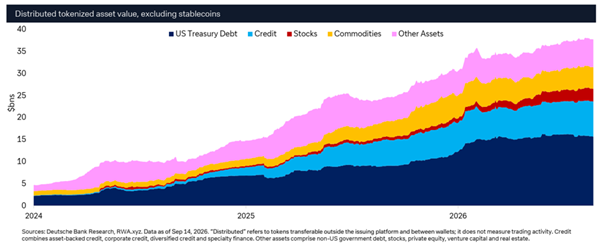
If you're looking for an excellent overview of the fast-developing digital assets market, a great place to start is Deutsche Bank Research Institute's latest chartbook, "Asset Tokenization 101," by Marion Laboure and Camilla Siazon. It notes that if you exclude stablecoins, the global tokenized asset market has grown from roughly $10bn in January 2025 to about $39bn this month. That is fourfold growth in under two years, yet it is still a rounding error next to the traditional markets it claims to be modernizing.
The Deutsche Bank analysts reckon stablecoins make up about 89% of the combined value of stablecoins and distributed tokenised assets. Everything else is a small slice of a small pie.
US Treasury debt is the biggest segment ex-stablecoins at $15bn, followed by credit, commodities and equities. Tokenised stocks account for under 1% of the market. The Treasury story is the most convincing use case, according to the analysts. Much of the $15bn sits in tokenised money market funds, and the bank attributes demand to appetite for short-term, risk-free, yield-bearing collateral that can move around at speed. BlackRock leads on about $2.83bn, followed closely by Ondo, Circle and Franklin Templeton, each between $2.5bn and $2.7bn. Then there is a steep drop to WisdomTree and JPMorgan Asset Management. It is a concentrated field, and one that has already had its wobbles: the report notes steep outflows from BlackRock's BUIDL in July 2025, put down to profit-taking or rebalancing by large institutions after a rapid rise.
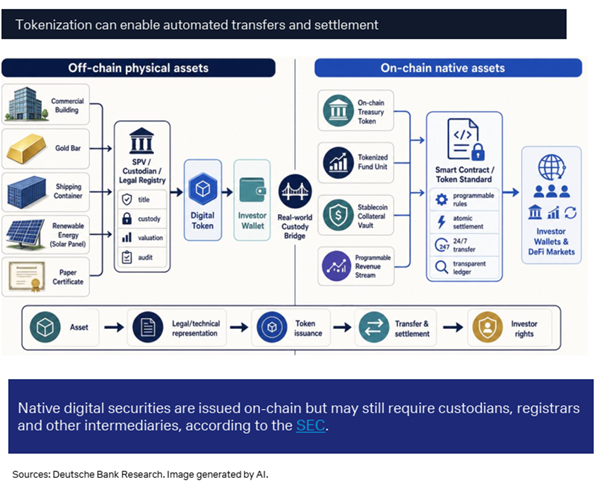
A new digital financial infrastructure. The real shift the authors identify is from tokenizing assets to tokenizing plumbing. Early products were tokenised claims on conventional securities, with the underlying assets staying off-chain. Now institutions are applying distributed ledger technology to settlement, funding and collateral. The DTCC is due to launch its tokenisation service in October, covering Russell 1000 constituents, ETFs tracking major indices and US Treasuries. Initial production trades took place in July with more than 30 firms, with tokens recorded on either DTCC's Hyperledger Besu network or on Canton, and the SEC has granted a three-year authorisation.
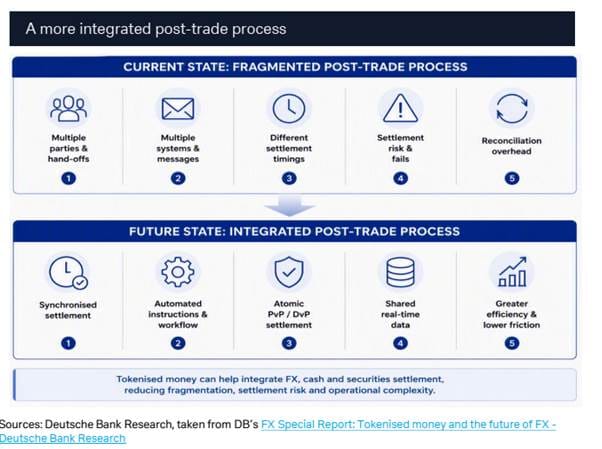
The Eurosystem's Pontes solution, which links DLT platforms to TARGET Services for settlement in central bank money, is expected to launch later this month. Clearstream, DTCC and Euroclear have published a joint interoperability framework, and the BIS-led Project Agorá has prototyped cross-border settlement using tokenised deposits and central bank reserves.
DLT fixed-income issuance reached €4.8bn in 2025, up 48%, an almost trivial amount in bond-market terms. But a Finadium study cited in the report estimates that running 15% of intraday repo activity on platforms such as JPMorgan's Kinexys and Broadridge's DLR could cut intraday liquidity buffer needs by 8% to 17%. Although tiny compared to other asset classes, real estate tokenisation grew from about $35mn in 2025 to $226mn this month. Fractional units of $100 to $1,000 might broaden access, but a BIS study they cite suggests that liquidity often depends on the platform promising to buy tokens back, which simply shifts risk onto the platform.
Private credit is a larger segment, at around $8bn, split across asset-backed credit, specialty finance, corporate credit, and diversified credit. The larger figure hides in what the report calls represented credit, about $35bn, where firms such as Figure use blockchains as a record-keeping layer rather than a trading venue. That is over four times the distributed market, and a useful reminder that much of the real activity is back-office rather than tradable.
Lurking in the background of all these more alternative asset classes is the issue of liquidity. The analysts admit that "token issuance does not automatically create secondary-market liquidity." Tokenised bonds tend to be held to maturity, investor participation is thin and platforms do not talk to each other. Tokenised equities carry a legal wrinkle too. Under certain third-party wrapper structures, the token provides limited exposure to a share without making the holder a shareholder, so voting and dividend rights may not follow; this contrasts with the DTCC approach, where tokenized securities are meant to keep the entitlements and protections of the traditional form. It notes that 68% of equity tokenisation in 2025 was direct tokenisation of individual stocks or baskets, which it reads as a sign that the market is moving towards the securities themselves and away from third-party wrappers.
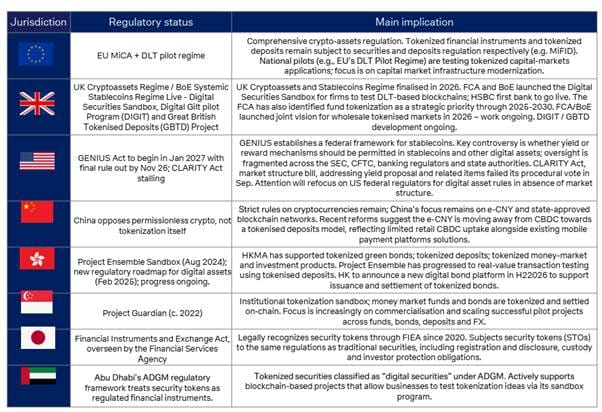
Regulation is the other friction, and the report is candid that it is moving in the wrong direction in the United States. The GENIUS Act takes effect on the earlier of 18 January 2027 or 120 days after final implementing rules. Meanwhile, the CLARITY Act, the market structure bill, failed a procedural vote, which the authors say likely rules out progress in this congressional session. Attention now returns to the SEC and CFTC. The UK looks comparatively well-organized, with its cryptoasset and stablecoin regimes finalized this year, the Digital Securities Sandbox live and the Digital Gilt pilot under way. Hong Kong, Singapore, Japan and Abu Dhabi all get short entries, and China is described as opposing permissionless crypto rather than tokenisation itself.
Future growth? The bank sees tokenised real-world assets excluding stablecoins reaching $1.5trn to $2trn by 2030 and $3trn to $4trn by 2035, up from $25bn in 2025. Getting there requires roughly a sixty-fold increase in five years. The lower scenario has fixed income dominating, with modest regulatory progress, while the higher case assumes that institutional settlement networks mature and that private credit and real estate scale, with Asia and Europe leading. The authors list three catalysts: market infrastructure such as DTCC, NYSE and Nasdaq integrating tokenisation, growth in regulated on-chain money, and regulation. They also list the risks, including faster liquidity runs, yield-chasing by money market fund issuers, crypto contagion through stablecoin reserves, operational failures and financial crime.
The Deutsche analysts conclude that tokenization will modernize financial infrastructure rather than eliminate intermediaries, with banks retaining key roles. The money is flowing to Treasuries, collateral, and settlement, all areas where incumbents run the pipes. The disruptive vision of open, permissionless markets trading everything, all the time, remains a long way off.

Does tokenization have a liquidity problem?
By Damien Black
More than half of $60 billion in tokenized assets are sitting idle on the blockchain and not trading, according to research by BeInCrypto. It raises the question: does tokenization have a liquidity problem?
BeInCrypto monitored 1,289 tokenized assets earlier this year for one week, and found that 910 – worth just shy of $33 billion altogether – did zero trades. These “dormant assets” represent 56% of the total tokenized market, leading BeInCrypto to conclude that “the active tokenization market is much smaller than expected”.
But does this point to a genuine liquidity problem or not? Well, that all depends on whether a tokenized asset is intended for trading in the first place – in other words, on the owner’s intention when they put it on a blockchain. The BeInCrypto report distinguishes between “represented” and “distributed” assets. The former comprise tokenized assets that simply use blockchain technology as a “digital ledger” to represent an off-chain, that is, TradFi, investment. Unlike distributed assets, these were never intended for trading on the blockchain itself. This brings to light BeInCrypto’s key finding: tokenization may or may not have a liquidity problem, depending on how you look at it. But it certainly appears to have a nomenclature problem – one, you might say, that is all too typical of a fledgling industry that has yet to fully find its feet.
Defining liquidity
Anthony Georgiades runs Innovating Capital, which looks after $220 million across digital assets, deep tech, enterprise and AI. “Yes, tokenization has a liquidity problem, but I would define it carefully,” he told the Intersection. “Tokenization can make an asset easier to record, transfer, settle, and program. It does not automatically create buyers, sellers, market makers, or continuous price discovery.” He agrees that many of the assets found on the blockchain were never intended to trade.
“I would also be cautious about treating transfer activity as a direct measure of liquidity,” said Georgiades. “A Treasury fund or private-credit vehicle may be designed for buy-and-hold ownership, periodic subscriptions, or scheduled redemptions. A tokenized money-market fund that offers daily redemption at NAV [net asset value] can be liquid through its issuer even if the token rarely changes hands.” There are other false flags you’ll want to be wary of when assessing just how “liquid” the tokenized asset market is, he adds. “Transfers between wallets controlled by the same custodian can show activity without indicating a real market,” said Georgiades. “I would separate primary liquidity, meaning the ability to redeem with the issuer, from secondary liquidity, meaning the ability to sell to another investor at a reasonable price and in meaningful size.”
Are tokens a ‘non-market’?
So do bonanza headline figures like “$60 billion in tokenized assets and counting!” essentially disguise a non-market, I put it to Georgiades. “I would call an asset a ‘non-market’ when it is presented as tradable but holders have no practical route to sell it,” he said. “To assess that, I would ask whether the token is transferable, who can hold it, where it can trade, how it is priced, what the redemption terms are, and whether there is meaningful secondary-market depth.”
Swathes of money remaining frozen in aspic on the blockchain pose a risk that is peculiar to tokenization, Georgiades explains: “If billions of dollars remain static, the immediate risk is not necessarily a sudden loss of value – the risk is that the industry begins to confuse digitization with liquidity.”
This he says can produce inflated adoption narratives, prices that are barely supported by actual trades, and larger discounts when investors need to exit outside redemption windows. But what worries him most is what he describes as “the collateral issue”. “If tokenized assets are accepted as collateral on the assumption that they can be sold quickly, and there is no real secondary market behind them, that assumption will be tested during periods of market stress, when liquidity is hardest to find,” he said.
As such, Georgiades says it is essential to distinguish between represented and distributed assets, and agrees that the $60 billion headline is “incomplete and potentially misleading to investors”. “Represented assets can still have real value,” he added. “Using a blockchain as a shared ledger may reduce reconciliation costs, improve reporting, and create a cleaner operational record. But these assets should not be presented as equivalent to assets that can move across wallets, venues, or financial protocols.”
Georgiades urges reports on the size of the tokenization market to distinguish between the value represented on-chain, the value that is legally and technically transferable, and the value with demonstrated secondary-market activity. “I would also want to see active holders, transfer volume, bid-ask depth, redemption windows, venue access, and whether assets accepted as collateral could actually be liquidated,” he added. “Those measures would tell us much more about market maturity than issuance value alone.”
Big players dominate
Something else BeInCrypto pointed out that deserves closer scrutiny is the apparent concentration of the tokenised asset market: it registers over 7,000 assets on the blockchain, but just 62 of these “institutional” assets make up account forn’s share of the total value (88%). Somewhat dismissively, BeInCrypto described the rest as “experimental” assets.
Is this a good thing, I wonder – seeing most of the value of tokenized assets tied up in behemoth positions like BlackRock’s $2.3 billion BUIDL fund might be reassuring to some, but on the other hand wasn’t DeFi supposed to be about giving the so-called little guy a chance? And assuming tokenization of real-world assets (RWA) is the new wheelhouse of DeFi, what does this tell us about the direction of travel? Adili Yiligeer spent a couple of years working as product and strategy manager at Kraken before jumping ship to OKX crypto trading platform. He now works for Kamui, which specializes in bringing institutional-grade private credit and treasury-backed strategies onchain.
“The concentration is not surprising,” he told the Intersection. “In traditional finance, a large share of capital is also allocated to relatively lower-risk assets such as money markets and fixed income, and even money-market AUM is concentrated among a relatively small number of large providers.” Tokenized assets, therefore, are simply developing in response to investor demand, which tends to tilt strongly towards “familiar, liquid and lower-risk products”.
Yiligeer added: “As adoption grows and investors become more comfortable with the infrastructure, I would expect AUM to diversify gradually across a broader range of asset classes and risk profiles. The key question is whether that diversification translates into genuinely broader on-chain distribution and liquidity, rather than simply a larger number of tokenized products.”
He also agrees with Georgiades that the industry needs to distinguish clearly between distributed and represented assets. “There is a significant difference between an asset that is simply represented on-chain and one that is genuinely issued, distributed, transferred and settled on-chain,” he said. “Both are valid, but combining them can overstate actual blockchain adoption. I would prefer the market to distinguish between tokenized assets outstanding and assets that are actively distributed and used on-chain.”
Centralized DeFi?
Georgiades says that the institutional – one might say TradFi – dominance of tokenized assets brings benefits and hazards alike to the table. “If 62 assets account for roughly 88% of the value, that reflects where capital, compliant structures, custody, and distribution currently exist,” he said. “I do not think that is inherently bad. Large institutional products can help build the infrastructure others will use, although their size alone does not prove that a liquid market exists.” However, he added: “Tokenization may rearrange who controls finance’s most valuable choke points. If a small number of issuers, custodians, or venues control access to most tokenized value, the system may become more efficient while remaining highly centralized.”
Centralized decentralized finance – welcome to the brave new complexity of tokenization! Unfortunately for crypto natives, Georgiades does not see this trend reversing – not in the foreseeable future anyway. “I do not expect smaller issuers to dominate by value in the near term,” he said. “A more useful goal is for them to have access to interoperable rails, transparent standards, and distribution without needing to recreate the entire financial stack.”
In any case, he doesn’t think tokenization would necessarily benefit from proliferation of smaller assets on the blockchain. Rather, it is movement that will be key – in other words, addressing the liquidity issues that have been raised. “The next phase of tokenization should be judged less by how many assets have been issued and more by how many can actually move, settle, serve as collateral, and meet real investor demand.”

Tokenisation can make an asset transferable. It cannot make it liquid
By Ivan Kroshnyi, founder of SharPay

I spent more than a decade in trading before moving deeper into investing and building businesses. One distinction becomes very clear when you have spent enough time around markets: having an asset, having a price for that asset and being able to exit a position at that price are three different things.
Tokenisation does not change that. The technology can make ownership easier to record. It can divide an asset into smaller units. It can reduce settlement friction and allow those units to move outside traditional market hours. All of that matters. But none of it guarantees that another investor will be willing to buy the asset when you want to sell it, in the size you need, at a price close to the one displayed on your screen. That distinction is becoming more important as the tokenised asset market grows.
BeInCrypto Research recently tracked roughly $60 billion in tokenised real world assets across more than 7,000 products. Of the 1,289 assets above $100,000 that it examined for transfer activity, 910, worth $32.9 billion, recorded no transfers during the week studied. Just 62 assets represented 88% of total market value. BeInCrypto Research: The Real State of Tokenization in 2026. Those numbers sound like evidence of a liquidity crisis. I think the reality is more interesting.
A token that does not move is not automatically illiquid
The first mistake is treating onchain activity as a direct substitute for liquidity. BeInCrypto makes an important distinction between Distributed and Represented assets. Around $27 billion of the dormant value in its study consisted of Represented assets, where blockchain is used primarily as a digital record of an offchain position rather than as a public trading rail. Low transfer activity can therefore be completely consistent with the way some of those products were designed. BeInCrypto: Half of the $60 Billion Tokenization Market Has No Real Activity
An investor may also hold an asset for months while retaining a clear redemption mechanism. Another token might change wallets every day but have very little depth when somebody tries to sell a large position. Transaction activity tells us something. It does not tell us everything. The more useful question is whether an investor has a credible route from ownership back to cash. That is where tokenisation and liquidity separate.
Transferability is an infrastructure feature. Liquidity is a market outcome
Blockchain can remove technical barriers to transfer. It cannot manufacture the economic conditions required for an active market. Liquidity requires buyers, sellers, market makers, capital willing to warehouse risk, credible valuation and confidence in the legal and economic rights attached to the asset. Consider fractionalisation. Dividing an asset into smaller units can widen the pool of people capable of buying it. That is valuable, particularly for assets that traditionally require large minimum investments. But reducing the minimum ticket from $100,000 to $100 does not create demand for an asset nobody wants.
The same applies to continuous trading. A market being technically available 24 hours a day is different from that market having sufficient depth 24 hours a day. An investor does not benefit much from being able to submit an order at 2am if the spread is enormous or there is no meaningful bid for the position. Traditional markets have spent decades building the institutions that sit behind liquidity. Market makers, exchanges, clearing systems, research, custody, disclosure standards and large pools of capital all contribute to the ability to transact. Putting an asset onchain changes the infrastructure. It does not allow us to skip the process of building a market around it.
Headline AUM is therefore the wrong scoreboard
The tokenisation industry understandably celebrates assets under management. Growing AUM shows that issuers and investors are becoming comfortable putting real financial value onto blockchain infrastructure. But AUM measures how much value has entered a structure. It does not tell us how efficiently that value can leave. For an institutional investor, I would want to understand at least four things before treating a tokenised asset as meaningfully liquid.
First, what exactly do I own?
A token can represent direct ownership, a claim on an issuer, an interest in a fund or synthetic economic exposure. Those structures can behave very differently when an investor wants to exit. The technical similarity of the tokens should not obscure differences in the underlying rights.
Second, who will buy from me?
Issuance tells us about supply. Liquidity requires demand. Investors should look at actual turnover, the number and quality of active counterparties, spreads and available depth at realistic transaction sizes. A market that can absorb a $5,000 sale is not necessarily capable of absorbing a $5 million one.
Third, what is my path back to cash?
Secondary trading is only one source of liquidity. Some products have issuer or fund redemption mechanisms that matter more than wallet to wallet transfers. The important question is not simply whether the token traded yesterday. It is what happens when I need to exit tomorrow, how the redemption price is determined, how long the process takes and who provides the cash.
Fourth, where is the liquidity located?
Tokenisation can solve fragmentation, but it can also create it. If economically similar exposure exists across several chains, exchanges, wrappers, and jurisdictions, total market value may look appealing while actual liquidity is divided among many smaller pools. For institutional investors, interoperability matters because twenty technically accessible pools do not necessarily equal one deep market.
Concentration is not necessarily a sign of failure
The fact that 62 assets account for 88% of tokenised market value may look uncomfortable. I would be careful about concluding that this is inherently unhealthy. BeInCrypto Research: market concentration data. New markets rarely mature evenly. Institutional capital naturally moves first toward assets with familiar economics, clearer valuation, established issuers and predictable redemption.
BeInCrypto's research found that tokenised US Treasuries were the only one of the twelve asset classes it assessed as having reached what it describes as “production-grade” maturity. BeInCrypto: Only One Asset Class Is Ready for Prime Time Concentration can therefore be evidence of selection. The more important test is what happens next. Does liquidity gradually expand from a handful of successful products into a broader range of assets? Do market makers commit capital? Do investors begin using these instruments as collateral? Does secondary turnover develop? Do assets become usable across platforms rather than remaining isolated inside individual ecosystems?
If those things happen, today's concentration may simply represent an early stage of market formation. If issuance keeps expanding while actual market depth remains confined to a small group of products, then the industry has a different problem. It will have succeeded at digitising assets without succeeding at creating digital capital markets.
Tokenisation still matters
None of this is an argument against tokenisation. Better settlement, programmable ownership, fractional access and more efficient record keeping can materially improve financial infrastructure. These are significant advantages even when the asset itself remains relatively illiquid.
But investors should be precise about what technology has solved. An illiquid private asset does not become liquid because its ownership record moves onto a blockchain. A weak market does not become deep because trading hours extend to 24/7. Fractional ownership increases the number of people who can theoretically participate, but not necessarily the number who actually will. The next stage of tokenisation should therefore be judged less by how many assets we can put onchain and more by the quality of the markets we build around them.
For investors, the question is changing from “Can this asset be tokenised?” to “What can I actually do with the token once I own it?”
That is a healthier question for the industry.
The technology has already demonstrated that assets can move differently. The harder task now is proving that capital will move with them.
Events on our radar
- TOKEN2049 Singapore, 7–8 October 2026, Singapore. Tickets HERE
- Digital Assets Forum New York, New York 13 November 2026. Tickets HERE
- Digital Assets Week London, Tue, Oct 6, 2026 - Wed, Oct 7, 2026 at 9:00 AM-5:00 PM, St Katharine's Way, London E1W 1LD, UK. Tickets HERE
- RWA Europe (Sep 25, Institut de France, Paris) — a curated one-day summit on real-world-asset tokenisation, pairing asset managers and banks with tokenisation platforms and regulators. Event details HERE
- Sibos 2026 (Sep 28–Oct 1, Miami Beach Convention Center) — SWIFT's flagship global banking conference, first-ever Miami edition, with "Digital Finance for AI-Driven Economies" as the theme and a heavy tokenisation/digital-asset strand.
- TOKEN2049 Singapore (Oct 7–8), Marina Bay Sands) — the self-styled "world's largest crypto event," a 25,000+ attendee, five-floor takeover of the venue. Event tickets HERE
- Stablecoin Summit Singapore (Oct 8, Andaz Singapore) — Asia's dedicated stablecoin event, timed to run alongside TOKEN2049 week.
- Money20/20 USA (Oct 18–21, The Venetian, Las Vegas) — the world's largest fintech gathering; stablecoins and tokenized deposits are now a major track alongside core payments/banking content.


