

Welcome to another weekly letter (#35 for the week beginning Monday, October 26th, 2026) from TheIntersection team.
In this issue:
- News: HSBC's RedCoin goes live in Hong Kong
- Data: Stablecoins - What's next for crypto assets?
- Analysis: How Nigeria’s First On-Chain IPO Works
- Opinion: Crypto's Value Is Migrating Away From Infrastructure
- Our weekly events round-up
Before we dive in, one request: please forward this weekly letter to anyone you think might be interested. We also very much welcome feedback (and contributors). If you want to email us, just drop an email to us at teams@theintersection.news

News in Brief
HSBC's RedCoin goes live in Hong Kong. HSBC began rolling out RedCoin through PayMe on 23 October and reported about HK$80.6m in circulation. The only other licensed issuer, Anchorpoint, remains in a restricted institutional phase with no committed retail date. Source: crypto.news
OKXICE objections keep growing. CoinDesk reported on 20 October that Microsoft, Alphabet and Goldman Sachs had objected, bringing the total to 16 companies. Nasdaq has separately said it will opt out of the framework, citing missing real-time best-price displays and consolidated-tape reporting. Most of the 63 companies on the venue's initial list did not object. The first batch of nine was roughly 14%. Sources: Cointelegraph · Crypto Briefing · Fizen roundup
Aviva Investors tokenises its largest fund. Aviva launched a tokenised share class of its £22bn Sterling Liquidity Fund on the XRP Ledger. Financial News reports more than £86m invested across its two tokenised classes. Source: crypto.news
Luxembourg's DLT-native sovereign bond. The €1.7bn, 10-year bond carries a 3.70% coupon and was issued through LuxCSD on Clearstream's D7 platform. Source: Luxembourg government
WisdomTree reported tokenised AUM approaching $1.3bn on 12 October, up 65% this year. CoinPaprika
Gold and Commodity Collateralization: Tokenized commodities reached $4.85 billion, driven by Tether Gold (XAUT) and Paxos Gold (PAXG). Cross-margin protocols are increasingly integrating gold tokens alongside tokenized short-duration Treasury yields to replace unbacked crypto margin during volatile macro sessions.
What to Watch Out For Next Week
- DTCC go-live confirmation and the first participants.
- The Aave JAAA vote outcome.
- Further OKXICE objections, and whether the SEC responds.
- Treasury's treatment of foreign issuers (USDT) now the OCC rule is final, plus the separate AML and sanctions rulemaking.
Deep Dive: OCC finalizes the GENIUS Act rule (21 Oct).
The rule takes effect on 18 January 2027. It covers everything the OCC must write under the Act except Bank Secrecy Act, AML and sanctions rules, which will follow in a separate rulemaking with Treasury. It sets a $5m capital floor for issuers, adds flexibility in reserve management, and removes restrictions that could have limited yield and rewards arrangements. One commentary reads the rule as barring issuers from paying interest directly while leaving exchange-run reward programmes such as Coinbase's in a legal grey area. Sources: OCC Bulletin 2026-50 · Decrypt · Crypto Briefing · 24/7 Wall St

Stablecoins: Deutsche Bank on what's next for crypto assets?
Deutsche Bank Research Institute (Marion Laboure and Camilla Siazon, 20 October 2026) latest report on digital assets concludes that the stablecoin market is maturing rather than booming, with institutional use growing steadily and retail use in developed markets still peripheral.
The chartbook revisits the stablecoin market a year after the US GENIUS Act was signed. The authors write that the frenzy following GENIUS has diminished, but stablecoins' links to the financial system have continued to deepen, and more policymakers are seriously considering their use cases. The market capitalisation has hovered around $300bn for twelve months and reached a plateau of about $310bn in October 2026. The report reads this stability as a sign of maturity.
The report poses one question. Will stablecoins become merely a payments technology, or a genuine disruptor of the global banking system? Its answer is mixed. Institutional use is real and concentrated in cross-border payments, treasury management, 24/7 liquidity provision, collateral and real-time settlement.
Retail use in developed markets remains peripheral. The authors also frame the US promotion of stablecoins as a geopolitical tool to sustain dollar dominance, and they identify the regulatory treatment of yield-bearing stablecoins as the key debate to watch.
Market structure
Market capitalisation has grown from $5bn in 2020 to about $310bn in 2026, and it is highly concentrated. Tether's USDT holds roughly 60% and Circle's USDC roughly 23%. About 99% of the market by value is pegged to the US dollar, and the report notes these coins are largely backed by US Treasuries.
Estimates of use cases, which the authors take from BCG analysis, put crypto trading at around 77%, payments at 5-12%, store of value at 17-33% (especially in emerging markets), and other uses such as on- and off-ramps and tokenised real-world-asset settlement at 2-8%. The listed benefits are 24/7 transfers and settlement, fewer intermediaries, programmability (escrow, conditional release, automated reconciliation) and a dollar-based store of value. The alternatives named are central bank digital currencies, tokenised deposits and traditional financial architecture. The adoption section carries the report's most skeptical commentary: "Most stablecoin volume is still not driven by real economic activity." Allium data put 2026 year-to-date transaction volume at roughly $100trn unadjusted and about $2.42trn once adjusted. Chainalysis offers a more bullish estimate of $28trn for 2025, projected to reach $719trn by 2035 on organic growth alone. The first chart breaks adjusted volume into categories.
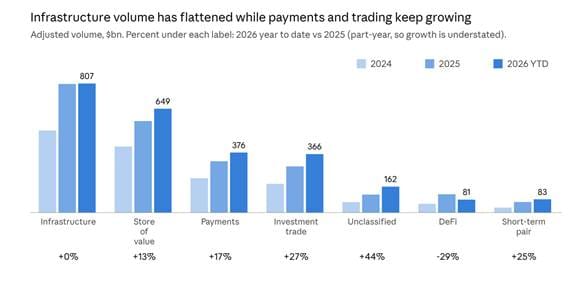
Deutsche Bank Research, VisaOnChain Analytics, Allium; adjusted volume, 2026 to 19 Oct 2026 · typed from the report's chart
Payments: businesses lead, consumers lag
Stablecoin payment volume is reported at $375bn for 2026 year-to-date. Payment volume rose from around $103bn in 2022 on one slide to $151bn on another (an inconsistency noted at the end). Businesses account for most payments (58-64%), led by business-to-business flows. Allium's September report listed the largest business payment categories as service fees ($56bn), payroll ($43bn) and service payments ($32bn). As a case study, payment volume across Visa's more than 160 stablecoin-linked card programs grew about 200% year on year.
Consumer payments in developed markets are described as "not yet there". A recent American Bankers Association survey found that only 24% of consumers think stablecoins could provide meaningful benefits. The authors argue that stablecoins resemble debit instruments rather than credit products. They do not naturally replicate rewards, revolving credit, dispute rights, chargebacks or fraud protection, so developed-market consumers have limited incentive to use them. Retail-sized transactions, defined as $250 or less, rose from $2.6bn in 2020 to $71bn in 2024, with $66bn year to date in 2026. The second chart shows where supply sits.
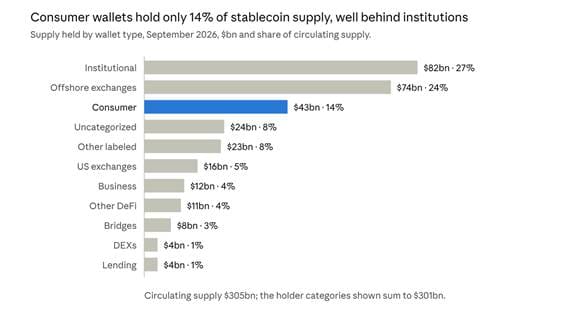
Deutsche Bank Research, Allium; supply by holder type, Sep 2026 · typed from the report's chart
Cross-border use
The report ties the strongest adoption to remittances, B2B payments and dollar access in countries with unstable currencies or weak banking systems. For cross-border use, it cites instant settlement, costs below $0.10 per transaction and remittance fees of 0.5-3.0% against a global average of about 6.6%. Stablecoins represented only 0.31% of fiat cross-border payment value in 2025, but grew 64% against 9% for fiat, according to Allium. A 2025 IMF study put stablecoin transaction flows at about 7.7% of GDP in Latin America and about 6.7% in Africa and the Middle East. The third chart ranks countries by payments received, using Allium data for January to August 2026. Only the receiving end is attributed, so a $100 payment counts once.
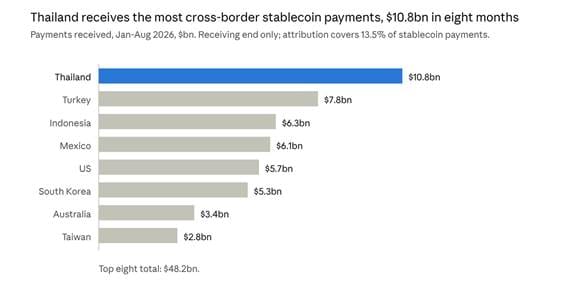
Deutsche Bank Research, Allium; Jan-Aug 2026 · typed from the report's chart
Liquidity, settlement and institutional adoption
The report presents cash and liquidity management as the area where stablecoins look strongest. Their 24/7 settlement addresses operational frictions in FX, treasury operations and collateral management such as intraday repos. Deutsche Bank's equity analysts estimate customer processing fee savings could rise from zero to about $70bn by 2035 if customers switch from traditional banks to stablecoins, which the report says poses a significant risk to banks' cross-border B2B business.
The authors add a caution. Stablecoins are not a replacement for FX settlement risk management because FX settlement requires exchanging two currencies simultaneously. Stablecoins currently act only as an intermediary between the two currency legs, producing what the report calls a "stablecoin sandwich". The heavy concentration in dollar coins also limits payment-versus-payment settlement across currency pairs, and fragmented interoperability, liquidity and regulatory uncertainty remain obstacles.
On institutional adoption, Mastercard has expanded its settlement capabilities to include stablecoins, using USDC and Paxos-issued coins. More than 140 companies and financial institutions helped launch Open USD (OUSD) in September 2026, and it reached $799mn of supply within two weeks. The report reads this as a shift toward consortium-backed, network-led digital dollar models. Banks are taking varied approaches. Société Générale's Forge has launched EUR and USD coins, AllUnity has launched a euro coin and plans a Swiss franc one, and ODDO BHF has launched a euro coin with reserves held directly on its balance sheet. The Qivalis consortium of European banks plans a euro-pegged coin, and a separate coalition of global banks is exploring stablecoins pegged to G7 currencies on public blockchains. The report adds that infrastructure providers and central securities depositories are exploring regulated stablecoins as the programmable cash layer needed for large-scale asset tokenisation.
The report sets out a bull, base and bear framing on the threat to card networks. Chainalysis suggests stablecoin transaction counts could match Visa and Mastercard between 2031 (bull), 2033 (base) and 2039 (bear). About 17% of stablecoin-linked card volume runs through Visa's business and commercial programmes. Banks' key concerns are a chain of fee pressure, deposit outflows, greater reliance on wholesale funding and pressure on net interest margins. Deutsche Bank's own equity analysts take a base case of more limited near-term risk, with Visa and Mastercard remaining dominant in advanced markets and KYC, AML, sanctions screening and fraud controls remaining essential for banks.

What the On-Chain Offering of the Dangote Petroleum Refinery IPO Reveals About Emerging Market RWAs
by Abiodun Oladokun
On September 14, 2026, Dangote Petroleum Refinery and Petrochemicals FZE, the most recent business venture of Africa’s richest man, Aliko Dangote, opened subscriptions to the public in what is now described as Africa’s largest initial public offering (IPO).
The IPO, which Dangote framed as a way to democratize wealth creation for ordinary Nigerians and investors worldwide, offers 4.1 billion ordinary shares at ₦525 each, with the company aiming to raise about ₦2.15 trillion (approximately $1.6 billion). The offer was first due to close on October 13, but Nigeria’s Securities and Exchange Commission (SEC) approved a two-week extension to October 27. Dangote said the offering had drawn strong investor interest across Africa, with subscriptions already at “three to four times its target.”
As Nigeria grows into one of Africa’s most active markets for blockchain innovation, GetEquity, a Nigerian investment platform and infrastructure provider, has brought a slice of the IPO on-chain, issuing tokens that represent subscriptions to Dangote shares. This marks the first time a Nigerian offering of this scale has opened subscriptions on public blockchains. Now five weeks into the offering, on-chain data from the tokenized subscription has revealed three critical patterns that provide a realistic look into the structural realities of bringing Nigerian—and, by extension, broader African—equities on-chain.
How Nigeria’s First On-Chain IPO Works
As noted earlier, participants can buy into the tokenized offering either directly through GetEquity or through NectarFi, a Solana-based app that partners with GetEquity to offer the same tokens and runs on its infrastructure. According to on-chain data tracked by Afriflux, GetEquity has minted 761,905 tokens, called DPRI, across two networks, Solana and Base. At 525 cNGN per token, that represents a ₦400 million slice of the IPO, split evenly between the two chains: ₦200 million on Solana and ₦200 million on Base.
Each half sits in its own vault smart contract. To buy, a buyer sends cNGN, the Naira-backed stablecoin, to the vault, either directly on GetEquity or through NectarFi, and receives DPRI at 525 cNGN per share. The same vault also buys DPRI back at the same price, allowing participants to return the tokens and get their money back. It is important to point out that DPRI is not the Dangote share itself. According to Solana Compass, the equity itself is not tokenized.
The actual shares exist within Nigeria’s conventional share registration and custody system, with the registrar recording ownership and the Central Securities Clearing System (CSCS) holding them. In this instance, GetEquity acts only as a nominee and custodian, issuing DPRI tokens that represent holders' claims on the underlying shares. In theory, bringing this real-world asset on-chain removes traditional market inefficiencies, but in practice, execution has created immediate headwinds.
A Steady Decay in Buyer Activity
Per Afriflux data, while the total pool of unique wallets holding DPRI currently sits at 315, overall engagement has sharply flattened since the September 14 launch. According to the data provider, daily active buyers peaked at 76 unique wallets on September 15. But this quickly tapered off into single digits in the following days. Although buyer activity picked up briefly between October 9 and 12, the rebound did not last, and it has not yet come close to the launch-week high of 76 wallets. For context, as of October 18, only two unique wallets bought DPRI.
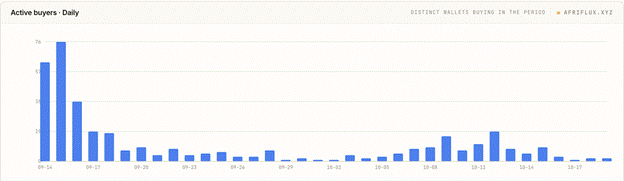
DPRI Daily Active Buyers | Source: Afriflux
Moreover, the daily count of first-time wallets participating in the on-chain offering has also plunged since the launch. Afriflux’s first-time wallet records show that 63 new wallets arrived on September 14 and 66 on September 15. Another 32 new wallets followed on September 16, which means half of all 315 wallets that have ever bought DPRI arrived in the first three days. Afterward, new arrivals fell sharply, dropping to almost none between September 29 and October 2, with no first-time buyers recorded on most days. By October 6, new interest began to re-emerge, and first-time buyers peaked at 15 new wallets on October 12. However, over the past seven days, the count of new addresses buying DPRI has trended downwards, signalling dropping interest from new participants.
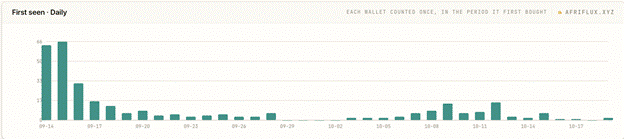
DPRI Daily New Buyers | Source: Afriflux
Large Wallets Concentration
An examination of DPRI buyer distribution shows that while tokenizing the IPO brought hundreds of individual wallets on-chain, total volume remains heavily concentrated among a handful of large wallets. Per Afriflux, across the entire offering, the 6 largest buyers ( 2% of all buyers) account for 38% of all capital subscribed on-chain. The timing of their purchase matters here as well. Data shows four of the six largest buyers arrived in the first week of launch, absorbing most of the initial volume.
This means the on-chain demand that made the launch look strong was largely carried by a handful of wallets. The biggest single buy came on September 20, when wallet address 4FRbkXj9… bought ₦5.1 million in a day, holding 17% of all DPRI bought on-chain so far. Together, these four large wallets currently account for 31% of all DPRI bought on-chain across both networks.
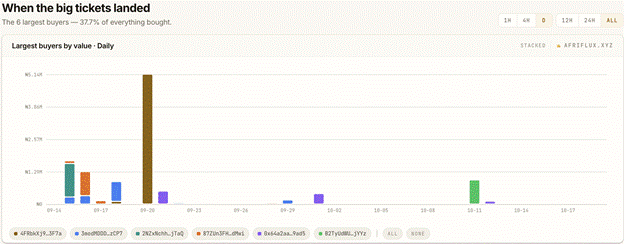
DPRI Large Wallet Activity | Source: Afriflux
A Buyer Base Dominated by Wallets Created Days Before Purchase
NectarFi has been the preferred route for most participants looking to access DPRI. According to Afriflux’s data, 194 of the 315 wallets that have bought DPRI came through NectarFi. What stands out is how new these wallets are. Afriflux measures each Solana wallet’s age from its first-ever transaction and tags any wallet created less than two days before its first DPRI purchase as a “new wallet.” By that measure, 157 of the 194 Solana wallets are new, and they hold 89.3% of the DPRI held on Solana. This suggests most buyers did not come from an existing pool of crypto users, as they created their wallets around the time of purchase. This pattern also extends to the largest buyers. Data from the provider shows that four of the six biggest wallets in the offering are tagged as new, each less than a day old at the time of its first purchase.
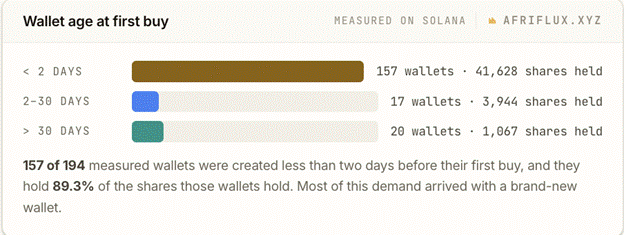
Wallet Age | Source: Afriflux
RWAs in Emerging Market: What Tokenization Solves and What It Cannot
In an earlier analysis, The Intersection detailed the multifaceted challenges facing Nigeria’s $115 billion stock market, with many touting tokenization as a remedy. However, the nation’s pioneer on-chain IPO experiment demonstrates that tokenization addresses only a part of these structural issues. Start with free float. Dangote Refinery is offering 4.1 billion shares—representing roughly 3.3% of the company's capital, rising to 4.3% if the over-allotment option is fully exercised. Tokenization can only wrap what the issuer chooses to release. GetEquity’s ₦400 million on-chain slice accounts for barely 0.02% of the total ₦2.15 trillion offer, meaning on-chain buyers can only compete for a tiny fraction of the equity put up for sale.
Furthermore, over the five weeks the IPO has been live, local market behavior has clearly favored traditional rails. Dangote reports that the overall offering is three to four times oversubscribed, with virtually all of that demand flowing through conventional banks, stockbrokers, and primary market fintech apps. Over that same five-week window, the on-chain route attracted just 313 unique wallets and roughly ₦28 million in net volume, leaving 92.9% of its allocation unsold. As pointed out above, capital inflow was heavily front-loaded into the first two days, over a thinotedapital came from just six wallets, and four out of five Solana buyers o;ened a brand-ny to subscribe. For most domestic investors, buying on-chain offered no clear operational advantage over the channels they already use. The on-chain route genuinely made a difference by reaching investors outside Nigeria, creating a compelling proof of concept for cross-border access. In a September 16 report published by Mariblock, Getproof of conceptDike noted that "more than 90% of its confirmed 160 buyers purchased DPRI from outside Nigeria" during the initial launch phase.
This signals a real appetite among foreign and diaspora investors—who routinely face daunting KYC friction when opening a Nigerian brokerage account—for a globally accessible route to local equities. If this cross-border corridor is where tokenized equities ultimately find their market, the core question for emerging-market RWAs is less about replacing domestic infrastructure and more about whether on-chain rails can meaningfully scale access for those previously locked out.

Crypto's Value Is Migrating Away From Infrastructure
By Steve Bailey
For most of the past decade, the smartest money in crypto evangelized the idea of building the pipes. Layer-1s, Layer-2s, wallets, custody platforms, payment rails, node providers, tokenization tools — billions of dollars and countless engineering hours went into the plumbing of this industry, on the theory that whoever controlled the infrastructure would control the upside. That theory is now running out of road. Infrastructure has become a commodity. Walk through nearly any category in crypto today and you'll find a dozen capable competitors doing roughly the same thing, whether layer-1s competing with rollups on throughput and fees, wallets converging on the same core features, or custody providers offering nearly identical guarantees. When everyone can build the same thing, nobody can charge a premium for building it. Artificial intelligence is accelerating this trend, because it has made software development dramatically cheaper and faster, which means the technical moats that used to protect infrastructure companies now erode in months instead of years. A clever architecture used to buy a company real time before competitors caught up. That’s less true nowadays.
The maturation of crypto infrastructure
The natural result of commoditization is fee compression, and that's exactly what we're seeing across the infrastructure stack. Transaction costs keep falling as competitors undercut each other to win volume. This is unambiguously good for users, who get cheaper and faster access to the network. But it's brutal for the companies building that network. Margins that once supported ambitious R&D budgets are shrinking. Businesses that spent years establishing technical credibility are finding that credibility doesn't convert into pricing power. Yes, the pipes work better than ever, but they’re also worth less than before. This is why the industry's strategic priority needs to change. Infrastructure has become an invisible utility, like electricity or bandwidth once they matured. Nobody chooses a bank based on its power grid. Soon, nobody will choose a crypto product based on which chain it settles on either. In other words, after focusing on the pipes for so long, crypto needs to really get building the taps — the consumer-facing products people actually touch, trust, and return to every day.
Value has migrated to consumer-facing applications
What does matter, more than ever, is distribution. Acquiring and keeping millions of loyal users is now the hard part of this industry. That scarcity is what makes consumer-facing companies so valuable right now. A company that owns the customer relationship has something infrastructure providers can't structurally replicate, no matter how good their technology gets. Technology, after all, is fungible in a way that trust is not. A protocol can be forked in an afternoon, and a fee schedule undercut overn But a bn't people trust with their money, a product they've built into their daily routine — well, companies that own these relationships can layer in new products again and again without having to rebuild an audience from scratch each time. Because once a company has real distribution, it can add payments, lending, savings, investing, rewards, remittances, tokenized assets, and AI-driven financial tools on top of a single customer relationship. Each new product monetizes the same user again. Infrastructure providers, by contrast, are usually stuck monetizing a single layer of the stack, collecting a fee here or a spread there, with no easy path to expand the relationship the way a consumer platform can.
What to expect in the future?
It's the same story technology has told for thirty years. Infrastructure enables growth, but applications capture the profit. Cloud computing created enormous value, yet the companies that built genuinely massive businesses on top of it (Uber, Netflix, Spotify, Airbnb, to name a few) are worth many multiples of the infrastructure providers they depend on. The pipes made those businesses possible, but they didn't make the money. Digital assets are heading toward the same split. The good news is that utility, not speculation, is what will finally get us there. Bull markets are excellent at attracting new users, but they're terrible at keeping them once prices stall. If crypto only feels compelling when the charts are green, adoption will keep swinging between boom and bust indefinitely.
The path out of that cycle is integrating digital assets into things people already do every day — banking, payments, savings — so that usage doesn't depend on market sentiment. Mobile payment apps offer a useful model here. They kept growing long after the initial fintech hype faded, because they had solved a real, everyday problem. Crypto's infrastructure layer did its job. It proved the technology works. Now the value is moving to whoever can put that technology directly into people's hands and keep them coming back. The pipes got us here. The taps will decide who wins next.
Steve Bailey is the President and Chief Operating Officer of RockWallet, a fully licensed digital asset platform built for people who want to navigate the crypto economy with confidence.
Events on our radar
|
Start |
End |
Event |
City |
Country |
RWA
/ stablecoin angle |
Tickets
/ registration |
|
18 Oct 2026 |
21 Oct 2026 |
Money20/20 USA |
Las Vegas |
US |
Tokenisation and stablecoins are one of the content
pillars |
|
|
2 Nov 2026 |
6 Nov 2026 |
Hong Kong FinTech Week
(main conference 2-3 Nov) |
Hong Kong |
Hong Kong |
Digital Assets & Web3 Forum: regulated stablecoins,
RWA tokenisation |
|
|
13 Nov 2026 |
13 Nov 2026 |
Digital Assets Forum New
York |
New York |
US |
Institutional-only: tokenisation, stablecoins, regulation |
|
|
18 Nov 2026 |
20 Nov 2026 |
Singapore FinTech
Festival |
Singapore |
Singapore |
MAS-run; tokenisation and digital currencies on agenda |
|
|
7 Dec 2026 |
10 Dec 2026 |
Abu Dhabi Finance Week |
Abu Dhabi |
UAE |
Tokenisation and digital financial assets; 70+ sub-events |
|
|
19 Jan 2027 |
22 Jan 2027 |
Stablecoins for Banks
(virtual) |
Online |
US |
Banking Exchange stablecoin series for banks |
https://m.bankingexchange.com/joomla-pages-iii/categories-list/223-channel-page |
|
1 Feb 2027 |
2 Feb 2027 |
Digital Assets Forum
London |
London |
UK |
Institutional digital assets, 1,500+ expected |
https://www.tickettailor.com/events/europeanblockchainconvention/2031272 |
|
1 Feb 2027 |
3 Feb 2027 |
Consensus Hong Kong |
Hong Kong |
Hong Kong |
CoinDesk flagship for Asia; tokenised assets, stablecoins |
|
|
3 Feb 2027 |
3 Feb 2027 |
RWA Summit Hong Kong
(Hong Kong RWA Week 1-3 Feb) |
Hong Kong |
Hong Kong |
Pure RWA tokenisation summit (UVECON.VC) |
|
|
19 Apr 2027 |
21 Apr 2027 |
Hong Kong Web3 Festival |
Hong Kong |
Hong Kong |
RWA, tokenisation and stablecoin payments named as themes |
|
|
21 Apr 2027 |
22 Apr 2027 |
TOKEN2049 Dubai |
Dubai |
UAE |
Large crypto event; stablecoins and RWA on agenda.
Postponed from Apr 2026. |
|
|
7 May 2027 |
8 May 2027 |
Stablecoin Super
Conference |
Miami |
US |
Banking Exchange stablecoin conference |
https://m.bankingexchange.com/joomla-pages-iii/categories-list/223-channel-page |


