

What the On-Chain Offering of the Dangote Petroleum Refinery IPO Reveals About Emerging Market RWAs
by Abiodun Oladokun
On September 14, 2026, Dangote Petroleum Refinery and Petrochemicals FZE, the most recent business venture of Africa’s richest man, Aliko Dangote, opened subscriptions to the public in what is now described as Africa’s largest initial public offering (IPO).
The IPO, which Dangote framed as a way to democratize wealth creation for ordinary Nigerians and investors worldwide, offers 4.1 billion ordinary shares at ₦525 each, with the company aiming to raise about ₦2.15 trillion (approximately $1.6 billion). The offer was first due to close on October 13, but Nigeria’s Securities and Exchange Commission (SEC) approved a two-week extension to October 27. Dangote said the offering had drawn strong investor interest across Africa, with subscriptions already at “three to four times its target.”
As Nigeria grows into one of Africa’s most active markets for blockchain innovation, GetEquity, a Nigerian investment platform and infrastructure provider, has brought a slice of the IPO on-chain, issuing tokens that represent subscriptions to Dangote shares. This marks the first time a Nigerian offering of this scale has opened subscriptions on public blockchains. Now five weeks into the offering, on-chain data from the tokenized subscription has revealed three critical patterns that provide a realistic look into the structural realities of bringing Nigerian—and, by extension, broader African—equities on-chain.
How Nigeria’s First On-Chain IPO Works
As noted earlier, participants can buy into the tokenized offering either directly through GetEquity or through NectarFi, a Solana-based app that partners with GetEquity to offer the same tokens and runs on its infrastructure. According to on-chain data tracked by Afriflux, GetEquity has minted 761,905 tokens, called DPRI, across two networks, Solana and Base. At 525 cNGN per token, that represents a ₦400 million slice of the IPO, split evenly between the two chains: ₦200 million on Solana and ₦200 million on Base.
Each half sits in its own vault smart contract. To buy, a buyer sends cNGN, the Naira-backed stablecoin, to the vault, either directly on GetEquity or through NectarFi, and receives DPRI at 525 cNGN per share. The same vault also buys DPRI back at the same price, allowing participants to return the tokens and get their money back. It is important to point out that DPRI is not the Dangote share itself. According to Solana Compass, the equity itself is not tokenized. The actual shares exist within Nigeria’s conventional share registration and custody system, with the registrar recording ownership and the Central Securities Clearing System (CSCS) holding them. In this instance, GetEquity acts only as a nominee and custodian, issuing DPRI tokens that represent holders' claims on the underlying shares. In theory, bringing this real-world asset on-chain removes traditional market inefficiencies, but in practice, execution has created immediate headwinds.
A Steady Decay in Buyer Activity
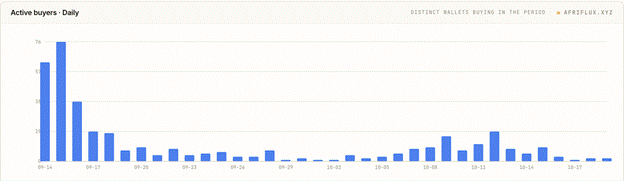
Per Afriflux data, while the total pool of unique wallets holding DPRI currently sits at 315, overall engagement has sharply flattened since the September 14 launch. According to the data provider, daily active buyers peaked at 76 unique wallets on September 15. But this quickly tapered off into single digits in the following days. Although buyer activity picked up briefly between October 9 and 12, the rebound did not last, and it has not yet come close to the launch-week high of 76 wallets. For context, as of October 18, only two unique wallets bought DPRI.
DPRI Daily Active Buyers | Source: Afriflux
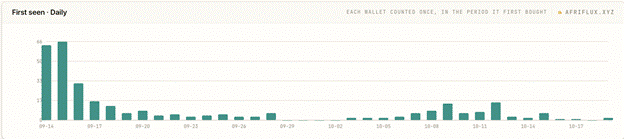
Moreover, the daily count of first-time wallets participating in the on-chain offering has also plunged since the launch. Afriflux’s first-time wallet records show that 63 new wallets arrived on September 14 and 66 on September 15. Another 32 new wallets followed on September 16, which means half of all 315 wallets that have ever bought DPRI arrived in the first three days. Afterward, new arrivals fell sharply, dropping to almost none between September 29 and October 2, with no first-time buyers recorded on most days. By October 6, new interest began to re-emerge, and first-time buyers peaked at 15 new wallets on October 12. However, over the past seven days, the count of new addresses buying DPRI has trended downwards, signalling dropping interest from new participants.
DPRI Daily New Buyers | Source: Afriflux
Large Wallets Concentration
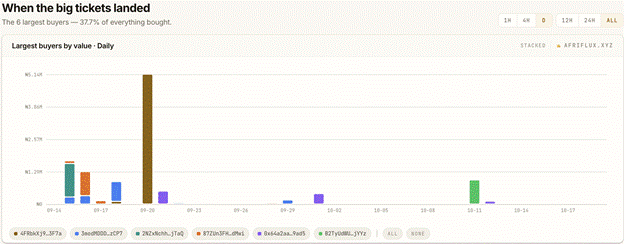
An examination of DPRI buyer distribution shows that while tokenizing the IPO brought hundreds of individual wallets on-chain, total volume remains heavily concentrated among a handful of large wallets. Per Afriflux, across the entire offering, the 6 largest buyers ( 2% of all buyers) account for 38% of all capital subscribed on-chain. The timing of their purchase matters here as well. Data shows four of the six largest buyers arrived in the first week of launch, absorbing most of the initial volume.
This means the on-chain demand that made the launch look strong was largely carried by a handful of wallets. The biggest single buy came on September 20, when wallet address 4FRbkXj9… bought ₦5.1 million in a day, holding 17% of all DPRI bought on-chain so far. Together, these four large wallets currently account for 31% of all DPRI bought on-chain across both networks.
DPRI Large Wallet Activity | Source: Afriflux
A Buyer Base Dominated by Wallets Created Days Before Purchase
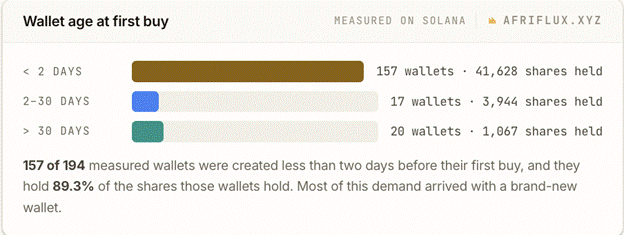
NectarFi has been the preferred route for most participants looking to access DPRI. According to Afriflux’s data, 194 of the 315 wallets that have bought DPRI came through NectarFi. What stands out is how new these wallets are. Afriflux measures each Solana wallet’s age from its first-ever transaction and tags any wallet created less than two days before its first DPRI purchase as a “new wallet.” By that measure, 157 of the 194 Solana wallets are new, and they hold 89.3% of the DPRI held on Solana. This suggests most buyers did not come from an existing pool of crypto users, as they created their wallets around the time of purchase. This pattern also extends to the largest buyers. Data from the provider shows that four of the six biggest wallets in the offering are tagged as new, each less than a day old at the time of its first purchase.
Wallet Age | Source: Afriflux
RWAs in Emerging Market: What Tokenization Solves and What It Cannot
In an earlier analysis, The Intersection detailed the multifaceted challenges facing Nigeria’s $115 billion stock market, with many touting tokenization as a remedy. However, the nation’s pioneer on-chain IPO experiment demonstrates that tokenization addresses only a part of these structural issues. Start with free float. Dangote Refinery is offering 4.1 billion shares—representing roughly 3.3% of the company's capital, rising to 4.3% if the over-allotment option is fully exercised. Tokenization can only wrap what the issuer chooses to release. GetEquity’s ₦400 million on-chain slice accounts for barely 0.02% of the total ₦2.15 trillion offer, meaning on-chain buyers can only compete for a tiny fraction of the equity put up for sale.
Furthermore, over the five weeks the IPO has been live, local market behavior has clearly favored traditional rails. Dangote reports that the overall offering is three to four times oversubscribed, with virtually all of that demand flowing through conventional banks, stockbrokers, and primary market fintech apps. Over that same five-week window, the on-chain route attracted just 313 unique wallets and roughly ₦28 million in net volume, leaving 92.9% of its allocation unsold. As pointed out above, capital inflow was heavily front-loaded into the first two days, over a thinotedapital came from just six wallets, and four out of five Solana buyers o;ened a brand-ny to subscribe. For most domestic investors, buying on-chain offered no clear operational advantage over the channels they already use. The on-chain route genuinely made a difference by reaching investors outside Nigeria, creating a compelling proof of concept for cross-border access. In a September 16 report published by Mariblock, Getproof of conceptDike noted that "more than 90% of its confirmed 160 buyers purchased DPRI from outside Nigeria" during the initial launch phase.
This signals a real appetite among foreign and diaspora investors—who routinely face daunting KYC friction when opening a Nigerian brokerage account—for a globally accessible route to local equities. If this cross-border corridor is where tokenized equities ultimately find their market, the core question for emerging-market RWAs is less about replacing domestic infrastructure and more about whether on-chain rails can meaningfully scale access for those previously locked out.


