

Welcome to another weekly letter (#32) from TheIntersection team.
In this issue:
- News: Stablecoins keep growing, but USDC slips
- Data: Morgan Stanley on Open USD going live
- Analysis: BlackRock tightens grip on stablecoins
- Opinion: Europe is building Euro stablecoins nobody asked for
- Our weekly events round-up
Before we dive in, one request: please forward this weekly letter to anyone you think might be interested. We also very much welcome feedback (and contributors). If you want to email us, just drop an email to us at teams@theintersection.news

News in Brief
DTCC’s tokenisation service moves into commercial launch: DTCC is preparing to launch its DTC Tokenization Service commercially this month, following successful production trades in July with more than 30 firms including BlackRock, JPMorgan and Goldman Sachs. The service converts DTC-custodied securities into tokenised “digital twins”, initially covering assets such as Russell 1000 stocks, major ETFs and U.S. Treasuries. It will run across Canton and LFDT Besu as part of DTCC’s multi-chain approach. Why it matters: This is a shift from tokenisation pilots towards putting blockchain infrastructure directly into the plumbing of traditional markets.
OKX and ICE file for 24/7 tokenised stock trading. OKXICE, the 50/50 venture between OKX and NYSE owner Intercontinental Exchange, has filed with the SEC to operate a 24/7 venue for tokenised U.S. stocks. The October 4 notice covers 63 proposed names, including Nvidia, Apple, Microsoft and Tesla, with trading planned through permissioned liquidity pools on XLayer. The proposal comes shortly after the SEC introduced its five-year Innovation Exemption for tokenised securities venues. Why it matters: A major traditional exchange operator is now testing whether tokenised equities can move from offshore crypto markets into a regulated U.S. market structure.
U.S. Treasury targets A7 network’s stablecoin-linked payment routes. The U.S. Treasury has sanctioned the A7 Network, a shadow banking network linked to Russia and used for sanctions evasion, while FinCEN proposed restrictions on financial institutions dealing with its sub-agents. Treasury says the network’s sub-agents processed more than $17 billion between January 2025 and June 2026. A7’s ruble-backed A7A5 token has also been used as a bridge into more widely traded digital assets, including Tether’s USDT. Why it matters: The action shows how stablecoins can become part of the enforcement perimeter when they are used as a bridge between restricted financial networks and global crypto liquidity.
Deep Dive: Stablecoins keep growing, but USDC slips
The top line: The stablecoin market continues to grow, with total supply now around $307 billion, according to DeFiLlama. Tether remains dominant with almost 60% market share, while USDC is around $74 billion. USDe is growing much faster, with supply up almost 14% over the past month. But USDC has moved in the opposite direction. Circle’s own figures show $74.1 billion in circulation as of October 5, down around $400 million over 30 days, with redemptions slightly ahead of issuance. The decline comes despite Binance investing $100 million in Circle and signing a new five-year agreement to promote and expand USDC, particularly across emerging markets.

Morgan Stanley on Open USD going live
Open USD Goes Live: Can Shared Economics Build Stablecoin Scale? Is investment bank Morgan Stanley's latest digital assets update.
Written by Felix Stratmann, James E Faucette, Michael J. Cyprys, CFA, CPA, Michael N Infante, Kade O'Reilly, it focuses on OUSD, a stablecoin challenger launching with over 200 partners, more than $1bn of founder liquidity commitments, major distribution rails, shared reserve economics, and partner equity. The key test will be whether this converts into sustained usage and balances. Key takeaways from the report include:
· Launch distribution involves over 200 partners, four chains, and access through Coinbase, Mastercard, Stripe, and Visa.
· Differentiated economics: OUSD shares reserve economics with participating partners and offers partner equity; minting and burning are offered at 1:1 with no fee.
· Scale requires winning flows: major partners support multiple stablecoins, suggesting OUSD would need to convert distribution into real usage and balances.
· Stablecoin backdrop remains mixed: activity is still mostly crypto-related, growth has slowed, velocity is high, and regulations may favor usage over holding.
· Partner economics are designed to solve the stablecoin cold-start problem. Open Standard shares reserve income based on the supply and activity partners generate, while qualifying contributors can earn equity, combining recurring economics with longer-term ownership incentives. A more collaborative governance model also aims to improve alignment, with a board of directors representing its shareholders.
· The broader stablecoin backdrop argues for focusing on usage, not just float. Activity remains mostly crypto-related, growth has slowed, and high velocity means transaction volumes can scale much faster than balances. GENIUS rulemaking may also constrain holding-based rewards, reinforcing a more transactional model.
Circle: Competitive backdrop for Circle is heating up. We believe Open Standard could represent a competitive challenge for Circle, as the nature of its revenue model, whereby partners receive the earnings generated on reserves less a small management fee, is differentiated relative to Circle's, which is more negotiated / distribution-led. However, this could take time to scale, with the shared governance model raising questions about decision making concentration and speed.
Coinbase: OUSD provides Coinbase with an additional stablecoin revenue stream beyond USDC, although the near-term financial contribution may remain modest given OUSD’s smaller scale.
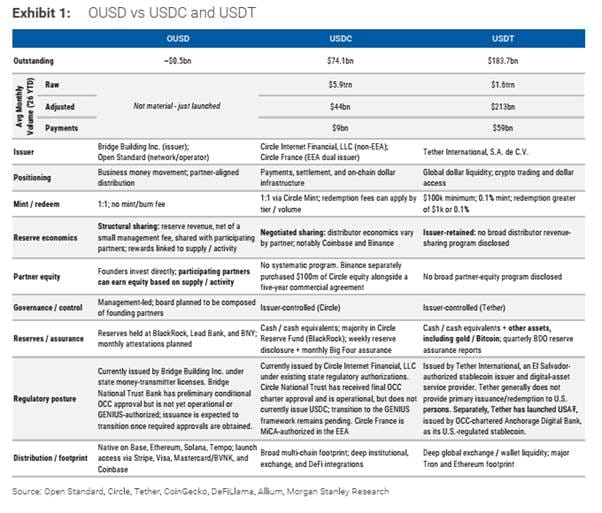
The highest-information milestones according to the Morgan Stanley report are:
1. How much of the >$1bn launch commitment converts into sustained circulating supply, rather than temporary seed liquidity.
2. Actual production volumes through Stripe, Visa, Mastercard, and Coinbase, especially payments/settlement rather than DeFi or market-making.
3. OUSD liquidity depth and redemption performance during volatility.
4. Concentration of supply by founder or platform.
5. Bridge's transition, if completed, into the federal issuer framework.
6. Whether OUSD's model forces USDC to broaden revenue and equity sharing further.
The last point may ultimately matter most. Even if OUSD never displaces USDC or USDT, it could still change the industry's economics by making distribution partners expect a larger share of reserve income and ownership.

BlackRock tightens grip on stablecoins
by Damien Black
BlackRock continues its attritional move into tokenization with its recent bid to target stablecoin reserves. In the words of its own CEO, it wants to be “the stablecoin reserve manager of choice”. This led one media outlet to suggest that the $15 trillion asset giant wants to be “the landlord not the tenant” as the go-to infrastructure provider for a growth industry that tops $300 billion.
The BlackRock Select Treasury Based Liquidity Fund (BSTBL) and the Daily Reinvestment Stablecoin Reserve Vehicle (BRSRV) went live on August 3. The former effectively tokenizes a $6.1 billion BlackRock fund, migrating it to the Ethereum blockchain and handing the record-keeping reins to BNY Mellon. The latter is a purpose-built vehicle for high-net-worth investors, with a minimum stake of $3 million.
BlackRock CEO Martin Small sounded a heads-up the previous month, during the company’s Q2 earnings call held on July 15. “We want to be the stablecoin reserve manager of choice in the industry,” Small said. “We already manage $60 billion of reserves for Circle. We see lots of growth ahead.” Some might say this is ominous for smaller players and anyone who cares about the original ethos of DeFi – cutting out expensive middlemen and allowing anyone to get skin in the game on a peer-to-peer investment model. The Intersection reached out to finance and crypto experts to get their take on BlackRock’s move.
Centralisation fears over BlackRock move
“In my view, the picture around BlackRock is less scary than what is being painted,” Raj Kamal, founder of stablecoin payment company TransFi, told the Intersection. “Essentially, these vehicles, BRSRV and BSTBL, are enabling the tokenisation of reserves for blockchain and stablecoin issuers. These are GENIUS Act compliant, and for any stablecoin issuer that has to be 100% capitalised with assets, this creates a tokenised, on-chain way to manage reserves.”
Kamal adds that BlackRock the “landlord” will provide an infrastructure that ensures greater capital efficiency because tokenization avoids the “weekend lock-up” by allowing trading to continue throughout the week. “Yield that comes from these deposits also accrues directly on-chain,” he added. “It will benefit stablecoin issuers because they gain a compliant, liquid, on-chain way to comply with the GENIUS Act and other requirements.” However, Kamal sounds a cautionary note by way of caveat. “I think the real reason why some people are a little scared about this is because it creates a lot of centralisation,” he said. Holding stablecoin reserves in effect gives BlackRock a “kill switch”. “A regulator could ask BlackRock to unilaterally freeze or seize assets, in which case stablecoin issuers would be forced to burn those tokens. Even if the stablecoin issuer does not want to, BlackRock, because of its immense power, would be able to do it.”
Despite that concern, Kamal believes that a lot of industry players will welcome what BlackRock is offering. “Many stablecoin issuers would actually prefer to have an infrastructure layer that enables the on-chain management of reserves,” he said. “The jury is still out, and we will see how it goes.”
Regulation equals centralisation
Increased centralisation is not only desirable but inevitable, says Tim Sun of digital asset company HashKey Group. “An expansion in stablecoin issuance inevitably goes hand in hand with an expansion of reserve assets, which are underpinned by short-term Treasuries, cash, repurchase agreements, and money market funds,” Sun told the Intersection. “Managing these assets has always been BlackRock’s forte. What BlackRock truly wants is to become the largest manager of stablecoin reserve assets.”
While this might make DeFi enthusiasts wince, Sun maintains that increased regulation in the tokenization space means “oversight will inevitably concentrate toward large traditional institutions.” He added: “Although the front end features numerous stablecoin issuers, the cost, security, and management capabilities required for managing underlying reserve assets can only be satisfied by a handful of traditional financial institutions.” Of course, market concentration brings drawbacks, including operational vulnerabilities and liquidity risks. This will force crypto-native firms to innovate more aggressively, as big institutional players like BlackRock siphon off a portion of their reserve asset yield. “They [will] need to fully leverage on-chain distribution capabilities and DeFi composability,” said Sun. “Overall, both TradFi and crypto-natives must extend their capabilities into their respective areas of expertise and play to their strongest parts.”
However, Sun does not see this shift as spelling the end for crypto natives nor their inevitable replacement by TradFi operators like BlackRock. “Rather, they will complement each other’s strengths to form a brand-new business model,” he said. “Much like the internet era, where banks and tech companies did not substitute for one another – they ultimately complemented each other to establish a new commercial paradigm.”
Level playing field essential
For Vivek Raman, CEO of Ethereum blockchain finance infrastructure developer Etherealize, the devil is in the detail. “It’s important to note that BlackRock manages reserve assets for Circle, which is different from controlling the stablecoins,” he told the Intersection. “Circle issues USDC and sets its own reserve policy across multiple managers and custodians.”
BlackRock’s choice of Ethereum as the landing platform for its migratory BSTBL tokenized fund was driven by the numbers. “BlackRock is placing its institutional cash where the liquidity already sits,” he said. “Ethereum carries over half of all stablecoin supply, more than all other networks combined, and that concentration is why these products landed there.” Both BSTBL and BRSRV are regulated fund shares issued onchain with a transfer agent of record, which means real ownership with an actual registry sits behind them. Raman believes this gives BlackRock a durable business model. “Synthetic exposure products that reference an asset without conveying it are a different proposition and don’t necessarily carry the industry forward,” he added. But Raman echoes Kamal’s concerns over concentration. Even smaller DeFi actors should stand to gain from the increased liquidity BlackRock’s twin projects offer – provided the blockchain rails stay neutral. At this stage, it isn’t clear whether they will or not.
“Compliance requirements sit at the token layer, where identity checks, permissioning and transfer restrictions can all be applied,” he explained. “The settlement layer underneath stays open to everyone. A closed network owned by a group of incumbents hands one set of participants the ability to write the rules for everybody else. A neutral public network gives issuers real choice about who manages their reserves, and it lets a new issuer arrive without permission.”
It’s all about the customer...
Joe Lackner of Coin Interest Rate, which compares stablecoin rates across platforms, shares the cautious optimism of other experts the Intersection spoke to. “I don’t see BlackRock’s move as taking over stablecoins,” he said. “There’s a practical need for what it offers – regulated crypto platforms want to offer competitive earn products, but they don’t all want to build a reserve-management operation or rely on DeFi strategies.” As such, Lackner even sees BlackRock as potentially becoming “a major partner for those platforms”. He too acknowledges the fears over increased centralisation. “Having more stablecoin products doesn’t necessarily mean more choice unless everyone uses the same reserve manager,” said Lackner. “But managing reserves isn’t the same as controlling the platforms or their customer relationships.”
And perhaps it’s fair to say in the final analysis that the customer is what it’s all about: “From the customer’s perspective, the questions remain pretty straightforward – what am I earning, what risks am I taking, and can I get my money out when I need it?”

Europe is building Euro stablecoins nobody asked for
By Marcel Thiess, CEO of Thiess Invest GmbH
On 8 May 2026, Christine Lagarde spoke at the Banco de España's Latin America economic forum and made an argument that put her at odds with much of Europe's banking sector. "The case for promoting euro-denominated stablecoins is far weaker than it appears," the President of the European Central Bank told her audience. Twelve days later, 25 more European banks joined Qivalis, the consortium building exactly that. With ING, UniCredit and BNP Paribas among its members, it now counts 37 banks in 15 countries.
So who is right? After almost a decade at crypto exchanges, market makers and custody providers across Europe, my answer is Lagarde. When I say nobody asked for euro stablecoins, I mean the people who are supposed to use them.
European users already had a stablecoin that worked.
For most of those years, European traders used USDT. It was the most liquid trading pair on almost every exchange; it moved between platforms in minutes, and it worked the same way in Berlin as in Buenos Aires. Users wanted lower fees, faster withdrawals, and more tokens, but I rarely heard anyone ask for a euro version of it. Then MiCA's stablecoin rules applied from 30 June 2024, and Tether did not apply for an EU license. By the end of March 2025, Coinbase, Kraken and Binance had removed USDT for their European customers. Users had to convert into a coin they had not chosen, or move their money to a platform outside the EU. The rest of the world kept using USDT, which has around $190 billion in circulation today.
I understand why authorities wanted to regulate an issuer serving millions of Europeans without an EU license or supervised reserves. However, for users, the result was a worse product, and the euro stablecoins that were supposed to take its place have not.
The biggest euro stablecoin is American.
Euro stablecoins today are worth less than €1 billion together. That is about 0.25% of a stablecoin market of roughly $300 billion, even though the euro makes up about a fifth of global currency reserves. Circle's EURC has done best. It has grown almost five times since the end of 2024 to about 397 million tokens, and it now holds around 60% of the euro stablecoin market. However, Circle is an American company, so the largest euro stablecoin is a US product. Much of its growth also came from exchanges that needed a compliant replacement for the coins MiCA forced them to delist.
Bank coins, by contrast, have done far worse. AllUnity, the euro stablecoin backed by Deutsche Bank's asset manager DWS, received its license from the German BaFin in July 2025. More than a year later, it has about €0.4 million in circulation.
The banks are building for sovereignty.
But why are 37 banks spending money on this, then? The answer is in their own statements. When Qivalis was announced in September 2025, the founding banks called it "a serious European alternative to the US-dominated stablecoin market." Two months earlier, the US had signed the GENIUS Act, and the White House said stablecoins would ensure "the continued global dominance of the U.S. dollar."
For Europe, this is a serious concern, because if payments and savings slowly move into dollar tokens, the ECB loses influence over its own monetary policy and European banks lose deposits. ECB Executive Board member Piero Cipollone put it plainly in February: "if we lose control of our money, we lose control of our economic destiny."
Nevertheless, users choose a stablecoin for liquidity, cost and reach, and on all three a euro stablecoin currently loses to the dollar coins it is supposed to replace. The banks seem to know this as well. On 1 September, 21 institutions including Santander, BBVA, Commerzbank and Deutsche Bank announced a joint stablecoin company. Its first product will be a dollar stablecoin in 2027, and the euro version comes later.
Lagarde was right.
That brings us back to Lagarde. Her point in May was that stablecoins "are not an efficient way" to strengthen the euro's international role. At home, the case is even weaker, because Europe already has the payment rails a euro stablecoin would offer. Since October 2025, every eurozone bank has to send instant euro transfers around the clock at the same price as a standard transfer, and Wero, the European payment wallet, already has 60 million users. If a German company wants to pay a Spanish supplier in euros instantly, it does not need a token for that.
A euro stablecoin can make sense for settling tokenized assets on public blockchains, because a tokenized bond or fund needs a cash leg on the same chain. Crédit Agricole's new EURXT, for example, was first used in July to subscribe to a tokenized Amundi money market fund. However, the ECB launched Pontes on 21 September to settle exactly these transactions in central bank money, so even the most promising use case now has a competitor from Frankfurt.
Europe successfully (?) removed the stablecoin users preferred, replaced it with euro alternatives that hold a fraction of one percent of the market, and justified the effort with monetary sovereignty rather than customer demand. Even the ECB doubts the benefit, and many of the banks behind the project are launching a dollar coin first. For euro stablecoins to succeed, issuers must offer users something USDT and SEPA Instant don't, whether that is deeper liquidity, lower costs, or a clear role in tokenized markets. A stablecoin succeeds only when users choose it, and so far European users haven't chosen a euro one.
Marcel Thiess is CEO of Thiess Invest GmbH. Thiess Invest GmbH is a founder-led holding company focused on building and investing in early-stage startups in Fintech, Digital Assets, AI, and emerging technologies.
Events on our radar
- Digital Assets Forum New York, New York 13 November 2026. Tickets HERE
- Money20/20 USA (Oct 18–21, The Venetian, Las Vegas) — the world's largest fintech gathering; stablecoins and tokenized deposits are now a major track alongside core payments/banking content.


