

First published in our weekly letter from Wednesday February 4th
By Damien Black
HSBC has made big strides in the tokenization market since its 2022 launch of Orion, an in-house platform for issuing digital bonds. Two years later it introduced a gold token and digital asset custody for institutional investors, and it now facilitates tokenized domestic and cross-border payments.
Launched in 2025, HSBC’s tokenized deposit service promises “a new standard in digital money, combining speed with blockchain, and the security and reliability of a global bank”. More prosaically, it offers instant cross-border payments with real-time transaction transparency. The service is live in Hong Kong, Luxembourg, Singapore and the UK and supports sterling, dollar and euro transactions.
The watershed moment came in September, when HSBC used the service to complete its first US dollar-denominated transaction between Hong Kong and Singapore. Its first customer was Ant International, a digital payments company that prides itself on being at the cutting edge of financial technology. “The service addresses the growing demand for instant, cross-border settlement by providing an always on, blockchain-based platform, whilst supporting the rise of digital money and meeting clients’ evolving needs,” Financial IT reported at the time.
Tokenized deposits vs. cryptocurrency
One important distinction to make before we get deeper into this. Tokenized deposits are not stablecoins. Whereas the latter are digital currencies pegged to traditional fiat money like the dollar and typically backed by assets such as government bonds, deposit tokens are created on the issuer’s balance sheet and issued on the blockchain.
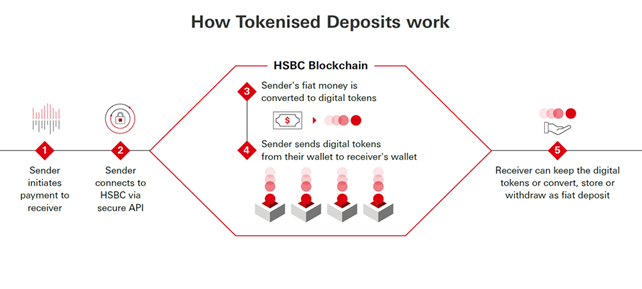
What this means in practical terms is instantaneous transfers backed by regulation, with the issuing bank assuming liability for any claims. And because they are issued by banks, tokenized deposits can also give interest payouts – something stablecoin issuers like Circle and Tether are currently banned from doing in the US, UK and EU. How do they work? In HSBC’s own words, a sender initiates a payment via the bank. The HSBC blockchain then converts the fiat payment into digital tokens, sending these to the intended receiver’s wallet. The recipient can then keep the money in digital token form in their wallet, or convert it to fiat to be stored or withdrawn as they wish.
Tokenised deposits at a glance, courtesy of HSBC
Tokens are good as gold
HSBC’s journey into tokenization has seen it pass several salutary milestones. In November, its Gold Token passed the $1 billion mark, indicating rising demand for tokenized versions of real-world assets (RWA) as banks scramble to get in on the action. HSBC boasts it is “the first bank in the world to offer tokenised ownership of physical gold, unlocking new possibilities in the precious metals market”. It’s available to institutional investors in the UK and their smaller retail counterparts in Hong Kong.
John O’Neill, HSBC boss of digital assets and currencies, told the Hong Kong FinTech Week that the token had facilitated more than 100,000 transactions since its launch in March 2024. Gold and tokenization, it would appear, are a match made in financial heaven.
Green shoots look promising
If gold is a good fit for tokens, so is green. That same month, HKMA announced “another milestone on the HKSAR Government’s bond tokenisation journey” with the issuance of HK$10 billion in digital green bonds. The transaction was denominated in Hong Kong and US dollars, renminbi and euros. “For both the HKD and RMB tranches, the option to settle via tokenised central bank money was introduced alongside traditional settlement rails in the primary issuance process, which helped further reduce settlement time, costs and counterparty credit risk,” said HKMA. The platform underpinning the transaction? HSBC Orion. Never slow to sing its own praises, the bank claimed the digital bond issuance was the largest to date of its kind.
“This latest digital issuance on HSBC Orion saw world record size and increased participation from institutional investors across various markets, further showcasing the potential of distributed ledger technology to enhance scalability in the bond market,” said David Liao, HSBC co-chief executive for Asia and Middle East.
Not all plain sailing
In case you’re thinking this sounds like a fairy-tale, it isn’t. HSBC has faced some pushback on its tokenization journey. And, you guessed it, said pushback is coming from traditional finance (TradFi) operators and most likely regulators too. In December, HSBC disclosed that a “recent meeting of the Securities and Exchange Commission’s (SEC) Investor Advisory Committee showed divisions on how a potential market for tokenized US equities should be regulated”. HSBC said representatives of TradFi firms such as Citadel Securities had called for the SEC to apply existing regulations to decentralised finance (DeFi) actors, with cryptocurrency players like Coinbase disagreeing and insisting that a new framework was necessary. The HSBC analysts who tabled the SEC meeting’s findings went on the record warning DeFi advocates not to expect an easy time of it. “The likelihood that the SEC will allow a token securities trading market subject to laxer standards than existing exchanges is low,” they said, concluding that the SEC would most likely insist on a market structure based on a permissioned blockchain. A permissioned blockchain is a private, closed network accessible only to authorized users and typically requires identity verification. This offers greater scalability and control, making it ideal for enterprise-level investors, but it compromises the blockchain’s original ethos of peer-to-peer transparency. Come on, tech bros, you didn’t seriously expect Uncle Sam to let you off that easily did you?
The way of the future
HSBC remains unfazed by the disputes. Though TradFi, DeFi and regulators may have their differences, the bank remains confident that all three broadly agree that tokenization is the way of the future. It plans to expand its cross-border tokenized payments service to the US and UAE by the middle of 2026. It also hopes to create what it calls “autonomous treasuries” that use AI and automation to help manage funds. Details are yet to come, though this would in theory see intelligent machines managing liquidity risk and the like.
HSBC betting big
It’s not surprising to find HSBC so bullish about tokenization. The bank estimates that digital assets will balloon in value over the next fifteen years to reach a staggering $16 trillion by 2040 and says four in ten financial market players already use some form of distributed ledger technology (DLT) or digital assets. Nick Mersh, another tokenization advocate recently interviewed by The Intersection, reckons the value of on-chain assets could hit $10 trillion in the next couple of years.
“The topic of tokenization, stablecoins, digital money and digital currencies has obviously gathered so much momentum,” said Manish Kohli, HSBC’s global head of payments solutions. “We are making big bets in this space.”
You can see why.
Damien Black is a veteran of newspapers and magazines, Damien Black traces his career back to another intersection – that of print and online journalism in the early 2000s. With a solid grounding in news, business, and features editing, he has also written on a variety of topics, including AI, cybersecurity, geopolitics, and finance.


